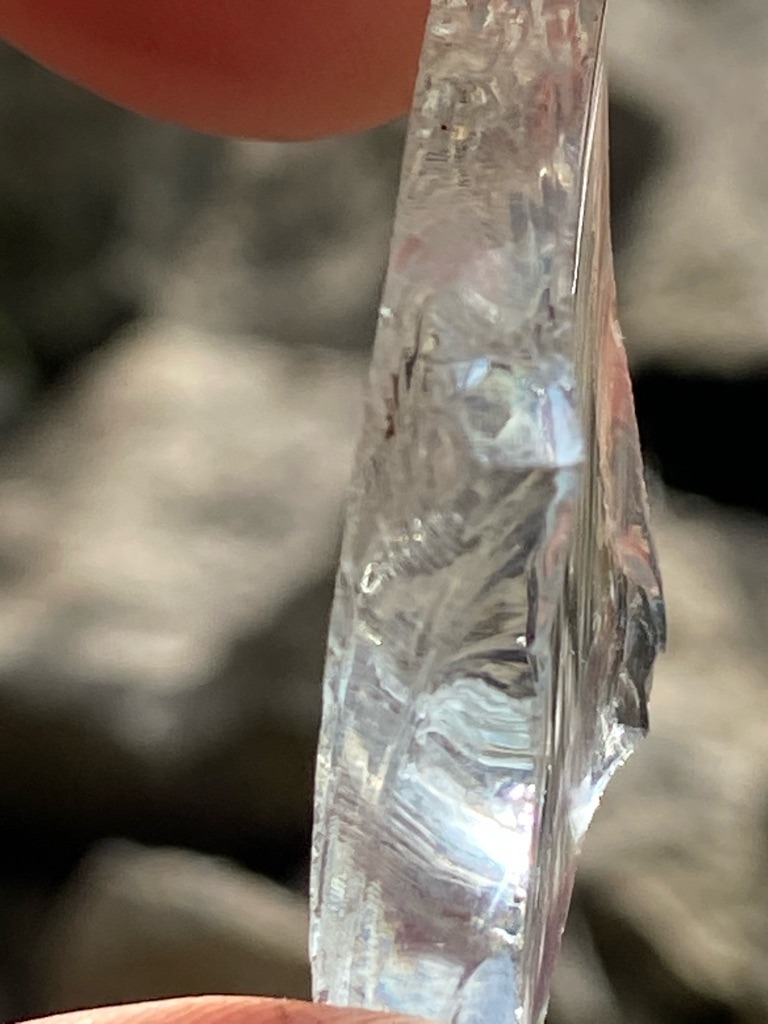
Natural rough mineral/crystal fragment (appears consistent with quartz or natural glass due to conchoidal fracturing, requires further gemological testing to definitively confirm diamond vs. quartz/glass)
Natural rough mineral/crystal fragment (appears consistent with quartz or natural glass due to conchoidal fracturing, requires further gemological testing to definitively confirm diamond vs. quartz/glass) · Uncut, irregular raw fragment
Not applicable (Raw, unpolished mineral specimen) Cut
Carat
Estimated 3.5 - 5.0 carats based on visual scale
Color
Colorless / Near-colorless
Clarity
Included / Imperfect (Raw rough state)
Shape
Uncut, irregular raw fragment
Overall Assessment
The specimen shown exhibits the characteristic conchoidal fractures and vitreous luster of a transparent mineral rough. While traditionally referred to colloquially, definitive testing (such as thermal conductivity or Raman spectroscopy) is necessary to confirm if this is diamond, quartz, or another colorless gem material.
Cut Quality
Not applicable (Raw, unpolished mineral specimen)
Brilliance
Vitreous reflection typical of raw transparent crystal
Fire
Minimal dispersion observed due to lack of precision facet geometry
Scintillation
Limited flash effect across irregular fracture planes
Proportions
Irregular raw proportions; no standard facet angles present
Symmetry
Asymmetrical raw crystal fragment
Polish
Natural unpolished fracture surfaces with vitreous luster
Fluorescence
Indeterminate from visual inspection
Inclusions
Internal fracture planes, feathers, and potential mineral inclusions visible
Blemishes
Natural rough surface textures, pitting, and striations
Origin
Natural geological origin
Treatment Detection
No obvious signs of artificial treatments, appears entirely natural
Estimated Value
Minimal gem value as a cut stone; valued primarily as a rough mineral specimen or collector piece
Certification Estimate
Not standard for rough specimens; specialized gemological lab (GIA/AGS) would issue an identification report rather than a standard cut diamond grading report
Investment Potential
Low investment potential for jewelry resale; collectible mineral specimen value only
Similar Diamonds
Comparable to other raw unworked diamond or high-clarity quartz/beryl rough specimens
Setting Suggestions
Wire-wrapped pendant setting or custom organic prong setting to showcase the raw crystalline form
Care & Maintenance
Store separately to prevent scratching other softer stones; clean gently with warm soapy water and a soft brush
Interesting Facts
Raw crystal specimens display natural growth lines and cleavage/fracture patterns that are removed during the traditional diamond cutting process