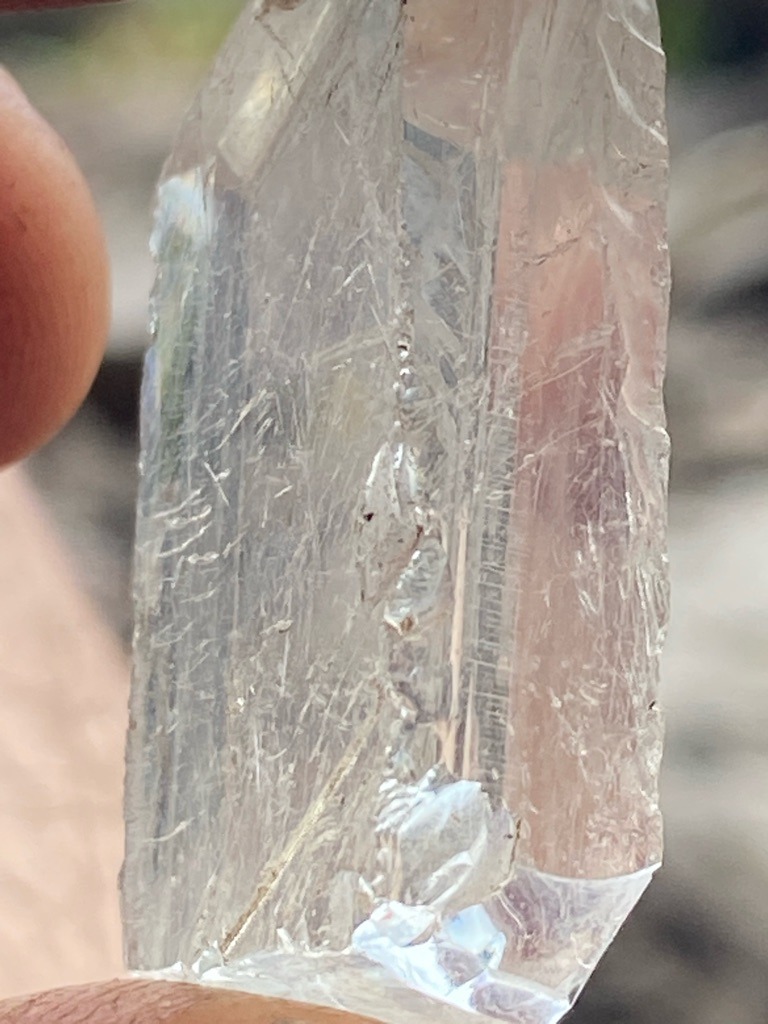
Not a diamond; this specimen appears to be rough quartz crystal or a similar silicate mineral based on the striated prismatic habit.
Not a diamond; this specimen appears to be rough quartz crystal or a similar silicate mineral based on the striated prismatic habit. · Uncut rough prismatic crystal with natural crystal faces and striated termination.
Not applicable as this is a raw, uncut mineral specimen. Cut
Carat
Estimated equivalent weight around 15-25 carats based on physical dimensions.
Color
Colorless (transparent white crystal).
Clarity
Included / Included 2 (contains surface striations, natural etch channels, and internal fractures characteristic of rough quartz).
Shape
Uncut rough prismatic crystal with natural crystal faces and striated termination.
Overall Assessment
The specimen shown is a raw, uncut quartz crystal rather than a diamond. It displays classic crystal striations and uneven fracture surfaces typical of natural quartz minerals.
Cut Quality
Not applicable as this is a raw, uncut mineral specimen.
Brilliance
Low to moderate vitreous luster, constrained by rough unpolished faces.
Fire
Minimal to none; quartz has a low dispersion rate (0.013) compared to diamond (0.044).
Scintillation
Poor due to lack of faceted geometry.
Proportions
Elongated prismatic crystal habit with natural vertical striations.
Symmetry
Asymmetrical natural crystal form with typical trigonal or hexagonal prismatic elongation.
Polish
Raw natural crystal surface with striated growth lines; unpolished.
Fluorescence
Indeterminate without UV testing, but typical quartz may show weak inert or faint blue/green under long-wave UV.
Inclusions
Internal fractures, feather-like veils, and small mineral inclusions typical of raw quartz.
Blemishes
Natural surface etching, growth striations, and rough contact areas from the host rock.
Origin
Natural geological mineral specimen (quartz family).
Treatment Detection
No visible signs of artificial treatments; appears completely natural and untreated.
Estimated Value
Nominal value as a mineral specimen (typically $10 to $50 depending on locality and size).
Certification Estimate
Gemological identification report rather than a diamond grading report (such as GIA Identification Report for colored stones/minerals).
Investment Potential
Low investment potential; collected primarily for educational, aesthetic, or metaphysical purposes.
Similar Diamonds
None, as this is visually identified as quartz and not carbonado or gem-grade diamond rough.
Setting Suggestions
Best suited for wire-wrapping in raw form, custom organic jewelry settings, or kept as a mineral specimen.
Care & Maintenance
Clean with mild soapy water and a soft brush; avoid harsh chemicals and ultrasonic cleaners if internal fractures are severe.
Interesting Facts
Quartz crystals grow in hexagonal systems and often display characteristic horizontal or vertical striations on their prism faces.