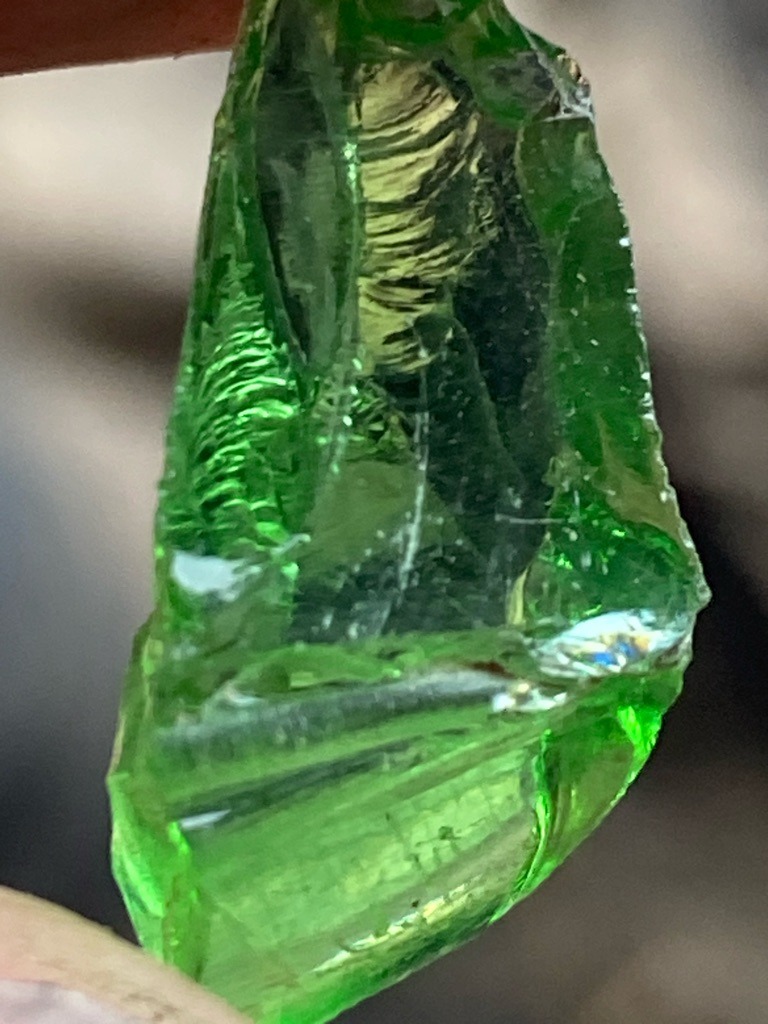
Not a diamond (appears to be green glass / slag glass with conchoidal fractures)
Not a diamond (appears to be green glass / slag glass with conchoidal fractures) · Rough / Ungraded / Irregular fragment
Not applicable (uncut raw fragment) Cut
Carat
Not applicable (glass material)
Color
Vivid Green (Fancy Intense Green simulation)
Clarity
Not applicable for glass (contains internal flow lines and bubbles)
Shape
Rough / Ungraded / Irregular fragment
Overall Assessment
The specimen displayed in the image is not a diamond or a gemstone, but rather a piece of vibrant green glass displaying characteristic conchoidal fractures and internal flow lines.
Cut Quality
Not applicable (uncut raw fragment)
Brilliance
Vitreous reflection typical of glass
Fire
Very low dispersion compared to diamond
Scintillation
Poor due to lack of standard facet arrangement
Proportions
Not applicable
Symmetry
Not applicable (irregular natural or broken shape)
Polish
Raw fracture surfaces with vitreous luster
Fluorescence
Unknown without UV testing
Inclusions
Internal swirl marks, flow lines, and gas bubbles typical of manufactured glass
Blemishes
Surface chips and conchoidal fracture ripples
Origin
Man-made glass / Cullet glass
Treatment Detection
Colored glass substitute, no diamond treatment applicable
Estimated Value
Nominal decorative or collector value (low monetary value)
Certification Estimate
Cannot be certified as a diamond by standard gemological labs (GIA/AGS/IGI)
Investment Potential
None as an investment gem
Similar Diamonds
None (this specimen does not share properties with diamond)
Setting Suggestions
Wire-wrapping or artisan crafting if used as a decorative specimen
Care & Maintenance
Standard care; avoid harsh impacts as glass is prone to chipping and scratching
Interesting Facts
Green glass is frequently mistaken for rough emerald, green diamond, or green tourmaline due to its vibrant color and conchoidal fracture pattern.