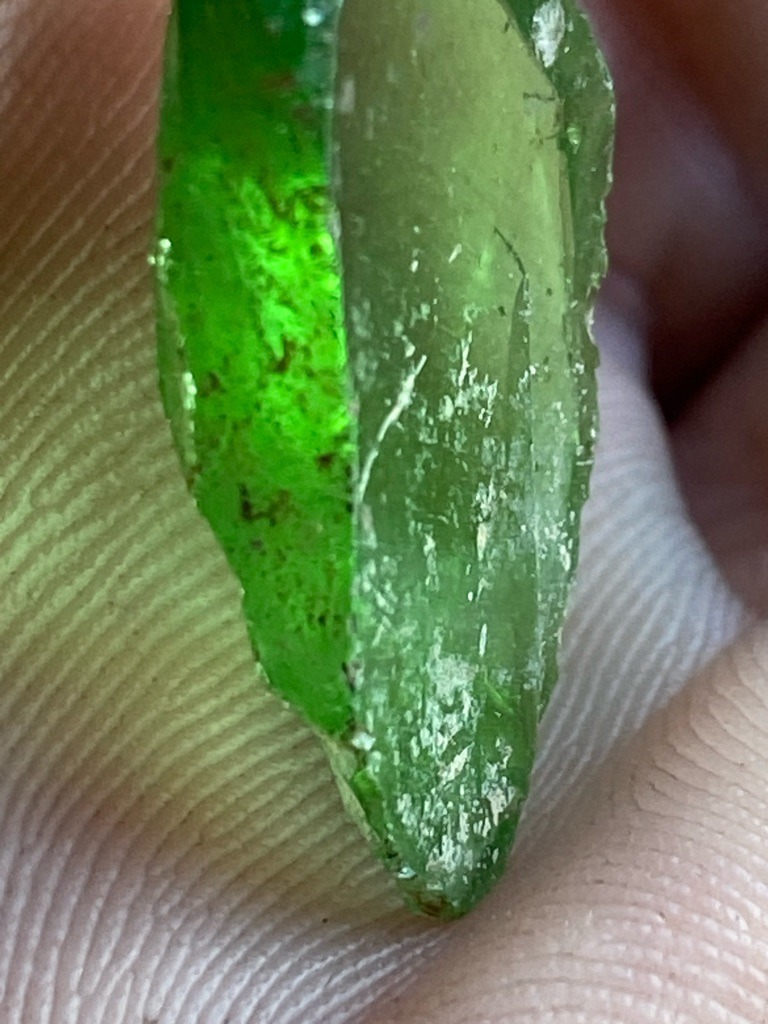
This is not a diamond; it appears to be a natural rough green gemstone crystal, likely tourmaline, peridot, or tsavorite garnet.
This is not a diamond; it appears to be a natural rough green gemstone crystal, likely tourmaline, peridot, or tsavorite garnet. · Rough uncut crystal form, elongated prismatic crystal structure.
Uncut / Rough. Not applicable as it is in its natural crystal state. Cut
Carat
Estimated around 3.5 to 5.0 carats based on visual proportions relative to human fingers.
Color
Vivid intense green, consistent with a saturated natural colored gemstone rather than a standard diamond.
Clarity
Included (I1-I2 equivalent), showing visible internal fractures, feather inclusions, and mineral spots.
Shape
Rough uncut crystal form, elongated prismatic crystal structure.
Overall Assessment
An attractive, vibrant green rough crystal specimen. While not a diamond, it possesses unique natural character suited for bespoke jewelry or mineral collections.
Cut Quality
Uncut / Rough. Not applicable as it is in its natural crystal state.
Brilliance
Low to moderate due to rough surfaces and lack of precise optical facets.
Fire
Limited dispersion visible in its raw state; would require cutting and polishing to exhibit proper fire.
Scintillation
Minimal play of light in its current uncut, unpolished form.
Proportions
Natural crystal elongation, lacking traditional faceted table, depth, and pavilion angles.
Symmetry
Natural asymmetrical crystal growth habit with striated prismatic faces.
Polish
Raw and unpolished natural crystal surfaces with typical vertical striations.
Fluorescence
Indeterminate without UV testing equipment, but typical green rough may show faint or inert reactions.
Inclusions
Internal fractures, cloudy areas, and dark mineral inclusions typical of raw gemstone material.
Blemishes
Natural surface etching, growth hillocks, and minor chips along the edges.
Origin
Natural geological origin, likely from a pegmatite or metamorphic deposit.
Treatment Detection
No obvious signs of human treatment; appears completely untreated and natural.
Estimated Value
Nominal value as a mineral specimen, highly dependent on the exact mineral species (e.g., tsavorite vs. green tourmaline).
Certification Estimate
Gemological laboratories such as GIA or local independent gem labs could issue an identification report confirming mineral species.
Investment Potential
Low investment liquidity compared to certified diamonds; valued primarily for mineral collection or custom artisan jewelry.
Similar Diamonds
Not applicable; comparable items would be other rough green colored gemstone crystals.
Setting Suggestions
Best suited for an organic-style wire-wrapped pendant or a custom bezel setting designed to protect raw crystals.
Care & Maintenance
Store separately to avoid scratching softer stones; clean gently with warm soapy water and a soft brush; avoid harsh chemicals and ultrasonic cleaners if fractures are deep.
Interesting Facts
Green rough crystals are prized by mineral collectors for their raw, unaltered beauty straight from the earth.