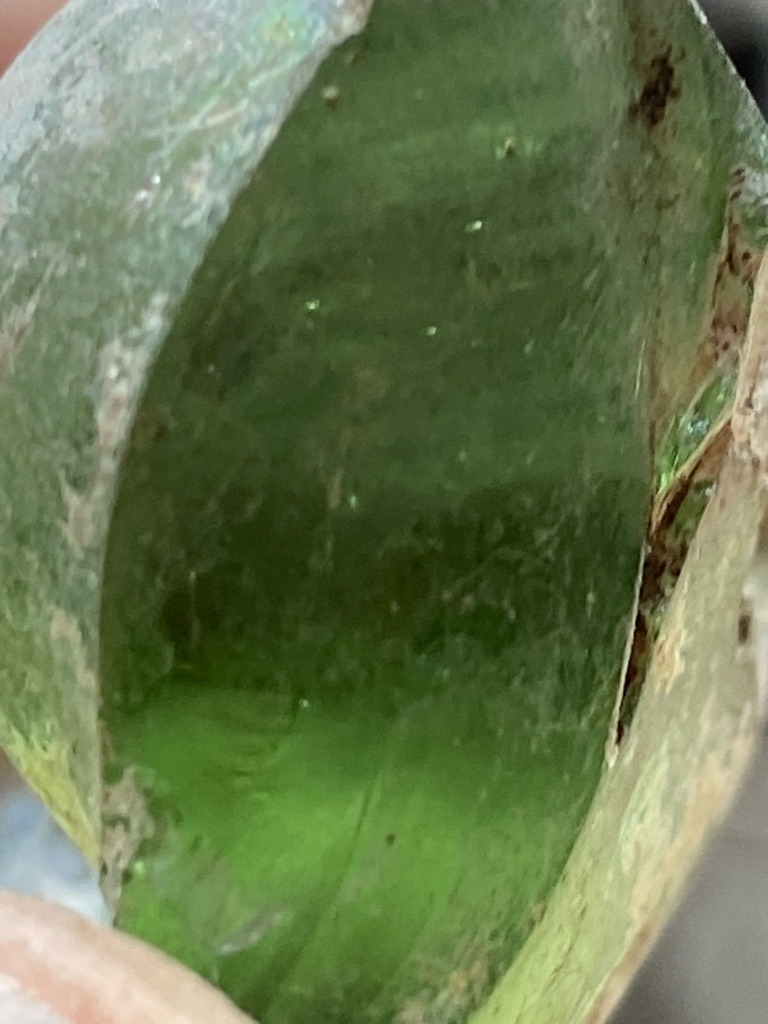
Not a diamond; appears to be raw green glass or slag, possibly historical bottle glass.
Not a diamond; appears to be raw green glass or slag, possibly historical bottle glass. · Irregular raw fragment / unstructured sherd
Poor / Uncut raw fragment Cut
Carat
Not applicable (Mineral/Glass specimen, weight undetermined from image)
Color
Deep forest green
Clarity
Included with internal bubbles and flow lines typical of glass
Shape
Irregular raw fragment / unstructured sherd
Overall Assessment
The specimen shown is a green glass fragment rather than a diamond or gemstone. It exhibits typical characteristics of glass such as conchoidal fracture and internal gas bubbles.
Cut Quality
Poor / Uncut raw fragment
Brilliance
Low due to material composition and lack of proper faceting
Fire
Minimal to none
Scintillation
Poor
Proportions
Not applicable
Symmetry
Asymmetrical
Polish
Natural weathered/broken surface with minimal polish
Fluorescence
Inert to faint
Inclusions
Gas bubbles and particulate matter characteristic of manufactured glass
Blemishes
Surface abrasions, chips, and weathering crust
Origin
Likely manufactured glass, potentially an old artifact or industrial byproduct
Treatment Detection
None applicable to glass
Estimated Value
Nominal value as a decorative or historical glass specimen
Certification Estimate
Gemological laboratories like GIA or AGS would not issue a grading report as this is not a diamond or precious gemstone.
Investment Potential
None as a gemstone investment
Similar Diamonds
None (glass material with no diamond equivalence)
Setting Suggestions
Wire-wrapping or bespoke artisan bezel setting if used as a decorative element
Care & Maintenance
Handle with care to avoid chipping; clean with mild soapy water and a soft cloth
Interesting Facts
Green glass is frequently mistaken for rough emerald, peridot, or green diamond by untrained observers due to its rich color.