Non-diamond (Likely Glass or Quartz)
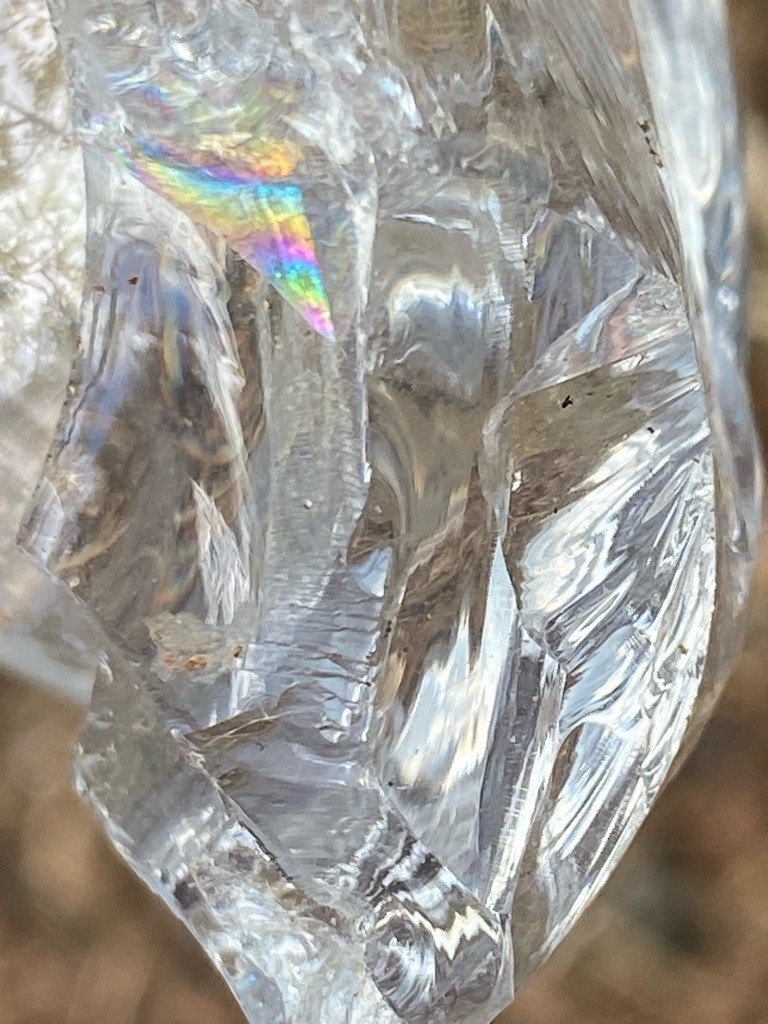
Non-diamond (Likely Glass or Quartz) · Rough / Uncut (Amorphous shard)
Not applicable (Raw/Rough material) Cut
Carat
Estimated 15-30 carats based on visual volume
Color
Colorless (D-F range visual)
Clarity
Included (I-grade equivalent due to surface-reaching fractures and internal debris)
Shape
Rough / Uncut (Amorphous shard)
Overall Assessment
This specimen is not a diamond. The conchoidal (shell-like) fracture patterns and the specific style of light dispersion are hallmark indicators of glass or quartz. It lacks the hardness and cubic crystal structure of a natural diamond.
Cut Quality
Not applicable (Raw/Rough material)
Brilliance
Low; material relies on surface reflection rather than internal light return
Fire
Strong prismatic dispersion visible on specific fracture planes (rainbow effect)
Scintillation
Low to None; lacks geometric facets to create sparkle
Proportions
Irregular fragment with sharp, uneven edges
Symmetry
None (Irregular shard)
Polish
Natural conchoidal fracture surfaces; no mechanical polish
Fluorescence
Indeterminate without UV light
Inclusions
Visible internal fractures (veils) and dark pinpoint mineral inclusions or debris
Blemishes
Conchoidal fracturing and significant surface abrasions
Origin
Terrestrial (Likely river-worn or industrially discarded glass/quartz)
Treatment Detection
None apparent; looks like raw mineral or glass cullet
Estimated Value
$1 - $50 (Decorative/Specimen value only)
Certification Estimate
Unlikely to be graded by GIA/AGS as it appears to be non-diamond mineral/glass
Investment Potential
None; specimen lacks gem-quality diamond structural properties
Similar Diamonds
None; characteristics (fracture patterns) do not align with diamond octahedral growth
Setting Suggestions
Not suitable for traditional jewelry; may be wire-wrapped as a curiosity
Care & Maintenance
Handle with care as edges appear razor-sharp; avoid heat and pressure
Interesting Facts
The rainbow effect seen is caused by thin-film interference or prismatic refraction on a fracture surface.