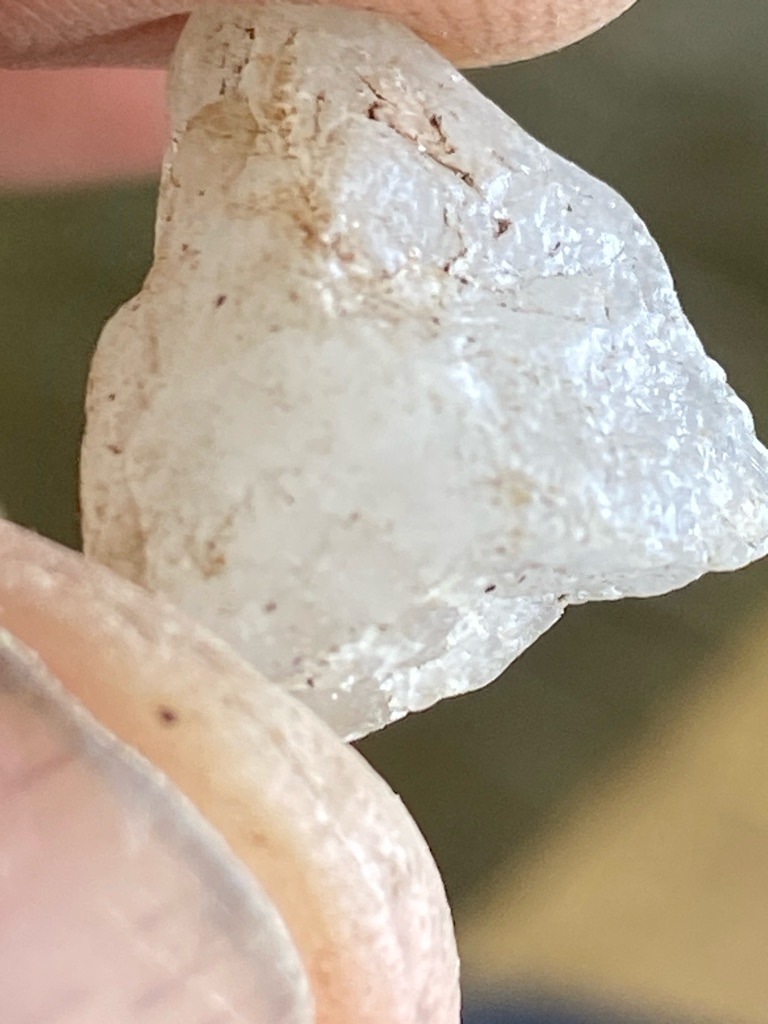
Natural rough diamond crystal
Natural rough diamond crystal · Uncut / Rough octahedral crystal fragment
Not applicable (rough uncut crystal) Cut
Carat
Estimated 2.0 to 3.5 carats based on visual scale against fingers
Color
Estimated H to J (near colorless with minor surface brownish staining)
Clarity
Estimated SI2 to I1 (visible internal feather inclusions and surface fractures)
Shape
Uncut / Rough octahedral crystal fragment
Overall Assessment
An interesting, natural rough diamond crystal in the raw, offering high potential for a bespoke custom cut or raw jewelry piece after professional evaluation.
Cut Quality
Not applicable (rough uncut crystal)
Brilliance
Low to moderate due to rough, unpolished exterior surfaces
Fire
Minimal due to lack of faceted optical geometry
Scintillation
Negligible until cut and faceted
Proportions
Natural crystal habit, no cut proportions applicable
Symmetry
Natural distorted octahedral symmetry
Polish
Natural unpolished crystal faces (trigons potentially visible under magnification)
Fluorescence
Indeterminate from visual inspection alone, likely none to faint
Inclusions
Internal cleavage planes, fractures, and small dark mineral crystals
Blemishes
Natural surface pitting, rough skin, and possible iron oxide staining in crevices
Origin
Likely alluvial or primary kimberlite pipe deposit (African or Canadian origin typical for rough)
Treatment Detection
No treatments detected; completely natural rough state
Estimated Value
Varies widely based on potential yield after cutting, roughly 500 to 1,500 USD
Certification Estimate
GIA or IGI would grade this as a rough diamond specimen
Investment Potential
Moderate speculative value depending on cutting loss and final polished grade
Similar Diamonds
Other unassorted run-of-mine natural rough diamond crystals
Setting Suggestions
Can be set raw in a custom organic bezel setting (raw diamond jewelry) or cut into a cushion or oval shape
Care & Maintenance
Avoid harsh acids, ultrasonic cleaners, and hard impacts that could exploit natural cleavage planes
Interesting Facts
Rough diamonds straight from the earth often feature natural triangular growth marks called trigons on their faces