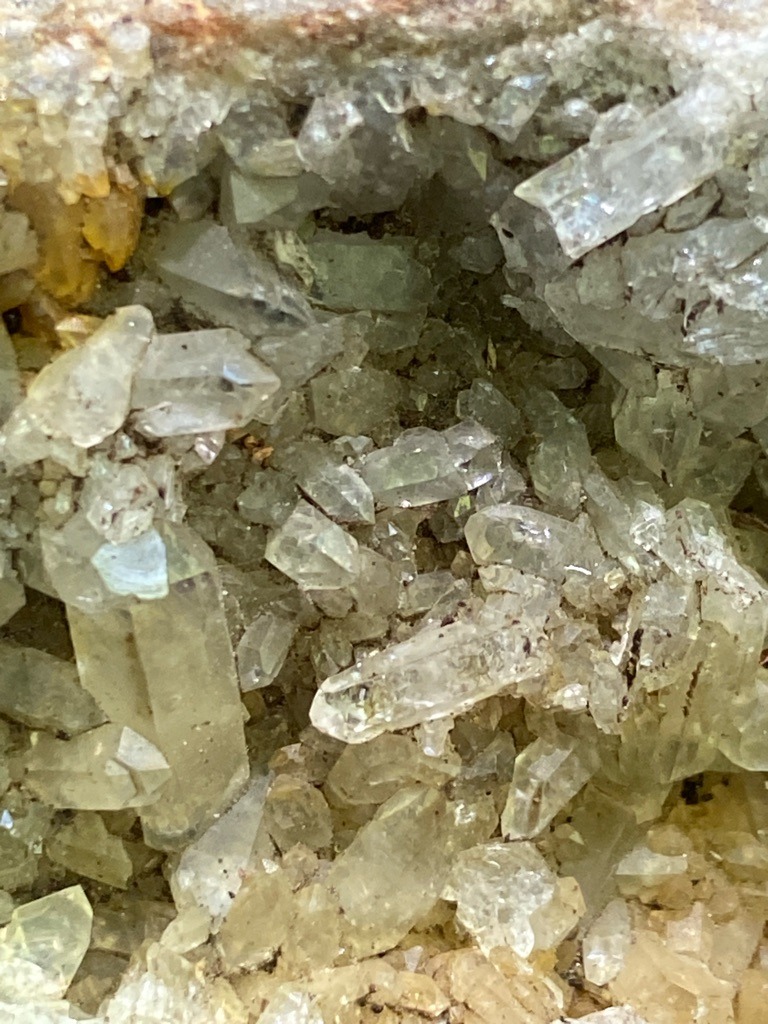
Not a diamond; the image shows a mineral geode or cluster consisting of natural quartz crystals (silicon dioxide).
Not a diamond; the image shows a mineral geode or cluster consisting of natural quartz crystals (silicon dioxide). · Rough crystal habit, predominantly prismatic terminated quartz crystals.
Uncut natural crystal formation (rough/raw mineral specimen). Cut
Carat
Not applicable as these are raw mineral specimens, not cut or polished gemstones.
Color
Colorless to pale yellowish (characteristic of natural quartz matrix with minor iron staining).
Clarity
Included to heavily included due to natural internal flaws, fractures, and mineral inclusions typical of raw crystal growth.
Shape
Rough crystal habit, predominantly prismatic terminated quartz crystals.
Overall Assessment
An attractive natural quartz crystal cluster inside a geode or vug, showing well-formed prismatic termination points and natural matrix context.
Cut Quality
Uncut natural crystal formation (rough/raw mineral specimen).
Brilliance
Vitreous to sub-adamantine luster typical of unpolished quartz crystal faces.
Fire
Very low dispersion compared to diamond, typical of quartz optical properties.
Scintillation
Reflective flashes from multiple randomly oriented crystal faces within the vug/geode.
Proportions
Natural growth proportions, elongated prismatic crystal habits.
Symmetry
Natural crystal symmetry showing hexagonal prismatic forms with pyramidal terminations.
Polish
Raw, unpolished natural crystal faces with characteristic striations.
Fluorescence
Typically inert to faint under UV light depending on trace impurities.
Inclusions
Various solid and fluid inclusions common in natural quartz formation, including mineral debris and matrix traces.
Blemishes
Natural surface etching, growth hillocks, and minor damage from matrix extraction.
Origin
Natural geological formation within a hydrothermal vein or vug, likely sourced from common quartz-producing regions worldwide.
Treatment Detection
No signs of artificial treatment; completely natural untreated mineral cluster.
Estimated Value
Valued as a mineral specimen or decorative geode cluster rather than per-carat gemstone pricing.
Certification Estimate
Gemological laboratories would issue a mineral identification report rather than a diamond grading report, identifying the specimen as natural quartz.
Investment Potential
Collected for aesthetic or metaphysical value rather than financial investment, with stable collector market prices.
Similar Diamonds
None, as quartz and diamond are entirely different mineral species.
Setting Suggestions
Best displayed as a raw mineral specimen or home decor piece rather than set into jewelry.
Care & Maintenance
Clean gently with warm soapy water and a soft brush; avoid harsh chemicals and protect from impact to prevent matrix damage.
Interesting Facts
Quartz is the second most abundant mineral in Earth's continental crust and exhibits piezoelectric properties.