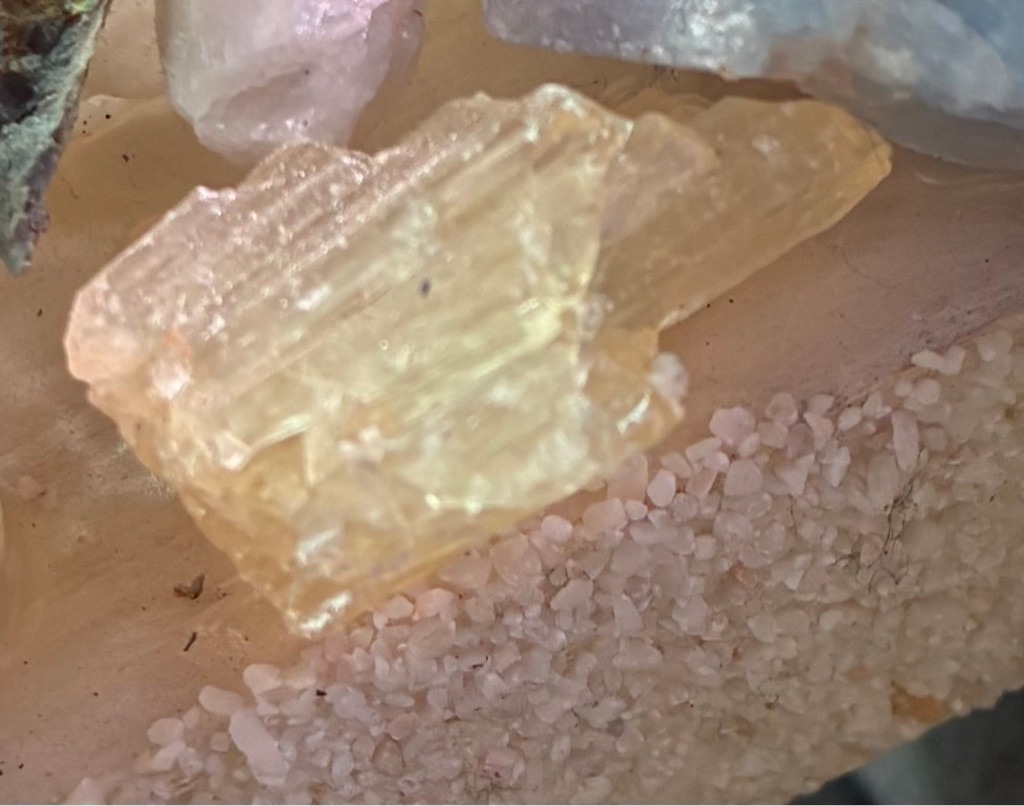
Not a diamond; this is a rough, unpolished crystal specimen, likely quartz or calcite colored yellow by mineral inclusions.
Not a diamond; this is a rough, unpolished crystal specimen, likely quartz or calcite colored yellow by mineral inclusions. · Rough, uncut crystal crystal habit with irregular elongated prismatic form.
Not applicable (Uncut, raw crystal with natural faces and cleavage planes rather than a faceted cut). Cut
Carat
Estimated around 3.5 to 5.0 carats (approximately 0.7 to 1.0 grams based on visual scale).
Color
Natural light yellow to champagne tint.
Clarity
Included (Contains visible internal fractures, striations, and matrix material characteristic of raw minerals).
Shape
Rough, uncut crystal crystal habit with irregular elongated prismatic form.
Overall Assessment
An interesting and aesthetically pleasing raw mineral specimen resting on a bed of fine-grained matrix, valued for its natural state rather than gemstone qualities.
Cut Quality
Not applicable (Uncut, raw crystal with natural faces and cleavage planes rather than a faceted cut).
Brilliance
Low to moderate, typical of raw minerals lacking precise optical facet angles.
Fire
Minimal dispersion due to lack of standard gemstone faceting and polish.
Scintillation
Absent; light reflects statically off uneven cleavage planes rather than flashing dynamically.
Proportions
Non-standard; raw crystal specimen with irregular depth and elongation.
Symmetry
Asymmetrical, natural growth habit typical of raw mineral formations.
Polish
Raw, unpolished surface showing natural crystal striations and fracture textures.
Fluorescence
Cannot be definitively determined without UV testing, though similar rough quartz/calcite may show faint inert or weak fluorescence.
Inclusions
Internal fractures, cloudiness, and possible mineral sediment trapped during growth.
Blemishes
Natural growth lines, surface etching, and rough edge chips.
Origin
Natural rough mineral specimen, likely sourced from pegmatite or sedimentary deposits.
Treatment Detection
No evidence of artificial enhancement; appears completely natural and untreated.
Estimated Value
Nominal decorative or mineral specimen value ($10 - $50 USD depending on exact mineral composition and source).
Certification Estimate
Not applicable for standard diamond labs (GIA/AGS); would require a general gemological lab certificate (e.g., GIA Colored Stone Identification Report) if verified.
Investment Potential
None; sold purely as a mineral specimen or collectible curiosity rather than an investment asset.
Similar Diamonds
None, as this is not a diamond.
Setting Suggestions
Wire-wrapped pendant setting in sterling silver or gold-plated brass to preserve the natural organic aesthetic.
Care & Maintenance
Avoid harsh ultrasonic cleaners or aggressive scrubbing; clean gently with a soft brush and mild soapy water.
Interesting Facts
Raw mineral specimens like this are often collected by enthusiasts for their natural beauty before any human intervention or cutting takes place.