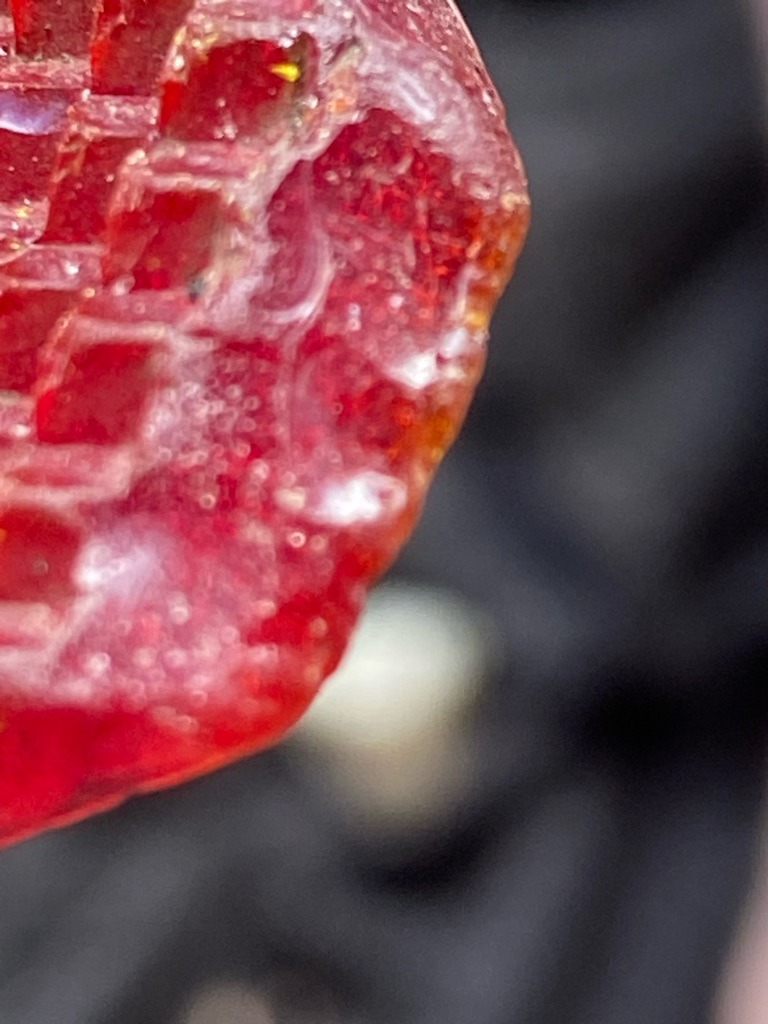
Not a diamond; this is a rough mineral crystal, likely a red colored mineral specimen such as vanadinite, cinnabar, or rubellite tourmaline rather than a diamond.
Not a diamond; this is a rough mineral crystal, likely a red colored mineral specimen such as vanadinite, cinnabar, or rubellite tourmaline rather than a diamond. · Rough crystal habit with natural crystal faces and step-like growth structures (not a standard faceted cut shape).
Not applicable (raw, uncut mineral specimen). Cut
Carat
Difficult to estimate accurately from a close-up macro image without scale, but appears to be a heavy crystal fragment.
Color
Vivid deep red / orange-red fancy color.
Clarity
Included / Opaque due to heavy internal crystal structure and matrix characteristics.
Shape
Rough crystal habit with natural crystal faces and step-like growth structures (not a standard faceted cut shape).
Overall Assessment
An interesting and vibrant red rough mineral specimen with distinct crystal growth steps, requiring formal lab testing for definitive mineral species identification.
Cut Quality
Not applicable (raw, uncut mineral specimen).
Brilliance
Sub-adamantine to resinous reflection across natural crystal faces rather than faceted diamond brilliance.
Fire
Low dispersion compared to diamond; shows mineral-specific luster.
Scintillation
Limited flash due to opaque and heavily textured raw surface.
Proportions
Natural mineral formation; standard diamond proportion measurements (table, depth, crown/pavilion angles) do not apply.
Symmetry
Natural crystal symmetry exhibiting hexagonal or monoclinic prismatic growth steps.
Polish
Unpolished natural crystal surface with resinous to sub-adamantine luster on faces.
Fluorescence
Unknown without UV testing, though some specimens like vanadinite show inert reactions.
Inclusions
Dense internal crystal growth patterns, fluid inclusions, and parallel growth zoning typical of rough minerals.
Blemishes
Natural surface etching, pitting, and micro-fractures common in raw mineral specimens.
Origin
Natural mineral origin, likely from a well-known locality for red crystal specimens (e.g., Mibladen, Morocco for vanadinite).
Treatment Detection
Appears untreatable as a raw mineral specimen; standard natural rough state.
Estimated Value
Depends heavily on mineral identification and specimen quality, typically valued as a mineral collector piece rather than a gemstone.
Certification Estimate
Gemological institutes like GIA or GRS would identify the mineral species rather than grading it as a diamond.
Investment Potential
Valued primarily by mineral collectors and specimen enthusiasts rather than as a precious gemstone investment.
Similar Diamonds
None, as this is visually distinct from a diamond in both color, crystal system, and luster.
Setting Suggestions
Best preserved as a raw mineral specimen in a custom display mount or wire-wrapped pendant rather than a traditional prong setting.
Care & Maintenance
Handle with care to avoid chipping fragile crystal edges; avoid harsh chemicals, ultrasonic cleaners, and prolonged exposure to direct sunlight.
Interesting Facts
The stepped blocky structure visible in the image is characteristic of certain heavy mineral crystal growth habits.