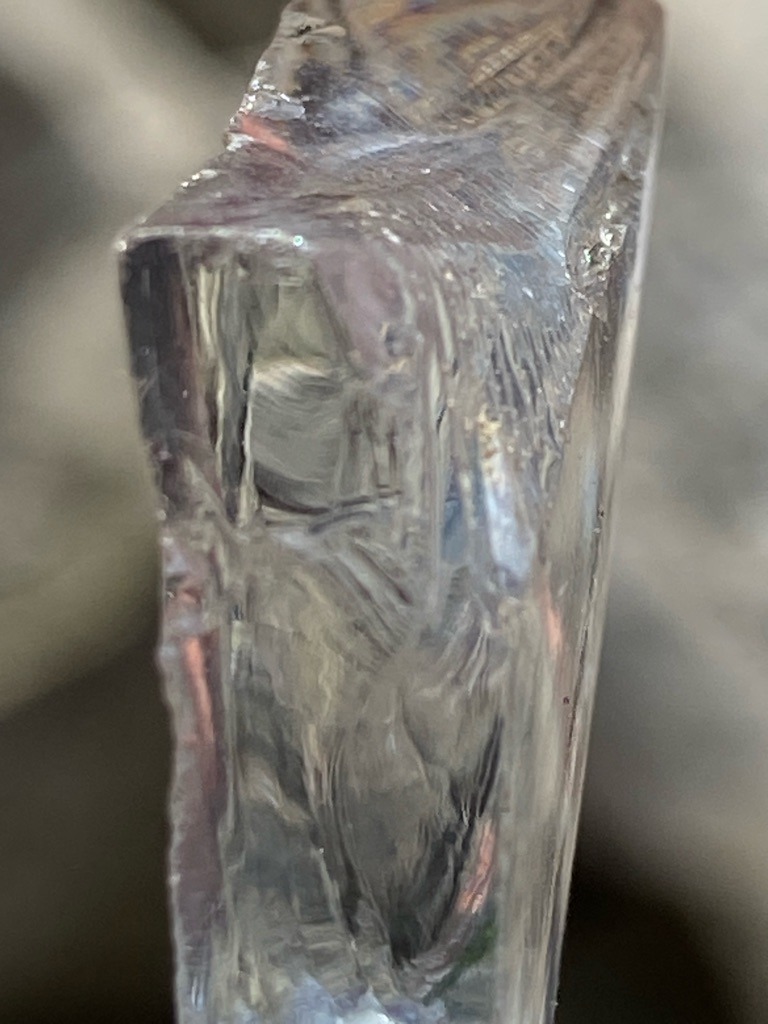
The image shows a raw or roughly cut crystalline mineral fragment, appearing glassy or quartz-like, but lacks the specific structural habits, cleavage planes, or optical features characteristic of a natural or lab-grown diamond. It is likely a quartz or synthetic crystal block.
The image shows a raw or roughly cut crystalline mineral fragment, appearing glassy or quartz-like, but lacks the specific structural habits, cleavage planes, or optical features characteristic of a natural or lab-grown diamond. It is likely a quartz or synthetic crystal block. · Irregular / Rough block fragment with flat sawn or fractured faces.
Not applicable; this is an unpolished, rough block or slab. Cut
Carat
Difficult to estimate accurately from a close-up macro image, but the visible section is substantial, roughly equivalent to several hundred carats if the whole piece is intact, though it is not a gem-quality diamond.
Color
Colorless to slightly grayish or tinted white in the visible transparent sections.
Clarity
Included / Heavily fractured with internal fissures and surface textures.
Shape
Irregular / Rough block fragment with flat sawn or fractured faces.
Overall Assessment
The specimen depicted in the image is a raw, rough crystalline block or mineral slab—likely quartz or a similar silicate—rather than a diamond. It features significant internal fracturing and unpolished surfaces, making it unsuitable for standard diamond evaluation and grading.
Cut Quality
Not applicable; this is an unpolished, rough block or slab.
Brilliance
Minimal, due to the rough and fractured nature of the material preventing proper light return.
Fire
Absent, as the material lacks the high refractive index and dispersion of a diamond.
Scintillation
Poor to non-existent due to lack of faceted symmetry.
Proportions
Non-standard rough block, lacking traditional diamond pavilion/crown proportions.
Symmetry
Poor / Irregular natural or fractured crystal growth.
Polish
Rough / Unpolished surfaces with visible sawing marks or fracture textures.
Fluorescence
Unknown without UV testing, though typical silicate materials may show faint or no fluorescence.
Inclusions
Heavy internal fracturing, veil-like inclusions, and fissures typical of rough quartz or raw mineral specimens.
Blemishes
Rough surface texture, chips, and uneven fracture planes.
Origin
Likely mined mineral specimen (such as quartz) or industrial synthetic block.
Treatment Detection
No obvious gemstone treatments detected; appears to be in its raw, unaltered state.
Estimated Value
Minimal gem value, priced strictly as a raw mineral specimen rather than a gemstone.
Certification Estimate
Would not be certified by major diamond grading laboratories (GIA, AGS, IGI) as a diamond.
Investment Potential
Low investment potential for jewelry or gem trading; strictly of interest to mineral collectors.
Similar Diamonds
None, as this material is not a diamond.
Setting Suggestions
Not suitable for standard jewelry settings unless specifically wire-wrapped or carved as an ornamental specimen.
Care & Maintenance
Standard mineral specimen care: avoid harsh impacts to prevent further fracturing along cleavage or fracture planes.
Interesting Facts
Raw mineral blocks often display natural growth lines and fracture patterns that tell the geological history of the crystal formation.