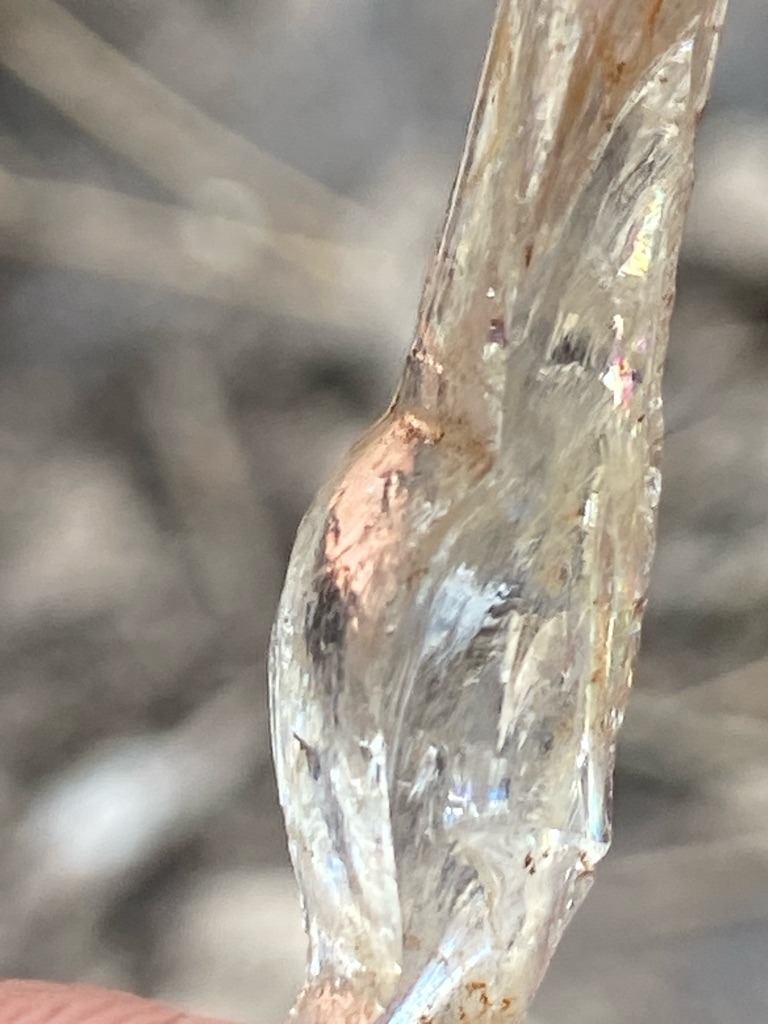
Not a diamond; appears to be raw quartz crystal or natural resin/silicate formation
Not a diamond; appears to be raw quartz crystal or natural resin/silicate formation · Rough uncut crystal formation
Uncut / Raw specimen Cut
Carat
Not applicable as this is a mineral specimen, not a cut gemstone
Color
Colorless with brownish-orange matrix staining
Clarity
Included due to fibrous and structural nature
Shape
Rough uncut crystal formation
Overall Assessment
Visual analysis indicates this specimen is a raw mineral crystal (likely quartz or similar silicate) rather than a diamond, exhibiting natural striations and fibrous growth patterns entirely inconsistent with diamond crystallography.
Cut Quality
Uncut / Raw specimen
Brilliance
Vitreous to resinous luster rather than diamond brilliance
Fire
Low dispersion typical of quartz or similar silicates
Scintillation
Reflective flash across natural striations rather than facet-based scintillation
Proportions
Elongated natural crystal habit
Symmetry
Asymmetrical natural crystal growth
Polish
Natural unpolished surface with fibrous texture
Fluorescence
Undetermined without UV testing
Inclusions
Heavy internal striations, gas/fluid channels, and matrix inclusions
Blemishes
Natural surface etching and growth lines
Origin
Natural geological formation
Treatment Detection
No treatments detected; natural state
Estimated Value
Minimal commercial value as a mineral specimen
Certification Estimate
Gemological laboratories would identify this as quartz or resin rather than issue a diamond report
Investment Potential
Low; decorative or educational mineral value only
Similar Diamonds
None, as this is visually confirmed not to be a diamond
Setting Suggestions
Wire-wrapped or organic bezel setting suitable for raw mineral specimens
Care & Maintenance
Standard gentle cleaning with mild soap and water; avoid harsh chemicals
Interesting Facts
Raw mineral specimens showcase the natural growth habit before human intervention and cutting