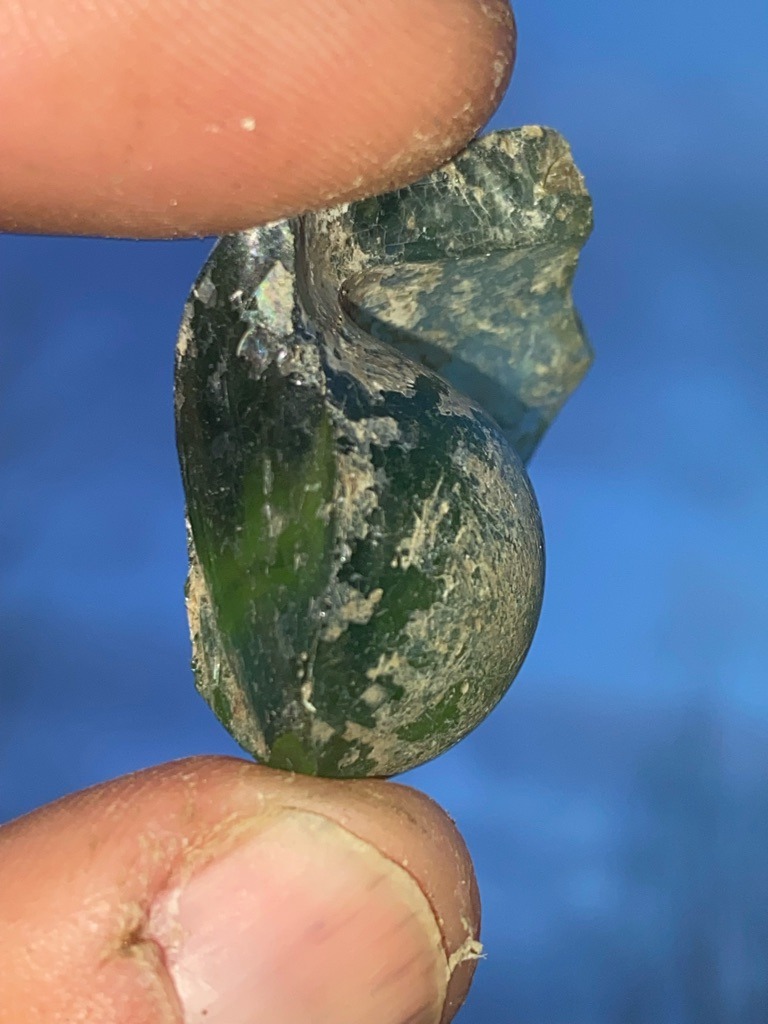
The provided image displays a material likely to be industrial glass or slag, not a diamond. It lacks the crystal structure of natural or lab-grown diamonds.
The provided image displays a material likely to be industrial glass or slag, not a diamond. It lacks the crystal structure of natural or lab-grown diamonds. · Rough, irregular, and glassy fragment. It does not have a formal jewelry cut.
None (Rough material/Raw fragment). Cut
Carat
Estimated at 5 to 10 carats based on visual size comparison with fingertips.
Color
Deep forest green to blue-green (Not applicable to white diamond D-Z scale).
Clarity
Heavily included/opaque due to surface wear and internal bubble-like features.
Shape
Rough, irregular, and glassy fragment. It does not have a formal jewelry cut.
Overall Assessment
The specimen is not a diamond. Based on the deep green color, surface texture, and fracture patterns, it appears to be a fragment of green industrial glass or 'sea glass' that has undergone significant environmental weathering.
Cut Quality
None (Rough material/Raw fragment).
Brilliance
Very Low; minimal internal light return.
Fire
None; lacks the refractive index required for spectral dispersion.
Scintillation
None; surface is too matte and irregular for sparkle.
Proportions
N/A.
Symmetry
N/A (Irregular shape).
Polish
Very Poor; showing signs of conchoidal (glass-like) fracturing and heavy surface abrasion.
Fluorescence
None observed visually.
Inclusions
Large internal swirls and potential air bubbles indicative of glass, not diamond.
Blemishes
Severe surface scratching, pitting, and conchoidal chips on the edges.
Origin
Man-made industrial byproduct or discarded container glass (sea glass).
Treatment Detection
N/A (Non-diamond material).
Estimated Value
Minimal to zero market value as a gemstone; primarily of curiosity or decorative value.
Certification Estimate
Unlikely to be accepted by GIA or IGI as a diamond; would likely be identified as glass or synthetic spinal/glass slag.
Investment Potential
None.
Similar Diamonds
None; this material does not resemble natural green diamonds (which are typically much lighter and more translucent).
Setting Suggestions
Not recommended for fine jewelry settings; possibly suitable for wire wrapping as a curios item.
Care & Maintenance
Avoid impact as glass is brittle; clean with warm soapy water.
Interesting Facts
The curved, shell-like (conchoidal) fracture markings are a classic diagnostic feature used to distinguish glass from crystalline gemstones like diamonds.