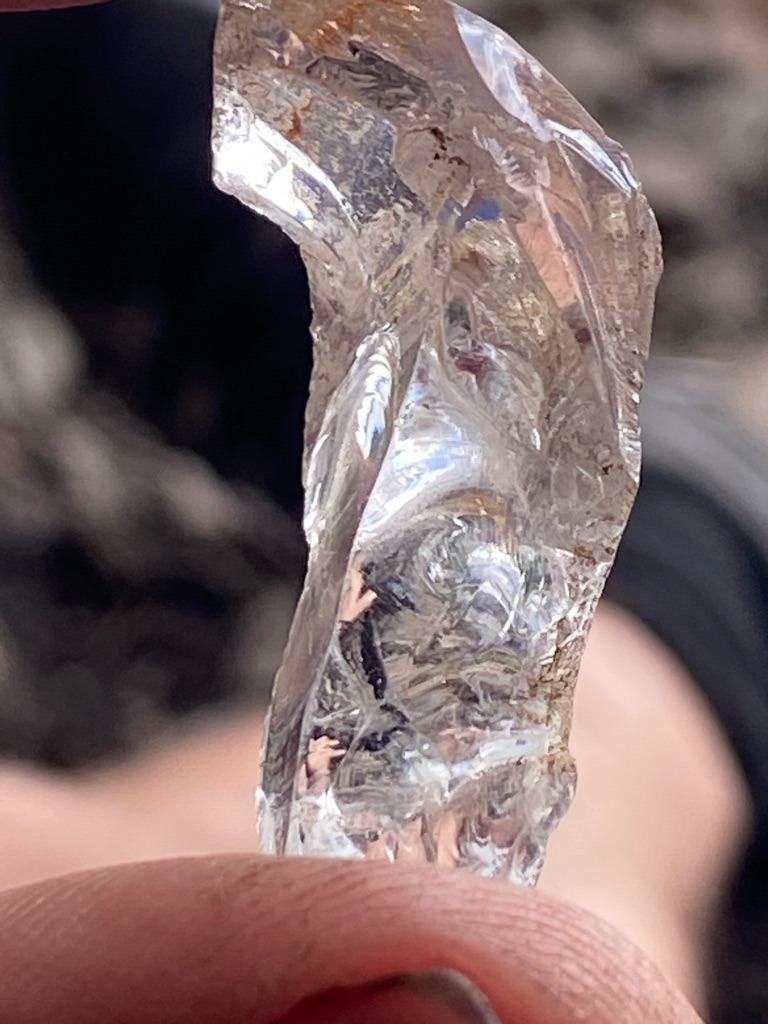
The specimen shown in the image appears to be rough, untreated mineral crystal, likely quartz or glass rather than a gem-quality diamond, exhibiting conchoidal fracture patterns characteristic of glass or quartz.
The specimen shown in the image appears to be rough, untreated mineral crystal, likely quartz or glass rather than a gem-quality diamond, exhibiting conchoidal fracture patterns characteristic of glass or quartz. · Irregular rough crystal fragment / Raw unstructured piece with no standard gem cut.
Not applicable as this is an uncut, unpolished raw crystal fragment. Cut
Carat
Difficult to estimate accurately from a 2D photograph without dimensions, but appears substantial, roughly estimated between 10 to 30 carats if measured as a raw gemstone equivalent.
Color
Near colorless to light brown tint, typical of raw quartz or mineral fragments.
Clarity
Included / heavily included due to visible internal fractures, fissures, and inclusions throughout.
Shape
Irregular rough crystal fragment / Raw unstructured piece with no standard gem cut.
Overall Assessment
The specimen is a raw, irregularly shaped mineral crystal (likely quartz or glass slag) rather than a diamond. It displays prominent conchoidal fractures, internal fissures, and an unpolished surface, making it unsuitable for standard gemstone jewelry without significant cutting and polishing.
Cut Quality
Not applicable as this is an uncut, unpolished raw crystal fragment.
Brilliance
Low to moderate, limited by the lack of proper facet geometry and internal fractures.
Fire
Minimal dispersion of spectral colors due to lack of facet angles designed to maximize light return.
Scintillation
Poor sparkle; light reflection is scattered unevenly across irregular fracture planes rather than polished facets.
Proportions
Not applicable for rough, uncut mineral specimens.
Symmetry
Asymmetrical, completely natural and raw formation with uneven growth and fractures.
Polish
Raw, unpolished surface showing natural cleavage and fracture planes.
Fluorescence
Unknown without UV testing, but likely inert or faint depending on mineral composition.
Inclusions
Heavy internal fracturing, cleavage planes, feathers, and potential mineral or gas inclusions.
Blemishes
Natural surface roughness, uneven edges, chipping, and conchoidal fracture ripples.
Origin
Natural geological formation, likely found in pegmatites, hydrothermal veins, or surface alluvial deposits.
Treatment Detection
No obvious signs of artificial treatments, appears completely natural.
Estimated Value
Minimal monetary value as a gemstone; primarily of mineralogical, educational, or decorative interest.
Certification Estimate
Not applicable for standard diamond grading labs (GIA, AGS, IGI) as this is not a faceted diamond; would require a mineralogical report (e.g., GIA Gemological Identification Report) to confirm identity.
Investment Potential
Non-existent for investment purposes; holds value only as a raw mineral specimen.
Similar Diamonds
None, as this specimen is not a diamond; comparable to raw quartz crystals, glass cullet, or rough beryl.
Setting Suggestions
Wire-wrapped in sterling silver or copper for a rustic, organic jewelry style if desired.
Care & Maintenance
Handle with care to prevent chipping along existing fracture lines; clean gently with warm soapy water and a soft brush.
Interesting Facts
Raw mineral specimens like this often show conchoidal fracture patterns, which are typical of materials that break with smooth, curved surfaces rather than clean cleavage planes.