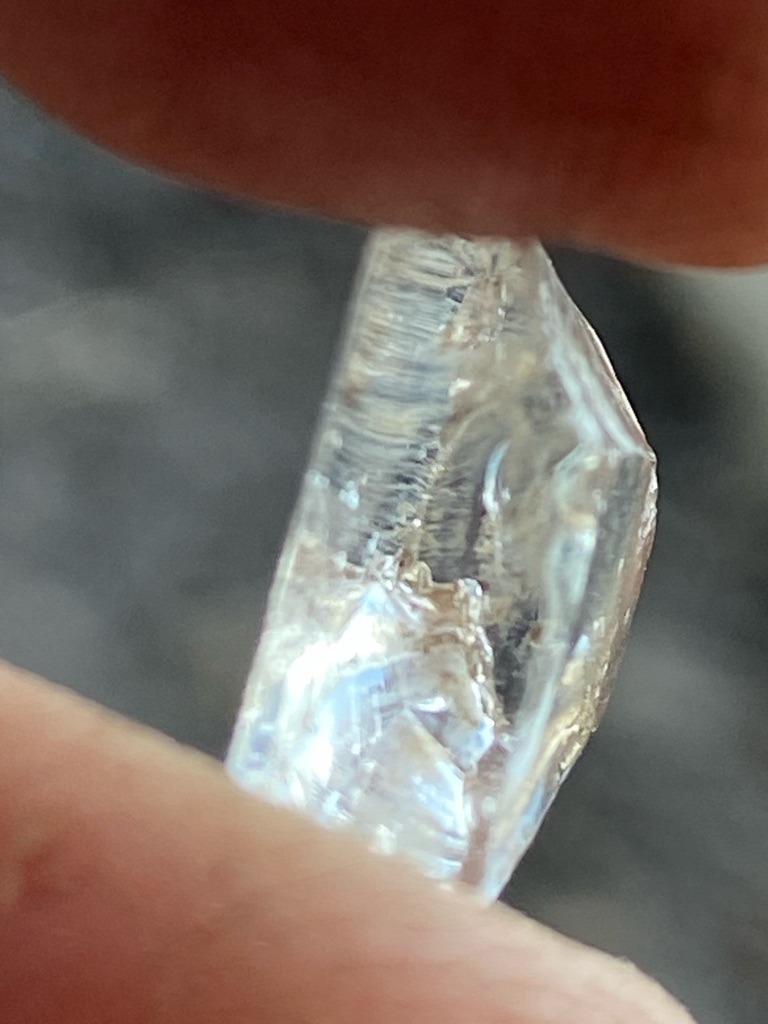
Natural rough diamond crystal showing distinct trigons and growth lines
Natural rough diamond crystal showing distinct trigons and growth lines · Rough crystal / Uncut octahedral or macle fragment
Not applicable (Rough, unpolished crystal) Cut
Carat
Estimated 0.85 - 1.20 carats based on visible scale
Color
Near-colorless to light brown (Approx. G-I range)
Clarity
Included (I1 - I2) due to internal feathers and crystal inclusions
Shape
Rough crystal / Uncut octahedral or macle fragment
Overall Assessment
An intriguing, natural rough diamond crystal displaying characteristic growth lines and surface features, ideal for custom organic jewelry or mineral collections.
Cut Quality
Not applicable (Rough, unpolished crystal)
Brilliance
Low due to lack of faceting and rough exterior
Fire
Minimal due to unpolished surface dispersion limits
Scintillation
Poor due to lack of standard facets and polish
Proportions
Natural rough proportions, deep unpolished mass
Symmetry
Natural crystal symmetry showing distorted octahedral faces
Polish
Natural crystal face texture with striations (trigons/growth lines)
Fluorescence
Unknown without UV testing (Likely none to faint blue)
Inclusions
Internal clouds, feathers, and pinpoint inclusions visible
Blemishes
Natural surface etch channels, trigons, and rough skin
Origin
Likely alluvial or primary kimberlite pipe origin (Africa or Canada)
Treatment Detection
No treatments detected; entirely untreated natural rough
Estimated Value
Varies by precise weight and purity, roughly $300 - $800 as rough specimen
Certification Estimate
GIA or AGS (Origin and rough analysis report)
Investment Potential
Moderate as a collector specimen or custom cut potential
Similar Diamonds
Other natural unpolished octahedral rough diamond crystals
Setting Suggestions
Raw diamond bezel setting in yellow or white gold to showcase organic form
Care & Maintenance
Avoid harsh impacts to prevent splitting along natural cleavage planes
Interesting Facts
Rough diamonds preserve the geological journey from the Earth's mantle, often displaying natural growth triangular markings called trigons