Natural (Likely) vs Simulant (Possible)
Natural (Likely) vs Simulant (Possible) · Oval Brilliant
Good to Very Good (some asymmetrical facets visible) Cut
Carat
Estimated 0.70 to 1.10 carats
Color
Estimated G-I (Near Colorless)
Clarity
Estimated SI1 to I1 (due to visible internal patterns and photographic blur)
Shape
Oval Brilliant
Overall Assessment
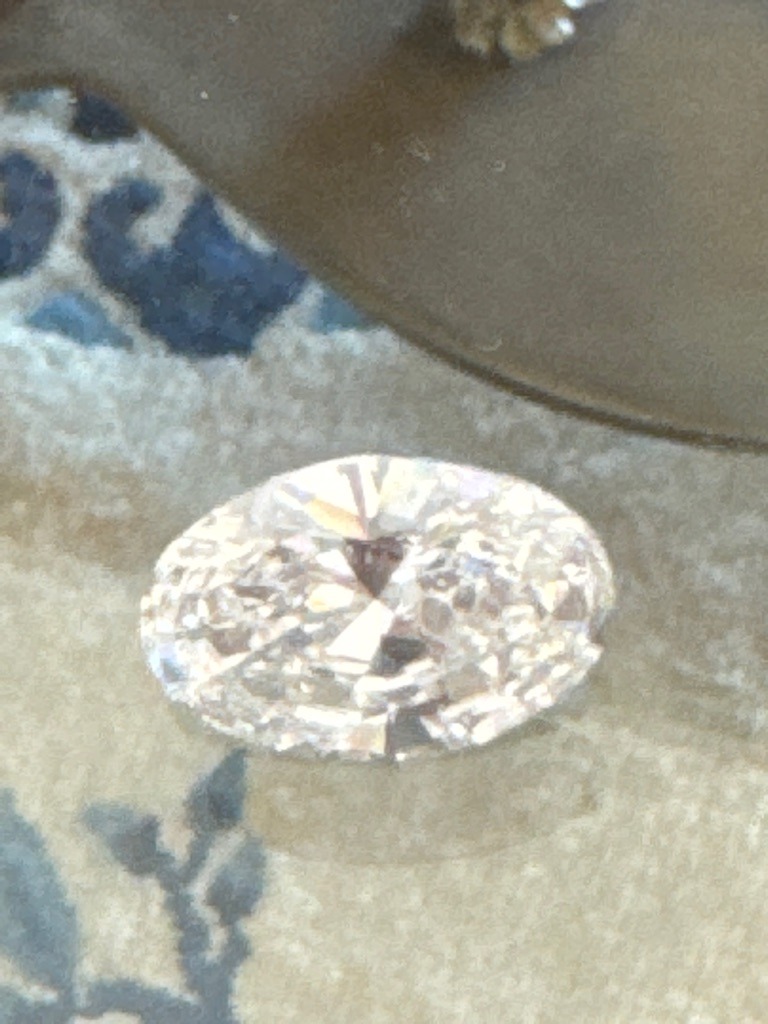
A bright, classic Oval Brilliant cut diamond with a common 'bow-tie' shadow effect and good brilliance suitable for an engagement ring.
Cut Quality
Good to Very Good (some asymmetrical facets visible)
Brilliance
High; strong return of white light in the center and edges
Fire
Moderate; small spectral colors visible near the outer facets
Scintillation
Moderate; contrast between light and dark facets creates a standard oval pattern
Proportions
Standard oval length-to-width ratio appearing roughly 1.4:1
Symmetry
Fair to Good; slight variations in pavilion facet alignment
Polish
Good; sharp edge definition seems present though blurred by photography
Fluorescence
Indeterminable from photo alone; no blue tint visible under standard light
Inclusions
Potential feathers or crystals near the center-left; slight 'bow-tie' effect visible
Blemishes
None clearly distinguishable at this resolution
Origin
Indeterminable from image; standard commercial global supply
Treatment Detection
No obvious signs of fracture filling or drill holes
Estimated Value
$1,800 to $3,500 USD (wide range depending on actual weight and origin)
Certification Estimate
GIA or IGI; estimated G-SI1 for natural, or F-VS2 for lab-grown
Investment Potential
Low; standard consumer grade commercial diamond
Similar Diamonds
Standard 1ct G SI1 Oval Brilliant diamonds
Setting Suggestions
Four-prong or six-prong solitaire in 14k/18k White Gold or Platinum
Care & Maintenance
Ultrasonic cleaner or warm soapy water with a soft-bristle brush
Interesting Facts
Oval diamonds provide a larger surface area per carat compared to Round Brilliants