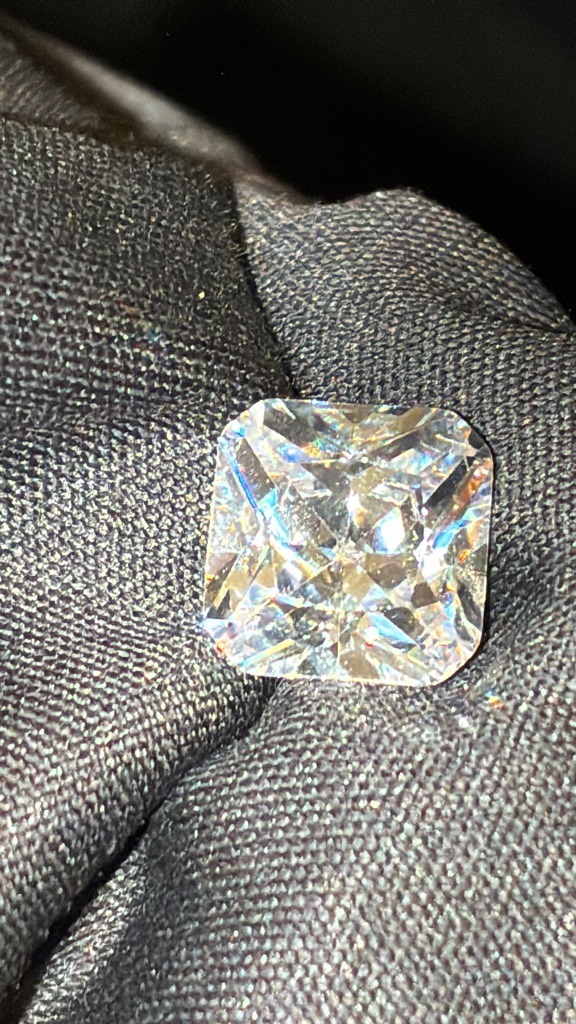
Likely Moissanite or High-Quality Diamond Simulant
Likely Moissanite or High-Quality Diamond Simulant · Radiant Cut (Modified Square/Rectangular)
Very Good to Excellent Cut
Carat
Estimated 1.5 - 2.0 carats based on visual dimensions
Color
Visual equivalent of D-E-F (Colorless)
Clarity
Eye-clean, likely VVS1-VVS2 equivalent
Shape
Radiant Cut (Modified Square/Rectangular)
Overall Assessment
The stone displays the classic high dispersion and double refraction characteristic of Moissanite. It is an excellent choice for a jewelry piece requiring maximum sparkle and durability at a lower price point than a natural diamond.
Cut Quality
Very Good to Excellent
Brilliance
Very High; shows strong white light return
Fire
Extreme; displays high 'double refraction' typical of Moissanite rather than Diamond
Scintillation
Strong 'crushed ice' scintillation pattern
Proportions
Classic radiant proportions with a slightly large table and crushed-ice facet pattern
Symmetry
Good; facet junctions appear relatively sharp
Polish
Excellent; high surface luster visible
Fluorescence
Difficult to determine without UV, but shows high internal dispersion
Inclusions
No significant inclusions visible to the naked eye; suggests high clarity
Blemishes
Minimal surface wear detected; facet edges appear sharp
Origin
Likely Lab-Created (Synthetic)
Treatment Detection
No obvious coating or fracture filling visible
Estimated Value
$100 - $300 if Moissanite; significantly higher if natural diamond
Certification Estimate
Likely a manufacturer certificate (GRA for Moissanite) rather than GIA/AGS
Investment Potential
Low; primarily decorative value rather than asset appreciation
Similar Diamonds
Charles & Colvard Forever One Moissanite
Setting Suggestions
Platinum or 14k White Gold four-prong solitaire or halo setting
Care & Maintenance
Ultrasonic cleaning or warm soapy water with a soft brush
Interesting Facts
Radiant cuts were the first to have a complete brilliant-cut facet pattern on both the crown and pavilion