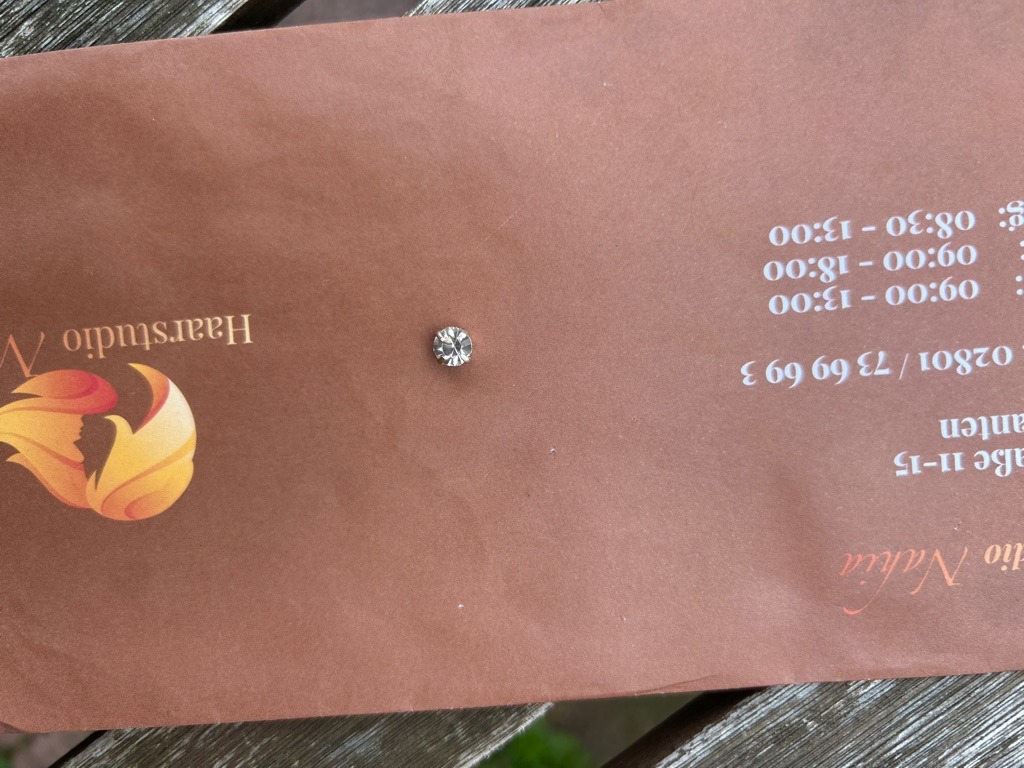
Probable Simulant (Glass or Crystal)
Probable Simulant (Glass or Crystal) · Round Brilliant Style
Fair to Poor (Substantial lack of symmetry and depth consistency) Cut
Carat
Estimated 0.10 - 0.20 carats (based on relative scale)
Color
Estimated M-N or Lower (Shows significant warmth/yellow-brown tint)
Clarity
Estimated I2-I3 (Visible internal cloudiness and surface wear)
Shape
Round Brilliant Style
Overall Assessment
The stone lacks the refractive index and brilliance of a natural or lab-grown diamond, likely a decorative glass or inexpensive simulant.
Cut Quality
Fair to Poor (Substantial lack of symmetry and depth consistency)
Brilliance
Low (The stone appears dull and does not return light efficiently)
Fire
Minimal (No visible spectral dispersion or rainbow flashes)
Scintillation
Poor (Static light pattern with little life)
Proportions
Shallow crown with an uneven table; light leaks significantly through the center
Symmetry
Poor (Misaligned facets and uneven pavilion reflection)
Polish
Fair (Surface appears dull with possible abrasions)
Fluorescence
None visible under natural light
Inclusions
Large dark spots and hazy internal texture suggestive of material impurities
Blemishes
Visible scratches and facet edge wear common in softer simulants
Origin
Manufactured (Likely glass or common crystal used in costume jewelry)
Treatment Detection
Not a natural diamond; possibly foil-backed or coated based on reflection
Estimated Value
$1 - $5 (Nominal value)
Certification Estimate
Unlikely to be graded by GIA or IGI; may be identified as a simulant
Investment Potential
None (No resale value as a gemstone)
Similar Diamonds
Preciosa crystals or Swarovski Chaton-cut stones
Setting Suggestions
Best suited for inexpensive costume jewelry or craft applications
Care & Maintenance
Avoid harsh chemicals; clean with a soft cloth and mild soap
Interesting Facts
The appearance of the facet junctions suggests a softer material than carbon