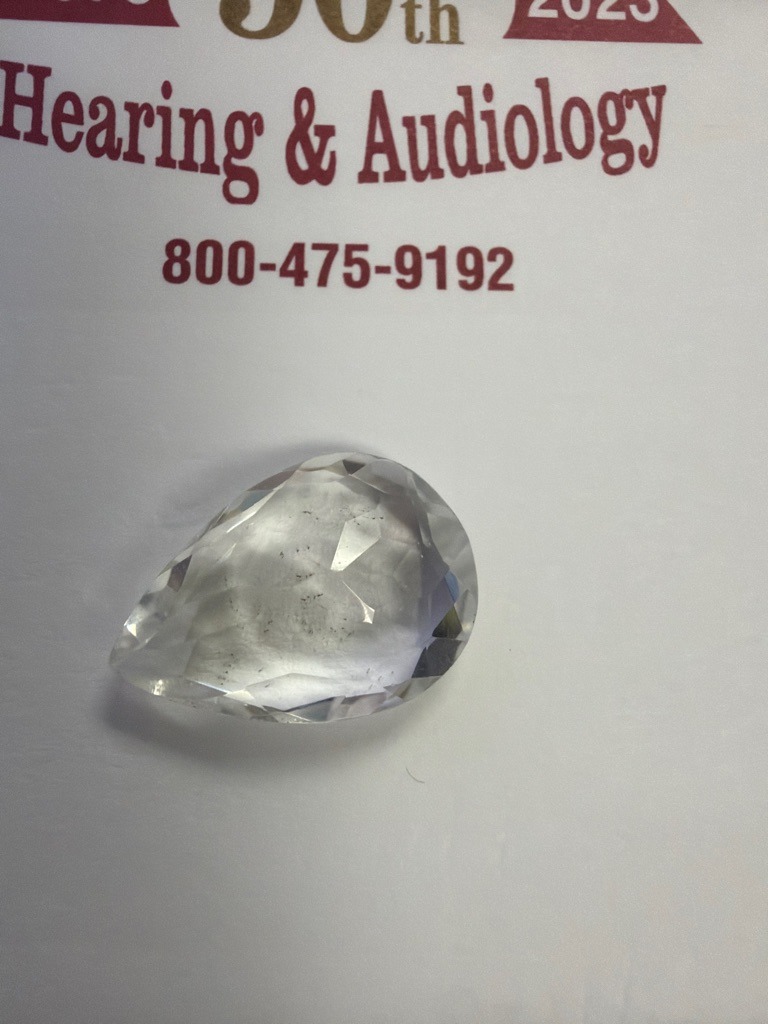
The image shows a faceted gemstone, but based on visual indicators like the irregular multi-facet pattern and lack of standard high-dispersion optical properties, this appears to be either a quartz, glass, or cubic zirconia rather than a genuine diamond. If confirmed as diamond, it would be Natural.
The image shows a faceted gemstone, but based on visual indicators like the irregular multi-facet pattern and lack of standard high-dispersion optical properties, this appears to be either a quartz, glass, or cubic zirconia rather than a genuine diamond. If confirmed as diamond, it would be Natural. · Pear (Teardrop)
Fair to Good, showing non-standard facet alignment typical of commercial or novelty cuts. Cut
Carat
Estimated around 3.0 to 4.0 carats based on visual dimensions.
Color
Colorless (Estimated G-H range if diamond)
Clarity
Included (Estimated SI2-I1 range due to visible dark inclusions near the center)
Shape
Pear (Teardrop)
Overall Assessment
A large pear-shaped translucent stone with central dark inclusions and a non-traditional facet arrangement. Visual inspection strongly suggests a fashion or alternative gemstone rather than a top-tier diamond.
Cut Quality
Fair to Good, showing non-standard facet alignment typical of commercial or novelty cuts.
Brilliance
Moderate, somewhat reduced by internal dark inclusions and non-ideal angles.
Fire
Low to Moderate dispersion.
Scintillation
Uneven flash pattern with noticeable dark dead zones due to inclusion clustering.
Proportions
Large table facet with a moderately deep pavilion, atypical of ideal diamond proportions.
Symmetry
Fair; the pear apex and curves show minor asymmetry.
Polish
Good, with standard facet line crispness.
Fluorescence
Unknown without UV testing, likely None
Inclusions
Noticeable cluster of dark pinpoints and carbon spots concentrated in the upper-center table area.
Blemishes
Minor surface scratches visible under magnification along facet junctions.
Origin
Unknown, likely commercial rough if natural stone.
Treatment Detection
No obvious signs of fracture filling or coating, standard untreated appearance.
Estimated Value
Nominal value if gemstone-grade quartz or glass ($20 - $100); significantly higher if authenticated as a high-clarity large diamond, though inclusion grade limits this.
Certification Estimate
Not recommended for certification by major labs (GIA/AGS) given the likely non-diamond material or lower commercial grade.
Investment Potential
Low, primarily decorative or costume use unless verified as a high-value rare diamond.
Similar Diamonds
Standard commercial pear-cut colorless stones with included clarity grades.
Setting Suggestions
Bezel setting to protect the pointed apex and help mask minor asymmetry.
Care & Maintenance
Standard ultrasonic cleaning (if durable quartz/diamond) or warm soapy water with a soft brush; protect point from impact.
Interesting Facts
Pear-shaped cuts combine the brilliance of the round brilliant with the marquise shape, originating in the 15th century.