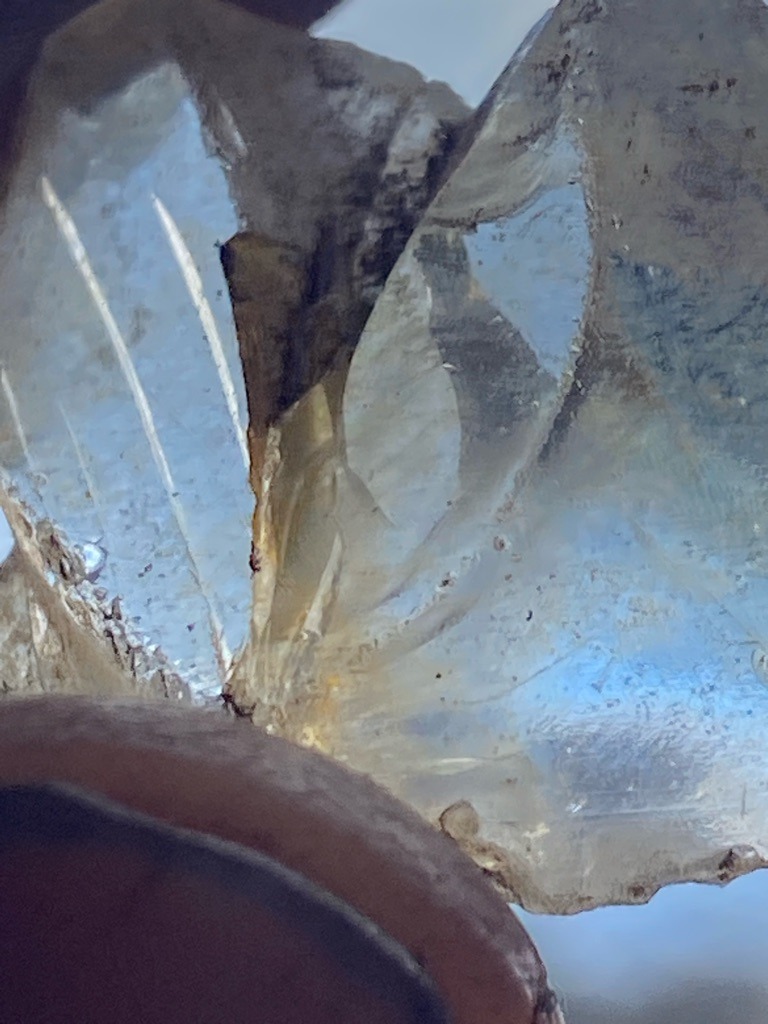
Not a diamond; appears to be raw quartz crystal or fractured mineral specimen, possibly glass or quartz shard showing conchoidal fracture patterns.
Not a diamond; appears to be raw quartz crystal or fractured mineral specimen, possibly glass or quartz shard showing conchoidal fracture patterns. · Irregular raw crystal shard / Uncut fragment
Not applicable (Raw, uncut mineral shard showing natural or accidental breakage patterns). Cut
Carat
Cannot accurately determine from visual estimate alone, likely substantial weight as a rough mineral piece.
Color
Colorless / Clear with some surface staining and inclusions.
Clarity
I3 / heavily fractured with prominent internal stress cracks and feather fractures.
Shape
Irregular raw crystal shard / Uncut fragment
Overall Assessment
The provided image does not show a diamond, but rather a rough, highly fractured mineral fragment—likely quartz or glass—displaying distinctive conchoidal fracture patterns. It possesses no gemological diamond characteristics.
Cut Quality
Not applicable (Raw, uncut mineral shard showing natural or accidental breakage patterns).
Brilliance
Low to moderate vitreous luster, dependent on lighting and fracture angles.
Fire
Minimal to none, characteristic of quartz rather than diamond.
Scintillation
Poor, lacking standard gemstone faceting to return patterned light.
Proportions
Not applicable to raw mineral fragments.
Symmetry
Asymmetrical due to random fracture mechanics (conchoidal fracture).
Polish
Unpolished natural or fractured surface.
Fluorescence
Unknown without UV testing.
Inclusions
Prominent conchoidal fracture ripples, stress lines, feathers, and potential trapped mineral or gas bubbles.
Blemishes
Rough, jagged edges, chips, and surface abrasions.
Origin
Natural mineral rough or manufactured glass shard, indeterminable without physical testing.
Treatment Detection
No obvious enhancements, though fractures appear natural or stress-induced.
Estimated Value
Nominal / Low decorative or mineral specimen value, essentially negligible as a gemstone.
Certification Estimate
Standard gemological laboratories (GIA, AGS) would not certify this as a diamond; mineralogical testing required to confirm species (e.g., quartz vs. glass).
Investment Potential
None; this specimen holds no financial investment value.
Similar Diamonds
None, as this specimen is not a diamond.
Setting Suggestions
Not suitable for standard jewelry settings due to fragility and lack of durability; wire-wrapping if used as a raw crystal pendant.
Care & Maintenance
Handle with care to avoid cutting fingers on sharp edges; clean gently with mild soap and warm water if desired.
Interesting Facts
The prominent curved lines visible on the surface are classic 'conchoidal fractures,' which occur when brittle materials like glass or quartz break along smooth, curved surfaces resembling sea shells.