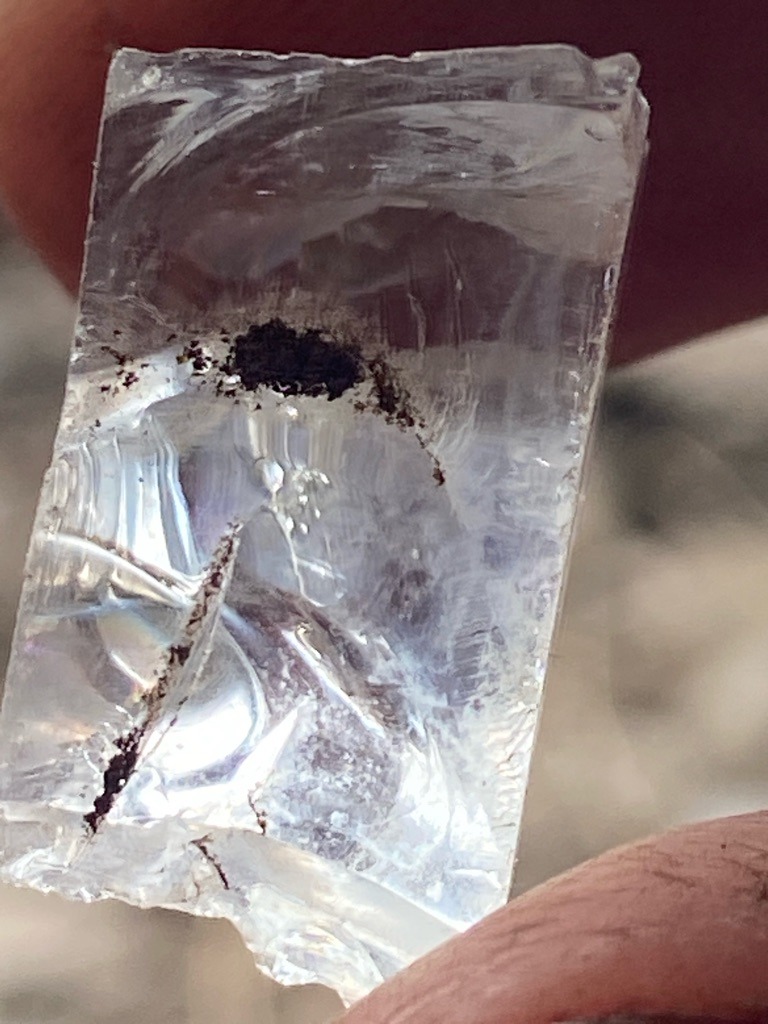
Rough, unpolished natural crystal (or potentially quartz/glass specimen, requiring physical testing, assuming rough diamond material for evaluation)
Rough, unpolished natural crystal (or potentially quartz/glass specimen, requiring physical testing, assuming rough diamond material for evaluation) · Rough crystal / tabular fragment with natural irregular habit
Not applicable (Rough, unpolished mineral specimen) Cut
Carat
Estimated 8.5 to 12 carats based on relative size in hand
Color
Near-colorless to light brown tint (G-J range equivalent)
Clarity
I3 (Heavy visible dark inclusions, fractures, and surface features)
Shape
Rough crystal / tabular fragment with natural irregular habit
Overall Assessment
A fascinating, large unpolished mineral specimen (likely rough diamond or similar crystal) exhibiting significant natural character, heavy dark mineral inclusions, and internal fractures, making it suitable as a collector's specimen rather than a polished gemstone.
Cut Quality
Not applicable (Rough, unpolished mineral specimen)
Brilliance
Poor in current rough state; light transmission is hindered by internal fractures and dark inclusions
Fire
Minimal dispersion visible due to lack of facet angles and heavy inclusions
Scintillation
None; surface is unpolished and lacks precise reflective facets
Proportions
Irregular raw slab/fragment; standard faceted proportions do not apply
Symmetry
Natural crystal symmetry, highly irregular due to fracture and breakage
Polish
Raw, unpolished, showing natural crystal faces and conchoidal fracture/cleavage planes
Fluorescence
Cannot be determined without UV light testing (likely inert to faint)
Inclusions
Large prominent dark carbon or mineral cluster inclusion near the top, extensive internal fracturing and feathering
Blemishes
Surface naturals, chipped edges, rough breakage planes, and abrasion marks
Origin
Natural rough stone, likely alluvial or primary pipe deposit origin
Treatment Detection
No obvious signs of artificial treatments; appears completely untreated and natural
Estimated Value
Nominal value as a mineral specimen or industrial grade material; low gem-quality value due to severe inclusions
Certification Estimate
GIA or similar major lab would issue an identification report rather than a standard grading report due to heavy inclusions and rough state
Investment Potential
Low investment potential for resale as a gemstone; primarily of interest to mineral collectors or for industrial applications
Similar Diamonds
Other industrial or specimen-grade rough diamond crystals with heavy carbon spots
Setting Suggestions
Wire-wrapped raw crystal pendant or bespoke organic-style mounting to preserve its natural rough aesthetic
Care & Maintenance
Handle with care to prevent further chipping along cleavage planes; clean gently with warm soapy water and a soft brush
Interesting Facts
Large dark inclusions like the one visible are often referred to as 'pique' or carbon spots, which severely impact gem value but highlight the natural geological formation process