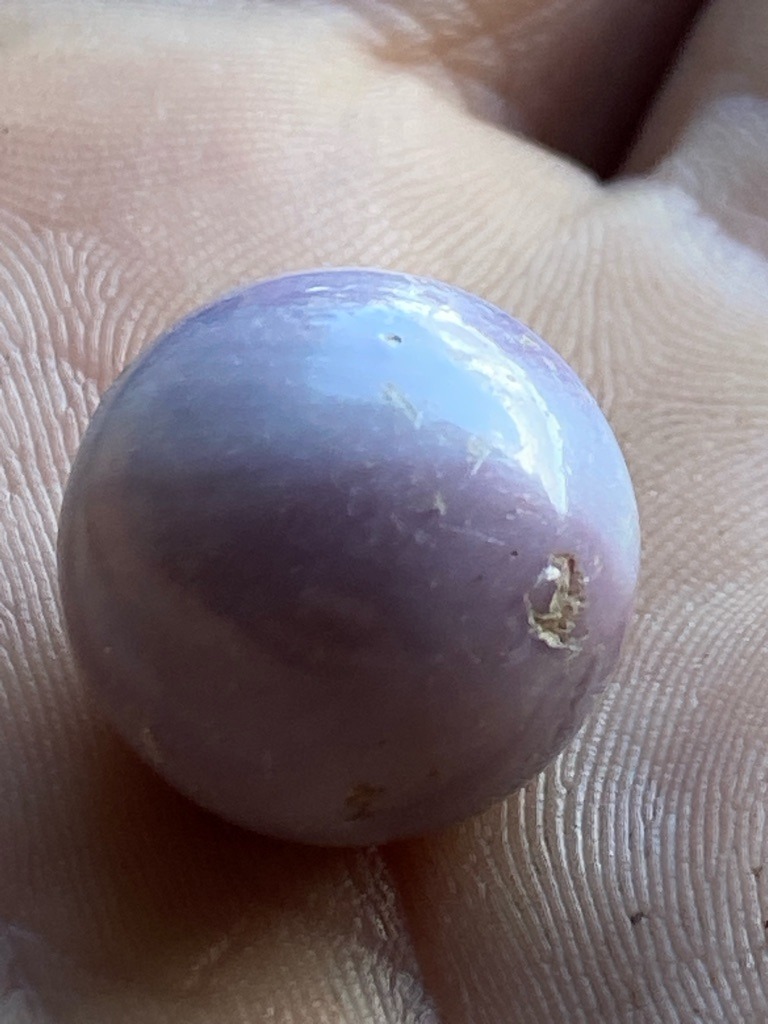
Not a diamond; visual characteristics and spherical cabochon shape strongly resemble a natural mineral bead such as Kunzite, Lepidolite, or tinted quartz rather than diamond.
Not a diamond; visual characteristics and spherical cabochon shape strongly resemble a natural mineral bead such as Kunzite, Lepidolite, or tinted quartz rather than diamond. · Spherical Bead / Cabochon
Poor / Non-Standard (Smooth spherical bead polish rather than a faceted gem cut) Cut
Carat
Estimated approximately 10 to 15 carats based on visual proportions against a human palm.
Color
Light Lavender to Pale Purple (Fancy Color gemstone classification, not applicable to standard D-Z diamond scale)
Clarity
Translucent to Opaque with visible surface inclusions and matrix spots (Not graded on the standard diamond clarity scale)
Shape
Spherical Bead / Cabochon
Overall Assessment
The specimen shown in the image is definitively not a diamond. It is an opaque to translucent, pale purple spherical gemstone bead featuring natural surface irregularities and inclusions, likely belonging to a mineral species such as kunzite, lepidolite, or chalcedony.
Cut Quality
Poor / Non-Standard (Smooth spherical bead polish rather than a faceted gem cut)
Brilliance
Low due to opaque/translucent nature and cabochon finish rather than faceted cuts
Fire
Minimal to none due to lack of facets
Scintillation
Low, characterized by soft directional specular highlights rather than diamond-like sparkle
Proportions
Spherical form with no table, crown, or pavilion angles
Symmetry
Fair (Slightly irregular spherical symmetry with surface pitting)
Polish
Good (Smooth surface polish with minor natural surface pitting)
Fluorescence
Unknown (requires UV testing)
Inclusions
Natural mineral inclusions and structural veining visible beneath the surface
Blemishes
Visible surface pits, minor abrasions, and a localized rough spot/cavity on the side
Origin
Natural mineral origin, potentially pegmatite-hosted (such as spodumene/kunzite or lepidolite)
Treatment Detection
No obvious signs of artificial treatments, though stabilization or dyeing cannot be entirely ruled out without spectroscopic analysis.
Estimated Value
Nominal value (typically under $50 USD depending on the exact mineral species)
Certification Estimate
Gemological laboratories such as GIA or IGI would classify this as a non-diamond mineral specimen or bead.
Investment Potential
None; ornamental or decorative use only
Similar Diamonds
None, as this object is not a diamond; comparable specimens include amethyst, kunzite, or rose quartz beads.
Setting Suggestions
Best suited for wire-wrapping, artisanal jewelry bezel settings, or bead-stringing designs.
Care & Maintenance
Avoid harsh chemicals, ultrasonic cleaners, and hard impacts to prevent surface chipping or scratching.
Interesting Facts
Spherical mineral beads are often carved and polished for metaphysical purposes, crystal healing, or beaded jewelry rather than fine diamond jewelry.