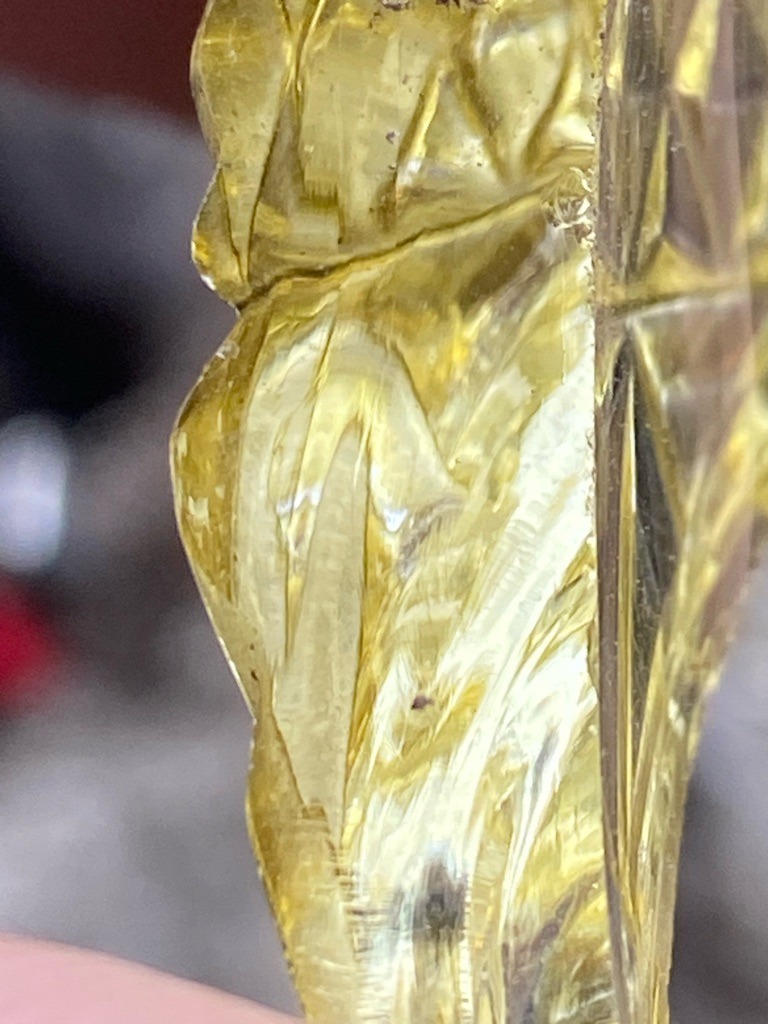
Not a diamond; appears to be raw or carved yellow amber, resin, or possibly a yellow glass/slag material due to the conchoidal fracture patterns, organic texture, and lack of diamond crystal habit.
Not a diamond; appears to be raw or carved yellow amber, resin, or possibly a yellow glass/slag material due to the conchoidal fracture patterns, organic texture, and lack of diamond crystal habit. · Irregular raw or carved form, not a standard faceted diamond cut
Not applicable Cut
Carat
Not applicable (does not apply to non-diamond organic resin or glass; visual scale is quite large if measured by weight, but specific gravity differs entirely from diamond)
Color
Deep yellow to golden-honey (Fancy Dark Yellow equivalent if evaluated on a color scale, though material is amorphous)
Clarity
Included (Contains visible flow lines, swirls, and organic inclusions typical of amber/resin)
Shape
Irregular raw or carved form, not a standard faceted diamond cut
Overall Assessment
The specimen displayed in the image is not a diamond. It exhibits the physical characteristics of yellow amber, resin, or glass, characterized by conchoidal fractures, resinous luster, and internal flow lines rather than the crystalline structure and adamantine luster of a diamond.
Cut Quality
Not applicable
Brilliance
Low to moderate, resinous luster rather than adamantine
Fire
None (dispersive power is extremely low compared to diamond)
Scintillation
Minimal sparkle, primarily surface reflection rather than internal light return
Proportions
Not applicable
Symmetry
Asymmetrical, organic formation
Polish
Resinous to waxy luster on unpolished surfaces, semi-glossy polish on shaped areas
Fluorescence
Often exhibits strong blue or greenish fluorescence under UV light if genuine amber, but cannot be definitively stated from visual image alone
Inclusions
Internal flow lines, possible particulate matter, air bubbles or botanical debris typical of natural resins
Blemishes
Surface scratches, natural resin pits, and uneven textures
Origin
Likely natural fossil resin (Baltic or Dominican origin if genuine amber) or modern synthetic polymer
Treatment Detection
Visual signs suggest natural formation or pressed amber composition, requiring FTIR spectroscopy to confirm lack of plastic imitation
Estimated Value
Minimal to moderate depending on whether it is genuine natural amber (fossilized tree resin) or synthetic plastic/glass
Certification Estimate
Gemological laboratories (like GIA or GRS) would identify this as amber or treated glass rather than issue a diamond report
Investment Potential
Low as an investment asset, primarily of decorative or collector interest
Similar Diamonds
None, as this object is chemically and structurally unrelated to diamond
Setting Suggestions
Wire-wrapping, bezel settings, or organic bezel mountings suited for soft gem materials
Care & Maintenance
Keep away from harsh chemicals, solvents, perfumes, and high heat; clean gently with a soft, damp cloth
Interesting Facts
Genuine amber is fossilized tree resin that can be millions of years old and occasionally preserves prehistoric insects or plant matter