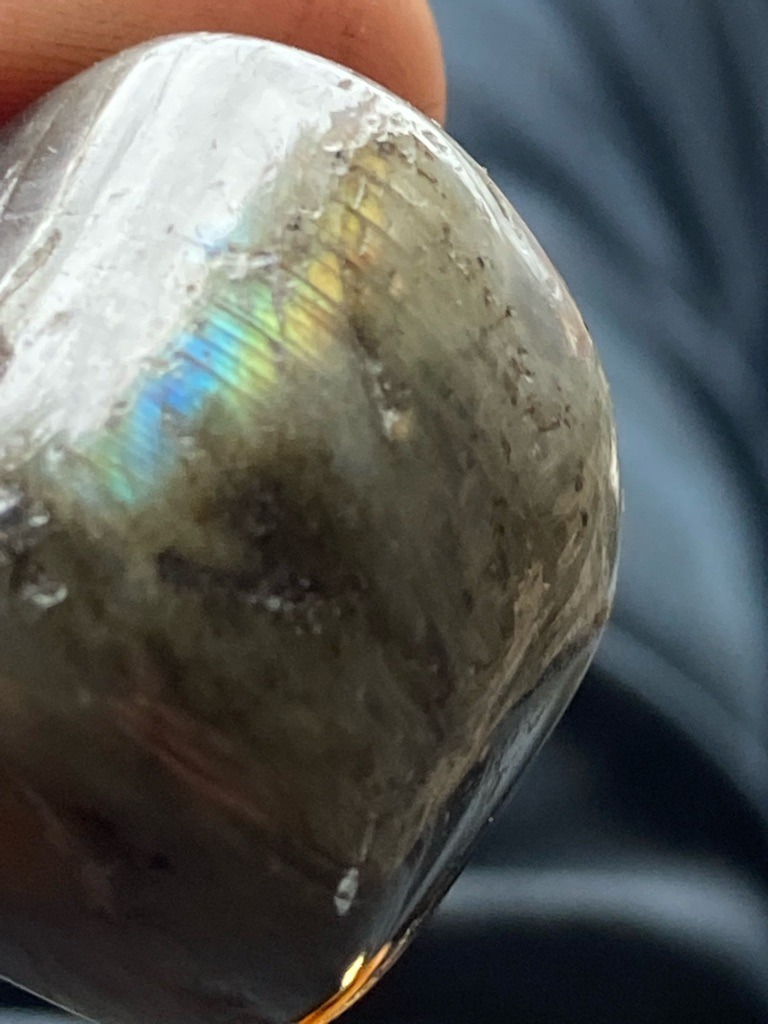
Not a diamond; this is a tumbled mineral specimen, specifically labradorite displaying labradorescence (optical phenomenon).
Not a diamond; this is a tumbled mineral specimen, specifically labradorite displaying labradorescence (optical phenomenon). · Tumbled/Irregular Freeform Cabochon
Not applicable (smoothly tumbled and polished pebble form rather than a faceted gem cut). Cut
Carat
Not applicable for non-diamond gemstones (estimated weight by volume is roughly 15-20 carats equivalent in mass).
Color
Not applicable (opaque to translucent dark body color with multicolored iridescent sheen).
Clarity
Not applicable (contains natural internal fractures, twinning planes, and mineral inclusions typical of feldspar).
Shape
Tumbled/Irregular Freeform Cabochon
Overall Assessment
The specimen shown in the image is not a diamond. It is a natural tumbled piece of labradorite exhibiting a vivid blue-green iridescent flash, appreciated for its unique optical properties rather than gem-grade hardness or rarity.
Cut Quality
Not applicable (smoothly tumbled and polished pebble form rather than a faceted gem cut).
Brilliance
Low brilliance due to opacity and diffused light scattering.
Fire
Displays spectral iridescent flashes (labradorescence) rather than traditional diamond fire.
Scintillation
Flashes of iridescent blue, green, and gold light appear as the viewing angle changes.
Proportions
Not applicable for a freeform tumbled specimen.
Symmetry
Asymmetrical freeform shape.
Polish
Good tumbled polish showing minor surface pitting and scratch marks.
Fluorescence
Not applicable (exhibits labradorescence/schiller effect rather than standard ultraviolet fluorescence).
Inclusions
Internal lamellar twinning planes, feather fractures, and magnetite or ilmenite inclusions.
Blemishes
Surface abrasions, natural pits, and minor scratches from the tumbling process.
Origin
Commonly sourced from Madagascar, Canada (Labrador), Finland, and Australia.
Treatment Detection
No treatments detected; natural untreated mineral specimen.
Estimated Value
Low market value (typically $5 to $20 USD depending on size and quality of the flash).
Certification Estimate
Gemological laboratories (like GIA or GRS) would identify this as Labradorite (feldspar mineral group), not issue a diamond grading report.
Investment Potential
Minimal; collected primarily for mineral collections or artisan jewelry rather than as an investment asset.
Similar Diamonds
None, as this is a feldspar mineral and shares no optical or physical properties with diamond.
Setting Suggestions
Best suited for wire-wrapping, bezel settings in artisan jewelry, or as a pocket stone.
Care & Maintenance
Avoid harsh chemicals, ultrasonic cleaners, and sudden temperature changes; labradorite has a Mohs hardness of 6-6.5 and can be scratched easily.
Interesting Facts
Labradorite is a plagioclase feldspar famous for its iridescent optical effect called labradorescence, caused by light diffraction in microscopic lamellae layers.