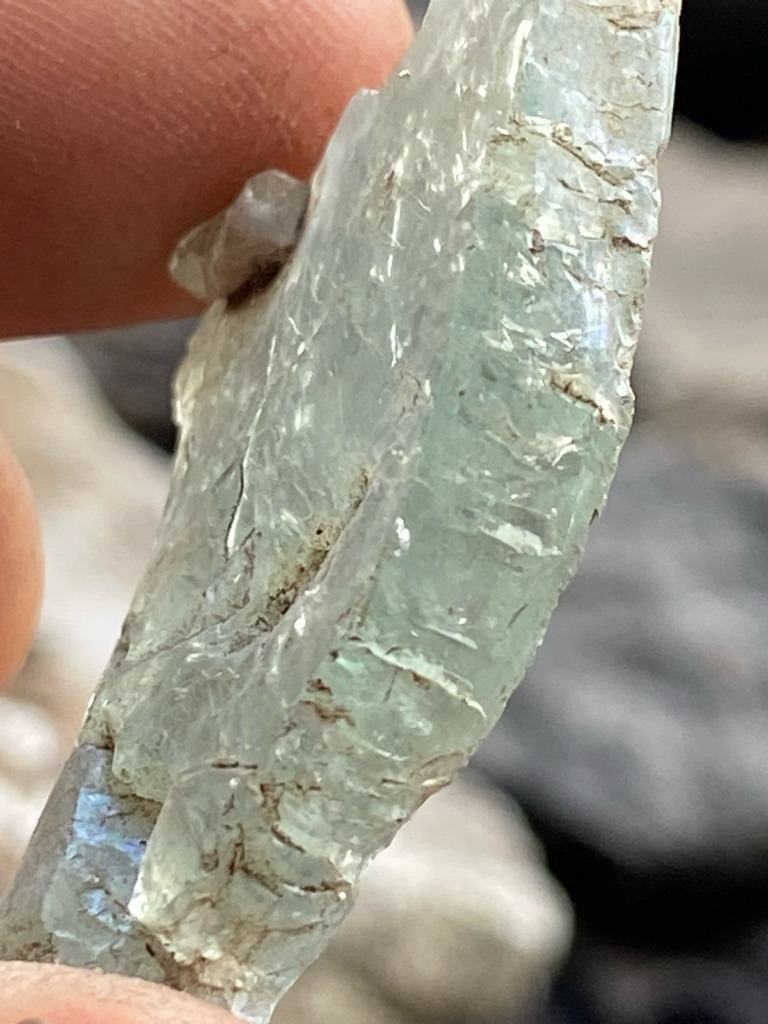
Not a diamond; this is a rough, unworked mineral specimen, likely beryl (aquamarine) or quartz based on the crystal structure, color, and surface striations.
Not a diamond; this is a rough, unworked mineral specimen, likely beryl (aquamarine) or quartz based on the crystal structure, color, and surface striations. · Rough crystal / Raw unshaped mineral fragment
Not applicable (Rough, unpolished raw crystal specimen) Cut
Carat
Cannot be precisely determined visually without a scale, but estimated to be a substantial piece of rough mineral (roughly 15 to 30 carats equivalent weight).
Color
Pale greenish-blue / Aquamarine tint (Not applicable to standard D-Z diamond grading)
Clarity
Included / Heavily fractured and included (Not applicable to standard diamond clarity scale)
Shape
Rough crystal / Raw unshaped mineral fragment
Overall Assessment
The specimen shown in the image is not a diamond, but rather a rough, unworked mineral crystal (likely beryl/aquamarine or similar pegmatite mineral) characterized by visible striations, pale greenish-blue coloration, and internal fractures.
Cut Quality
Not applicable (Rough, unpolished raw crystal specimen)
Brilliance
Low to moderate due to raw, unpolished surfaces and internal fractures
Fire
Negligible to none, characteristic of raw rough minerals rather than a faceted diamond
Scintillation
Poor, as light passes through unpolished and heavily fractured planes without standard facet reflection
Proportions
Irregular raw crystal fragment; proportions do not apply as it has not been faceted
Symmetry
Natural crystal growth symmetry showing striated prism faces
Polish
Raw, unpolished surface with natural crystal texture and growth marks
Fluorescence
Unknown without UV testing
Inclusions
Heavy internal fracturing, feather inclusions, and matrix material trapped within fissures
Blemishes
Surface etching, natural growth striations, and adhering matrix minerals
Origin
Natural rough mineral, likely originating from a pegmatite deposit.
Treatment Detection
No obvious signs of human treatment; appears to be in its natural raw state.
Estimated Value
Nominal value as a raw mineral specimen or lapidary rough, significantly lower than gem-grade diamond values.
Certification Estimate
Not applicable for diamond grading labs (GIA, AGS). Would require identification by a gemological institute such as GIA (Colored Stone Report) or GRS to confirm exact mineral species.
Investment Potential
Low investment potential; sold primarily as mineral specimens or low-grade lapidary rough rather than investment assets.
Similar Diamonds
None, as this is visually identified as a rough beryl/quartz crystal rather than a diamond.
Setting Suggestions
Wire-wrapped in sterling silver or gold for an organic, bohemian jewelry look, or kept as a raw mineral specimen for a collection.
Care & Maintenance
Handle with care due to internal fractures and potential fragility; clean gently with warm soapy water and a soft brush, avoiding harsh ultrasonic cleaners due to fractures.
Interesting Facts
Raw crystals often display natural growth striations along their prism faces, which are key diagnostic features for mineral identification.