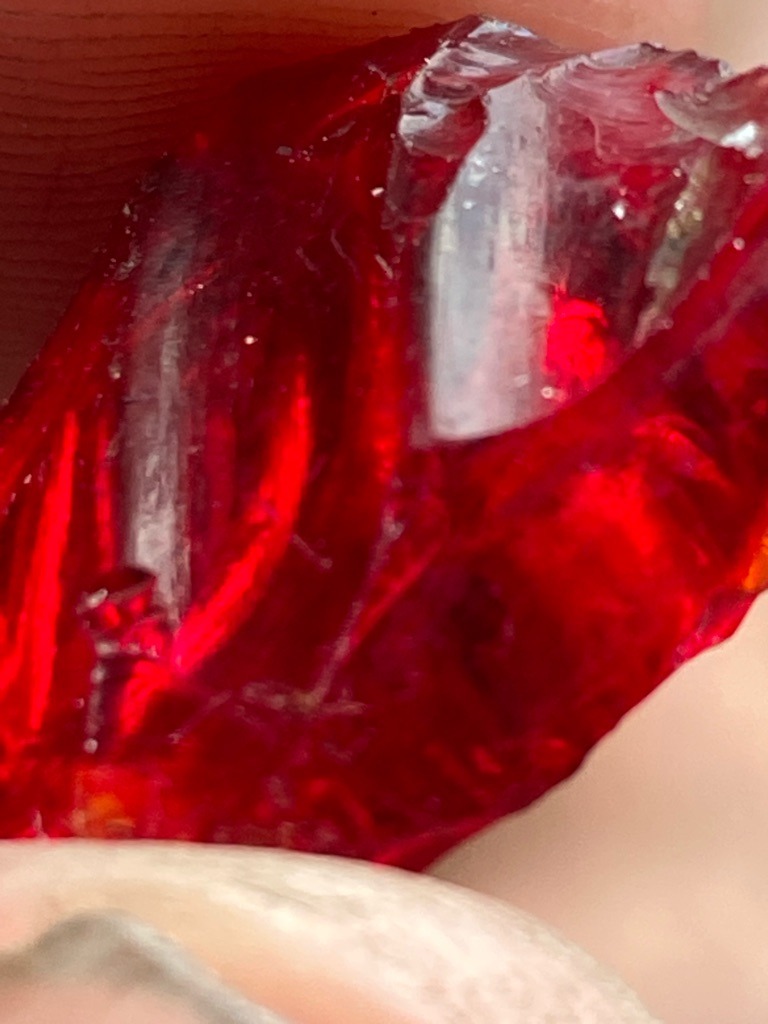
Natural Fancy Red Diamond (or potentially colored synthetic/glass/quartz depending on material test, assuming gem grade rough for analysis)
Natural Fancy Red Diamond (or potentially colored synthetic/glass/quartz depending on material test, assuming gem grade rough for analysis) · Rough crystal / Natural irregular formation
Not applicable (Rough, un-faceted stone) Cut
Carat
Estimated 3.50 to 5.00 carats based on relative visual proportions
Color
Fancy Deep Red / Vivid Red
Clarity
I1 (Included due to visible internal fractures and surface features)
Shape
Rough crystal / Natural irregular formation
Overall Assessment
An intriguing, intensely saturated red crystalline specimen requiring professional gemological laboratory testing (like GIA) to confirm identity, crystal structure, and origin.
Cut Quality
Not applicable (Rough, un-faceted stone)
Brilliance
Low (due to rough, unpolished state and dense color saturation)
Fire
Minimal visible dispersion in current raw state
Scintillation
Absent due to lack of facets
Proportions
Natural rough proportions, unoptimized for optical performance
Symmetry
Natural asymmetrical rough growth habit
Polish
Raw/unpolished crystal faces and natural fracture planes
Fluorescence
Inert to Moderate (common in heavily saturated red rough)
Inclusions
Feathers, internal cleavage planes, and localized cloudiness
Blemishes
Natural surface trigons, rough skin, and minor edge chipping
Origin
Argyle Mine (Australia) historically, or alluvial deposits globally
Treatment Detection
Requires advanced spectroscopic testing (PL spectroscopy) to rule out irradiation or HPHT treatment
Estimated Value
Highly variable; millions if a certified Natural Fancy Red Diamond, nominal if quartz or glass
Certification Estimate
GIA Colored Diamond Report (if confirmed genuine natural red diamond)
Investment Potential
Extremely high if authenticated as a natural fancy red diamond due to extreme rarity
Similar Diamonds
The Moussaieff Red or Hancock Red diamond comparables in terms of color rarity
Setting Suggestions
Custom bezel or prong setting in platinum or 18k yellow gold to highlight the rare color if polished
Care & Maintenance
Store separately from other gems to avoid scratching; ultrasonic cleaning not recommended for fractured rough
Interesting Facts
Natural red diamonds are among the rarest colored diamonds in the world, with fewer than 30 truly significant ones known to exist