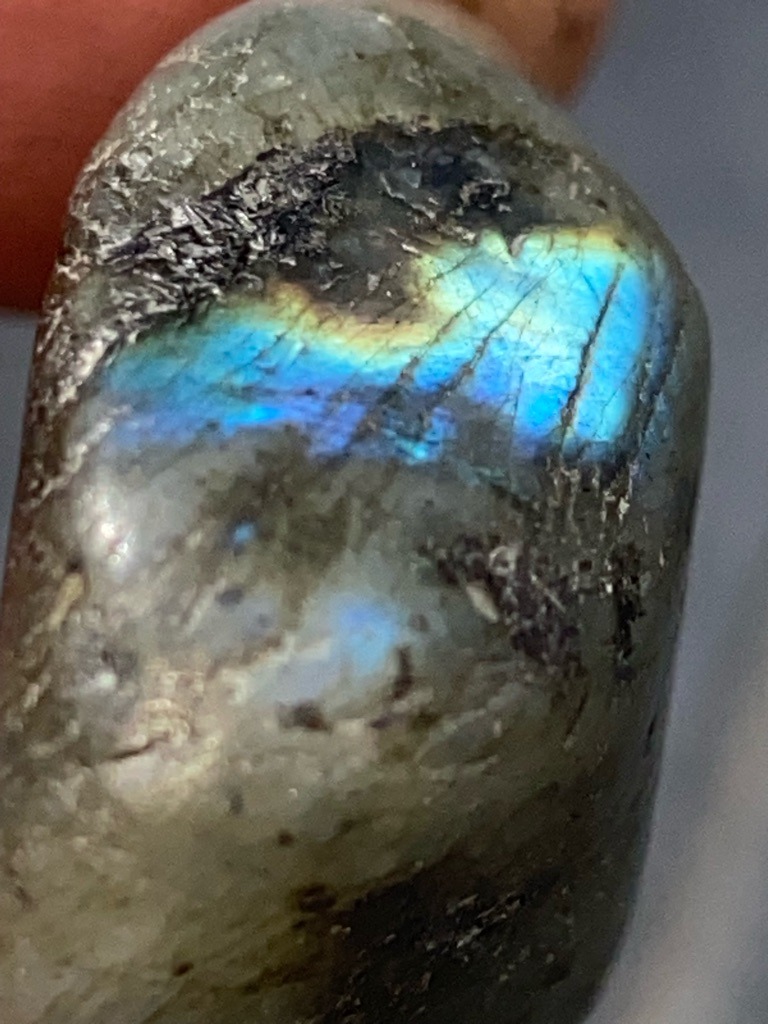
Not a diamond; this is a mineral specimen, specifically a polished piece of Labradorite feldspar exhibiting labradorescence.
Not a diamond; this is a mineral specimen, specifically a polished piece of Labradorite feldspar exhibiting labradorescence. · Irregular tumbled/freeform cabochon
Not applicable; carved and polished ornamental stone rather than a faceted diamond. Cut
Carat
Not applicable as this is not a diamond, though total weight would be measured in grams.
Color
Not applicable; displays a dark grey body color with iridescent flashes of blue, green, and yellow (labradorescence).
Clarity
Not applicable; opaque to translucent feldspar mineral with natural internal lamellar twinning planes and mineral inclusions.
Shape
Irregular tumbled/freeform cabochon
Overall Assessment
This is a misidentified specimen; the image clearly shows a piece of labradorite exhibiting its characteristic flash of spectral colors known as labradorescence, possessing zero gemological relation to a diamond.
Cut Quality
Not applicable; carved and polished ornamental stone rather than a faceted diamond.
Brilliance
Not applicable; displays optical schiller/labradorescence rather than diamond brilliance
Fire
Not applicable; displays interference colors (labradorescence) rather than prismatic fire
Scintillation
Flashes of iridescent color shift depending on the angle of observation
Proportions
Non-standard ornamental cabochon proportions
Symmetry
Asymmetrical freeform polish
Polish
Good surface polish with natural surface pitting along grain boundaries
Fluorescence
Not applicable to diamonds; may exhibit weak fluorescence under UV light depending on mineral impurities.
Inclusions
Natural mineral inclusions, fractures, and twinning planes responsible for optical interference effects
Blemishes
Natural surface pits, minor scratches, and unevenness typical of softer feldspar minerals
Origin
Commonly sourced from Madagascar, Canada (Labrador), Finland, and Australia.
Treatment Detection
Natural untreated feldspar; no enhancements detected.
Estimated Value
Low to moderate value as an ornamental gemstone or mineral specimen ($10 - $50 depending on size and play of color).
Certification Estimate
Gemological laboratories issue gemstone identification reports rather than diamond grading reports for labradorite.
Investment Potential
Low investment potential; collected for aesthetic, decorative, or metaphysical purposes rather than financial appreciation.
Similar Diamonds
None, as labradorite is a feldspar mineral and shares no optical or physical properties with diamond.
Setting Suggestions
Best set in sterling silver or custom wire-wrapped bezel settings as a pendant or statement ring.
Care & Maintenance
Soft mineral (Mohs hardness 6-6.5); avoid harsh chemicals, ultrasonic cleaners, and hard impacts to prevent scratching or cleavage fracture.
Interesting Facts
Labradorite was first discovered in the Isle of Paul in Labrador, Canada, in 1770, and Inuit legends say the Northern Lights were trapped inside the rocks.