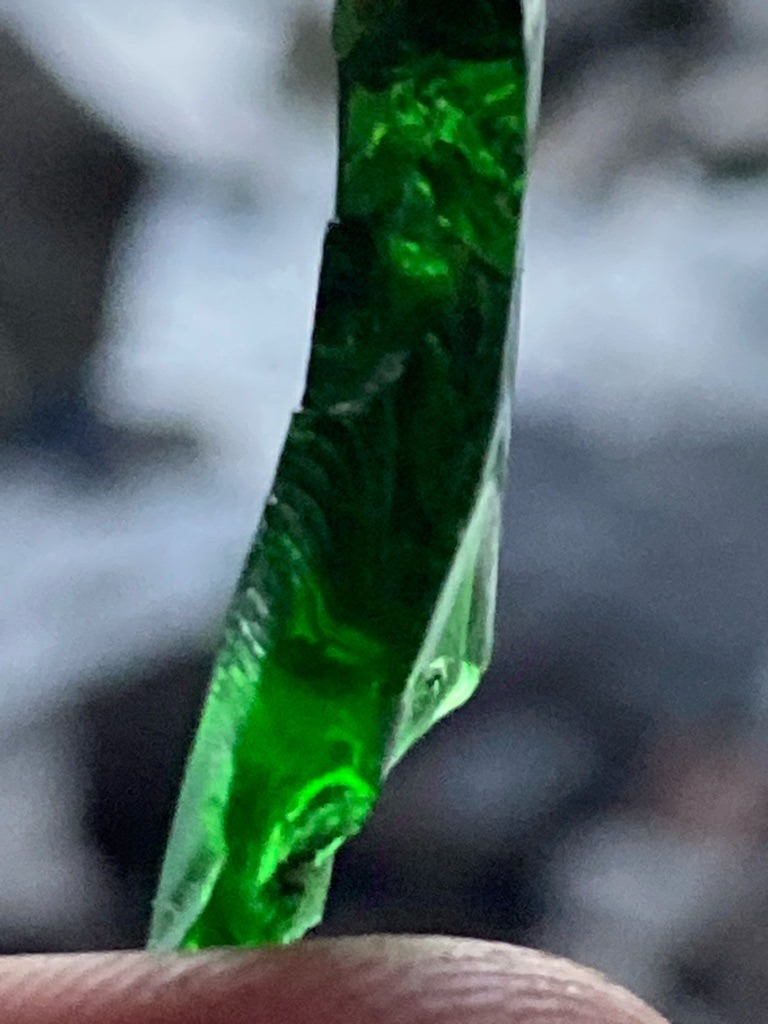
Not a diamond; this specimen appears to be green glass or synthetic glass slag, lacking the crystalline structure, hardness, and optical properties of a true diamond.
Not a diamond; this specimen appears to be green glass or synthetic glass slag, lacking the crystalline structure, hardness, and optical properties of a true diamond. · Rough uncut shard / irregular fragment
Not applicable (uncut raw fragment with conchoidal fracture) Cut
Carat
Not applicable for non-diamond material (estimated weight visually ~2.5 carats equivalent volume)
Color
Vivid Green (Fancy Intense Green appearance, though caused by coloration in glass rather than natural trace elements or radiation in diamond)
Clarity
Included (Contains visible internal bubbles and flow lines typical of manufactured glass)
Shape
Rough uncut shard / irregular fragment
Overall Assessment
The specimen shown in the image is a vibrant green glass shard rather than a diamond or precious gemstone. Its conchoidal fracture surfaces, visible internal bubbles, and vitreous luster clearly distinguish it as manufactured glass.
Cut Quality
Not applicable (uncut raw fragment with conchoidal fracture)
Brilliance
Vitreous luster, lower refractive index than diamond
Fire
Very low dispersion compared to diamond or moissanite
Scintillation
Limited due to lack of standard facet arrangement
Proportions
Irregular raw fragment, proportions do not apply
Symmetry
Asymmetrical, irregular fracture
Polish
Unpolished natural fractured surface with vitreous luster
Fluorescence
Unknown without UV testing, likely inert or weak greenish
Inclusions
Gas bubbles, swirl marks, and internal ripples characteristic of glass manufacture
Blemishes
Surface conchoidal fractures, chips, and flow lines
Origin
Man-made industrial or decorative glass (slag glass)
Treatment Detection
Contains characteristic bubbles and uneven coloration indicating glass production rather than natural gemstone formation
Estimated Value
Minimal/Decorative value only (less than $5 USD as a mineral specimen or craft material)
Certification Estimate
Gemological laboratories such as GIA or IGI would issue a report identifying this as man-made glass (slag)
Investment Potential
None; holds no monetary investment value
Similar Diamonds
None, as green diamonds are extremely rare and fundamentally different in physical and chemical composition
Setting Suggestions
Not recommended for fine jewelry due to softness and fragile nature; can be wire-wrapped for casual artisanal jewelry
Care & Maintenance
Store separately to avoid scratching softer materials, clean with mild soapy water and soft brush
Interesting Facts
Green glass is frequently mistaken for rough emerald, green tourmaline, or green diamond by untrained observers due to its striking color