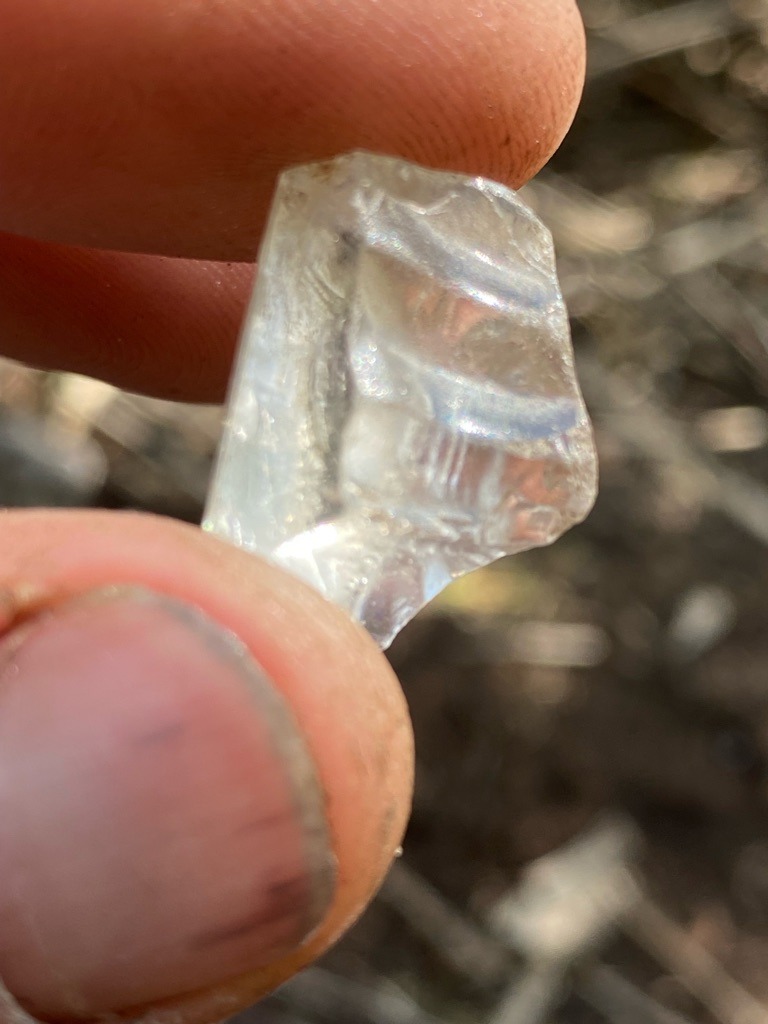
Rough Quartz or Common Glass (Potential Diamond Simulant)
Rough Quartz or Common Glass (Potential Diamond Simulant) · Irregular / Rough (Uncut)
N/A (Rough/Raw specimen) Cut
Carat
Estimated 8.00 - 15.00 carats (based on size relative to fingers)
Color
Near Colorless (Estimated I-J range if compared to diamond scale)
Clarity
Included (Contains visible fractures and internal veining)
Shape
Irregular / Rough (Uncut)
Overall Assessment
This specimen is highly unlikely to be a diamond. It lacks the characteristic isometric crystal habit of a diamond and displays fractures typical of silica-based materials like quartz or glass. It serves as a visual simulant but lacks the physical properties of a gemstone.
Cut Quality
N/A (Rough/Raw specimen)
Brilliance
Low (Due to lack of faceted surfaces)
Fire
None visible (Specimen exhibits low dispersion)
Scintillation
Poor (Surface reflection only)
Proportions
N/A (Raw state lacks geometric proportions)
Symmetry
N/A (Natural irregular form)
Polish
N/A (Natural surface texture)
Fluorescence
Indeterminable without UV light
Inclusions
Large internal fractures, planes of cleavage, and possible fluid inclusions
Blemishes
Surface abrasions, conchoidal fracturing, and impact marks
Origin
Terrestrial (Commonly found in alluvial deposits or as industrial debris)
Treatment Detection
None apparent; looks like raw mineral matter
Estimated Value
$5 - $50 (Typical for raw quartz or decorative glass fragments)
Certification Estimate
Unlikely to be certified by GIA/AGS as a diamond; would require a colored stone identification report
Investment Potential
None (Low-value common material)
Similar Diamonds
None (This specimen lacks the adamantine luster and crystal habit of a natural rough diamond)
Setting Suggestions
Wire-wrapped pendant or kept as a raw mineral specimen
Care & Maintenance
Avoid heavy impact; wash with warm soapy water
Interesting Facts
The conchoidal (shell-like) fracture visible on the edges is a primary indicator of quartz or glass rather than diamond, which has octahedral cleavage.