Natural Rough Crystal / Glassy Fragment
Natural Rough Crystal / Glassy Fragment · Rough / Uncut
Uncut / Raw gemstone Cut
Carat
Estimated 2.0 to 5.0 carats based on visual scale
Color
Near-colorless to light yellow tint (Estimated G-I range)
Clarity
Included (I1-I2 equivalent due to fractures)
Shape
Rough / Uncut
Overall Assessment
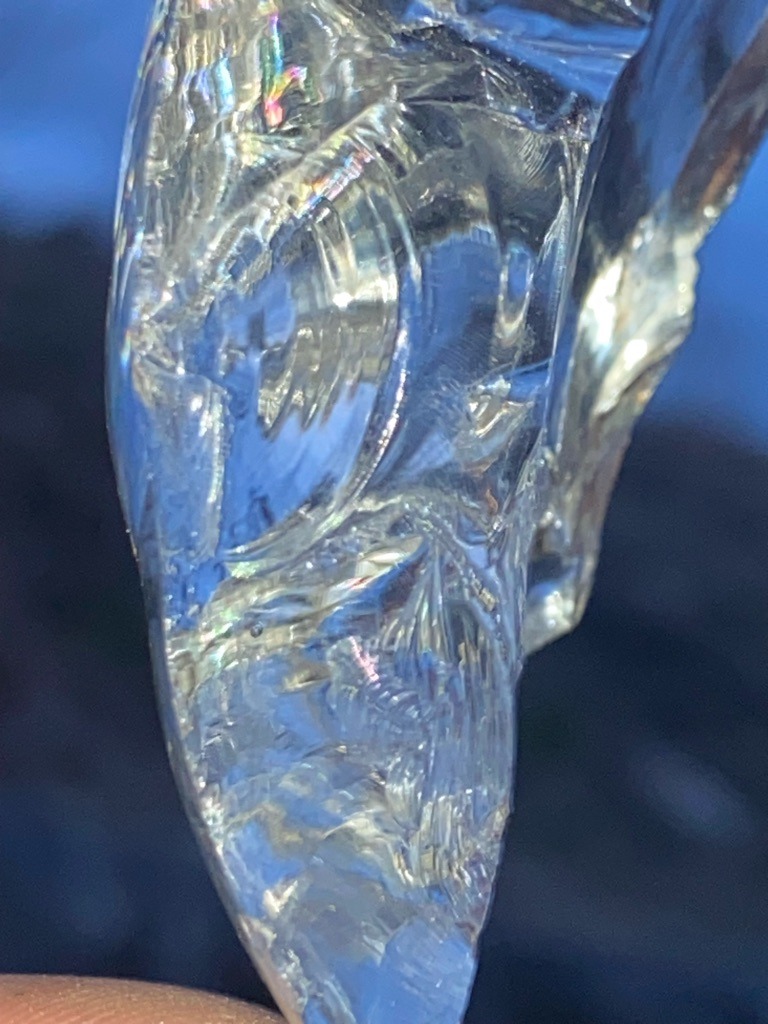
The specimen appears to be a high-luster rough mineral fragment, possibly a raw diamond or a similar gemstone like quartz or glass, characterized by significant internal fracturing and spectral fire.
Cut Quality
Uncut / Raw gemstone
Brilliance
Moderate surface luster; high internal reflection typical of high RI material
Fire
Visible spectral dispersion in fractured areas
Scintillation
Low to Moderate spark in rough state
Proportions
Asymmetrical rough crystal structure
Symmetry
None (Rough form)
Polish
Natural surface textures with conchoidal fractures
Fluorescence
Cannot be determined without UV light
Inclusions
Prominent internal fractures, glassy ripples, and potential fluid inclusions
Blemishes
Surface pitting and jagged edges typical of raw material
Origin
Likely alluvial or volcanic source if natural
Treatment Detection
No obvious signs of artificial treatment; appears raw
Estimated Value
$100 - $800 depending on actual mineral identity (higher if confirmed diamond, lower if glass/quartz)
Certification Estimate
GIA Rough Diamond Identification Report
Investment Potential
Low as a raw specimen unless significant size/clarity is confirmed after cutting
Similar Diamonds
Uncut Herkimer Diamond (Quartz) or Raw Diamond Macle
Setting Suggestions
Prong-style rough setting or wire-wrap to highlight natural form
Care & Maintenance
Avoid high heat or ultrasonic cleaning due to visible internal fractures
Interesting Facts
The conchoidal fracturing seen is common in both diamonds and glass, but diamonds often show trigonal growth marks on surface faces.