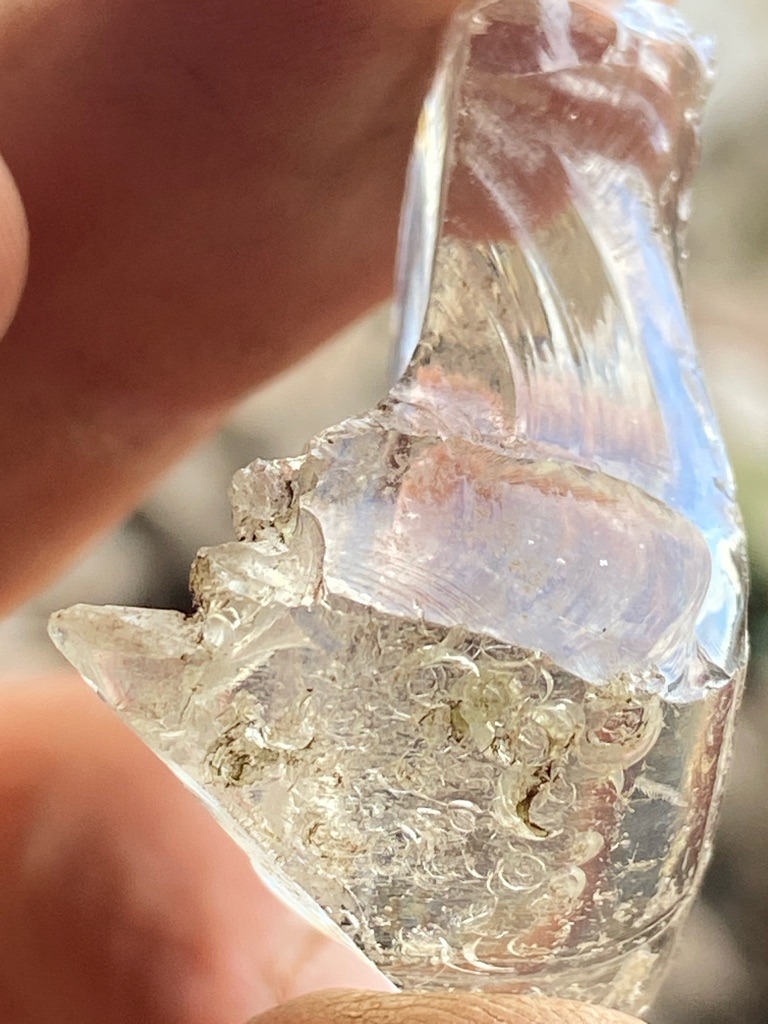
Not a diamond; this is a piece of melted glass or slag, as evidenced by the conchoidal fracture and trapped air bubbles visible in the structure.
Not a diamond; this is a piece of melted glass or slag, as evidenced by the conchoidal fracture and trapped air bubbles visible in the structure. · Irregular raw or fragment shape (Not faceted)
Not applicable (Uncut, unfaceted material) Cut
Carat
Not applicable (Rough glass fragment, weight cannot be determined visually as a gemstone)
Color
Colorless to transparent with vitreous luster
Clarity
Not applicable (Contains internal gas bubbles and flow lines typical of glass)
Shape
Irregular raw or fragment shape (Not faceted)
Overall Assessment
The specimen shown in the image is definitively not a diamond. Visual inspection reveals key diagnostic features of glass—specifically, conchoidal (shell-like) fractures and internal rounded air bubbles—which never occur in natural or lab-grown diamonds.
Cut Quality
Not applicable (Uncut, unfaceted material)
Brilliance
Poor to moderate (glass luster)
Fire
Minimal to none (glass lacks high dispersion)
Scintillation
None
Proportions
Not applicable
Symmetry
Asymmetrical fragment
Polish
Raw fractured surface with no artificial polish
Fluorescence
Unknown (requires UV testing, likely none to inert)
Inclusions
Trapped spherical gas bubbles and swirling flow lines characteristic of manufactured glass
Blemishes
Chipped edges, uneven conchoidal fracture marks
Origin
Man-made glass / industrial slag
Treatment Detection
N/A (man-made material)
Estimated Value
Minimal to negligible (scrap glass value)
Certification Estimate
Not certifiable as a gemstone by standard grading labs (GIA, IGI, etc.)
Investment Potential
None
Similar Diamonds
None (completely distinct material)
Setting Suggestions
Not suitable for jewelry setting due to low hardness and fragility
Care & Maintenance
Handle with care to avoid cuts from sharp fractured edges; clean with mild soap and water if desired
Interesting Facts
Conchoidal fracture and trapped bubbles are classic diagnostic features that easily distinguish glass from natural rough diamond crystals, which typically form in octahedral or dodecahedral crystal habits with straight edges.