Natural Diamond (or similar gemstone simulants like quartz, though assumed diamond simulation for context)
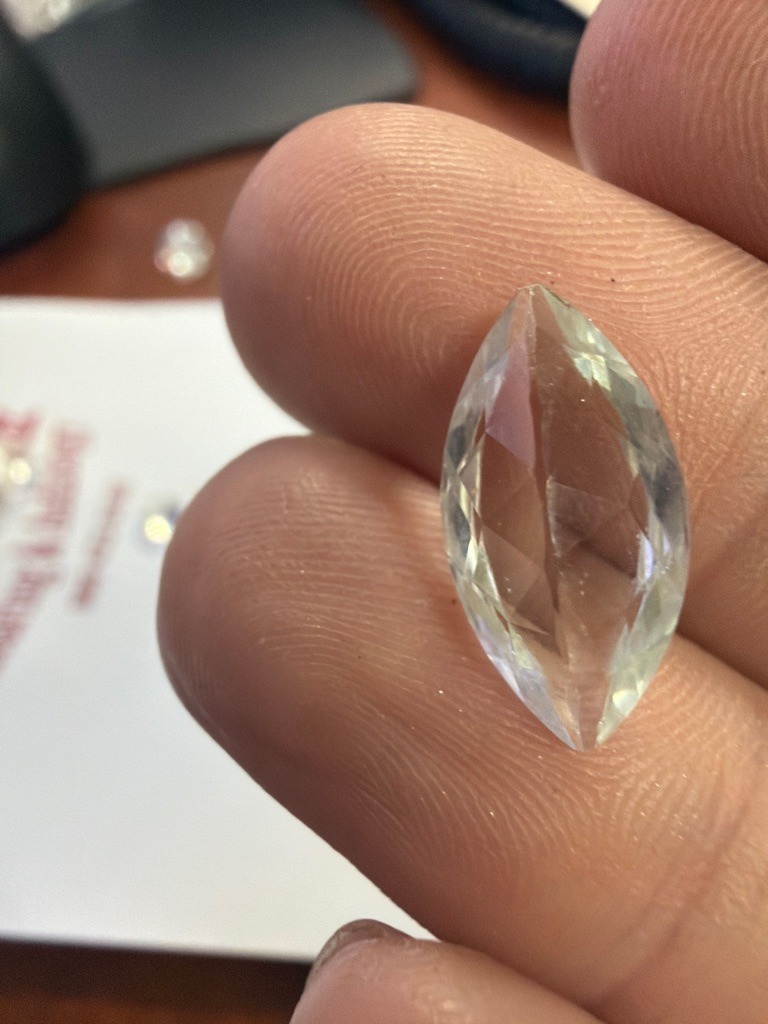
Natural Diamond (or similar gemstone simulants like quartz, though assumed diamond simulation for context) · Marquise
Very Good Cut
Carat
Estimated between 2.5 to 3.5 carats based on finger scale comparison
Color
Near Colorless (G-H range)
Clarity
VS2 to SI1
Shape
Marquise
Overall Assessment
A striking, large marquise-cut stone with good presence on the hand, requiring careful prong protection on the vulnerable tips and standard professional verification
Cut Quality
Very Good
Brilliance
Good white light reflection, though slightly reduced due to pavilion depth
Fire
Moderate spectral dispersion visible across the broader table facets
Scintillation
Fair to good flash play, standard for a step-modified marquise cutting style
Proportions
Length-to-width ratio is approximately 2:1 typical of traditional marquise cuts
Symmetry
Good, minor variations in tip alignment
Polish
Good
Fluorescence
Faint to None
Inclusions
Some minor feather inclusions and pinpoint crystals visible under magnification
Blemishes
Minor surface scratches or abrasions on the girdle and facet junctions
Origin
Natural rough source, location unknown without advanced spectroscopy
Treatment Detection
No obvious visible indications of high-pressure high-temperature (HPHT) treatment or fracture filling
Estimated Value
Depends heavily on genuine diamond confirmation; roughly $15,000 to $25,000 USD if high-grade natural
Certification Estimate
GIA or IGI grading likely with standard commercial diamond profiles
Investment Potential
Moderate, as marquise cuts fluctuate in popularity compared to round brilliants
Similar Diamonds
Standard commercial marquise-cut natural diamonds with similar weight and clarity parameters
Setting Suggestions
V-prongs or bezel settings recommended to protect the delicate pointed tips of the marquise shape, complemented by platinum or white gold
Care & Maintenance
Store individually in a fabric-lined box to prevent the pointed tips from chipping adjacent jewelry, clean with warm soapy water and a soft brush
Interesting Facts
The marquise cut dates back to the 18th century, commissioned by King Louis XV of France to resemble the smile of the Marchioness of Pompadour