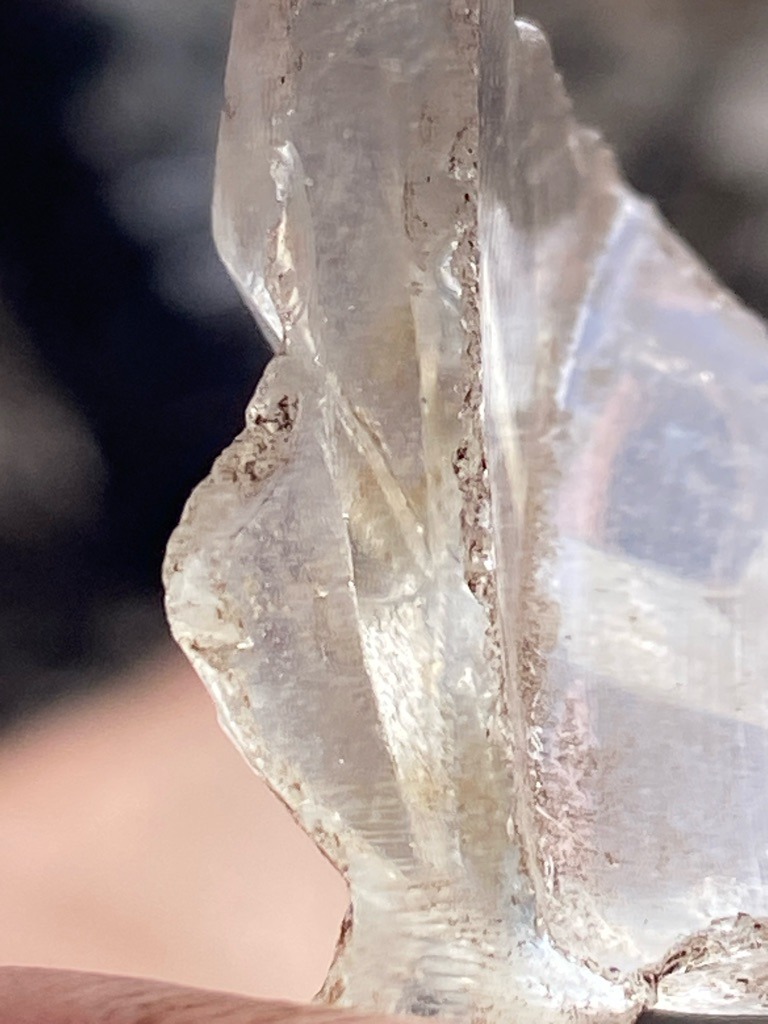
Not a diamond; this specimen appears to be rough, untreated quartz crystal or a similar silicate mineral matrix rather than crystallized carbon.
Not a diamond; this specimen appears to be rough, untreated quartz crystal or a similar silicate mineral matrix rather than crystallized carbon. · Rough uncut crystal specimen with natural irregular formation and fracture planes.
Not applicable (uncut rough mineral). Cut
Carat
Cannot be accurately determined as carat weight applies strictly to cut gemstones; estimated weight as a rough mineral specimen is approximately 15-25 carats equivalent.
Color
Colorless to very pale white with slight brownish-yellow matrix staining.
Clarity
Included / I3 equivalent due to numerous internal natural fractures, growth planes, and surface impurities.
Shape
Rough uncut crystal specimen with natural irregular formation and fracture planes.
Overall Assessment
This is a natural, unpolished rough mineral crystal (likely quartz) rather than a diamond. It features distinct natural striations, growth lines, and iron staining, making it a fascinating geological sample but lacking the hardness, optics, and value of a diamond.
Cut Quality
Not applicable (uncut rough mineral).
Brilliance
Low to moderate vitreous luster typical of rough quartz rather than diamond adamantine brilliance.
Fire
Minimal dispersion/fire due to the lack of precision facet angles and lower refractive index compared to diamond.
Scintillation
Limited, reflecting light in broad flashes off natural crystal faces rather than a faceted sparkle pattern.
Proportions
Irregular raw crystal habit; standard table, depth, and angle measurements do not apply.
Symmetry
Naturally asymmetrical due to raw geological formation.
Polish
Raw, unpolished natural crystal faces showing striations and matrix growth.
Fluorescence
Unknown / Not tested under ultraviolet light, though standard quartz often shows inert to faint blue/yellow luminescence.
Inclusions
Heavy internal feather fractures, cleavage planes, and localized iron-oxide staining along fissures.
Blemishes
Natural surface etching, rough edges, chips, and adhering matrix minerals.
Origin
Natural geological formation, likely from a pegmatite or hydrothermal vein deposit.
Treatment Detection
No evidence of artificial enhancement; appears completely natural and untreated.
Estimated Value
Nominal value as a rough mineral specimen (under $20 USD), primarily of educational or decorative interest.
Certification Estimate
Not applicable for major gemological labs (GIA, AGS) as this is not a gemstone-quality diamond; standard mineralogical verification by GIA or local gem lab would identify it as quartz.
Investment Potential
None; this specimen holds no financial investment or commodity value.
Similar Diamonds
None, as this specimen is chemically and structurally distinct from diamond.
Setting Suggestions
Wire-wrapping or organic bezel setting if used in artisan jewelry as a raw crystal pendant.
Care & Maintenance
Clean gently with warm soapy water and a soft brush; avoid harsh acids or sudden thermal shock.
Interesting Facts
Quartz is one of the most abundant minerals on Earth, composed of silicon and oxygen, completely distinct from the pure carbon lattice of a diamond.