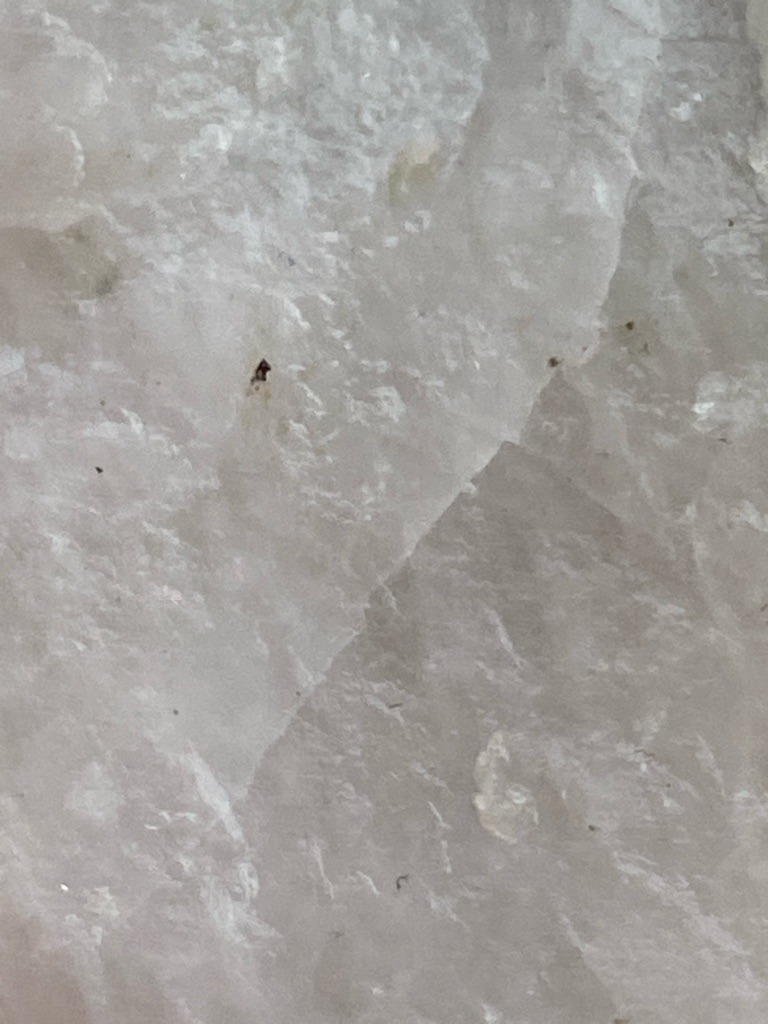
The provided image does not display a cut and polished diamond, but rather appears to be a close-up macro view of rough mineral matrix or aggregate, likely quartz or quartzite rather than crystallized diamond rough.
The provided image does not display a cut and polished diamond, but rather appears to be a close-up macro view of rough mineral matrix or aggregate, likely quartz or quartzite rather than crystallized diamond rough. · Uncut or raw crystalline structure, not applicable for a traditional cut shape.
Not applicable as this is raw unpolished mineral matrix. Cut
Carat
Cannot be accurately determined from this micro-texture image without scale or depth measurements.
Color
Milky white to translucent gray tones visible in the matrix.
Clarity
Heavy internal cloudiness, fractures, and dark mineral inclusions, characteristic of lower-grade or industrial aggregate material.
Shape
Uncut or raw crystalline structure, not applicable for a traditional cut shape.
Overall Assessment
The visual data indicates a macro shot of a raw, unpolished mineral aggregate (likely quartz or similar host rock) rather than a gemstone diamond. Gemological evaluation does not apply.
Cut Quality
Not applicable as this is raw unpolished mineral matrix.
Brilliance
Minimal to none, due to the opaque and fractured nature of the raw material.
Fire
Absent, as the material lacks faceted dispersion qualities.
Scintillation
Negligible, lacking facet arrangements necessary to create alternating dark and bright patterns.
Proportions
Not applicable due to lack of standard faceted proportions (table, depth, angles).
Symmetry
Natural irregular cleavage and fracture patterns without symmetrical faceting.
Polish
Unpolished, rough natural surface texture with visible grain and fracture planes.
Fluorescence
Cannot be determined without ultraviolet (UV) lighting testing.
Inclusions
Visible dark mineral spots, internal fractures, and cloudiness throughout the crystalline matrix.
Blemishes
Surface irregularities, chips, and rough cleavage planes inherent to the raw mineral.
Origin
Terrestrial mineral deposit, likely widespread quartz or pegmatite matrix.
Treatment Detection
No obvious signs of artificial enhancement; appears completely untreated and natural.
Estimated Value
Nominal value, primarily of geological or decorative rock specimen interest rather than gem value.
Certification Estimate
Standard gemological laboratories like GIA or IGI would not grade this as a diamond; it would require mineralogical analysis (e.g., Raman spectroscopy) to confirm exact species.
Investment Potential
Low investment value as a gemstone; primarily of interest to mineral collectors.
Similar Diamonds
None, as this material is not a gemstone-quality diamond.
Setting Suggestions
Suitable for wire-wrapping or organic, raw-mineral jewelry designs if durable enough.
Care & Maintenance
Standard cleaning with warm soapy water and a soft brush; avoid harsh acids depending on exact mineral composition.
Interesting Facts
Raw mineral matrices often showcase fascinating natural fracture patterns and inclusion formations that tell the geological history of the Earth's crust.