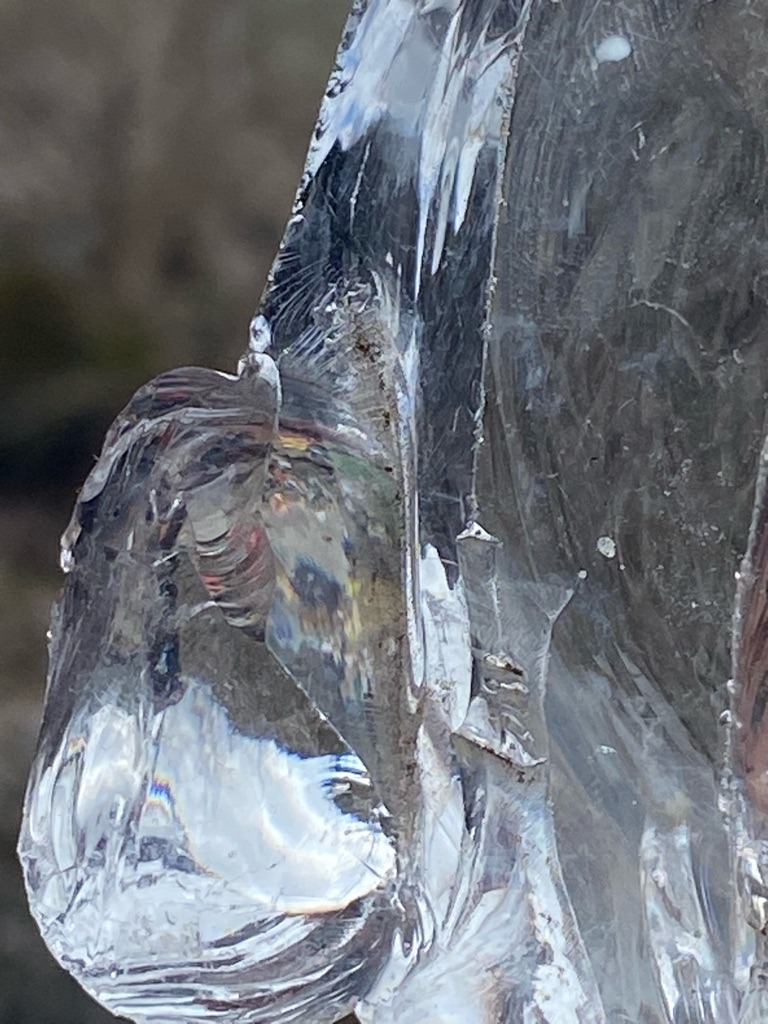
The provided image displays a transparent, crystalline material that does not exhibit characteristics of a cut diamond; it appears to be a natural mineral specimen such as Quartz or a piece of glass/industrial material.
The provided image displays a transparent, crystalline material that does not exhibit characteristics of a cut diamond; it appears to be a natural mineral specimen such as Quartz or a piece of glass/industrial material. · Irregular/Rough; this material is not cut or faceted into a gemstone shape.
None; the item is un-faceted and in a raw or broken state. Cut
Carat
Unknown; weight cannot be estimated from a macro image without scale references.
Color
Colorless with some grayish/white translucency.
Clarity
Low/Included; shows significant internal fracturing, bubbles, and cloudiness.
Shape
Irregular/Rough; this material is not cut or faceted into a gemstone shape.
Overall Assessment
The specimen in the photograph does not possess the physical, optical, or structural properties of a diamond. It is likely a piece of decorative glass, slag, or a common mineral like rock crystal quartz.
Cut Quality
None; the item is un-faceted and in a raw or broken state.
Brilliance
Very Low; lacks the refractive properties of a diamond to return white light.
Fire
Minimal to none; low dispersion observed compared to high-refractive-index gemstones.
Scintillation
Negligible; no pattern of light and dark due to lack of faceting.
Proportions
Not applicable; lacks geometric gemstone facets.
Symmetry
Poor/Asymmetric; natural irregular morphology.
Polish
None; surface displays natural growth striations or conchoidal fracture patterns rather than mechanical polish.
Fluorescence
Indeterminate from visual inspection without a UV light source.
Inclusions
Heavy internal fracturing, visible flow lines, and potential gas bubbles/mineral inclusions.
Blemishes
Severe surface abrasions, jagged edges, and chips consistent with bulk glass or raw mineral specimens.
Origin
Likely a natural silica-based mineral (Quartz) or a man-made glass byproduct (cullet).
Treatment Detection
N/A; shows no signs of gemstone enhancement, looks like raw industrial material.
Estimated Value
Minimal to none as a gemstone; value would be based on mineral specimen weight if decorative.
Certification Estimate
N/A; major laboratories like GIA or AGS would likely not certify this as a diamond.
Investment Potential
None; zero resale value in the diamond or gemstone luxury market.
Similar Diamonds
None; this specimen is not comparable to commercial gemstones.
Setting Suggestions
Not recommended for traditional jewelry settings due to high fragility and lack of refractive beauty.
Care & Maintenance
Avoid impact; the specimen shows brittle fracture characteristics and is prone to further chipping.
Interesting Facts
The conchoidal fractures visible are highly characteristic of glass or volcanic minerals rather than the octahedral cleavage typically found in diamonds.