Natural rough diamond (or more likely an unpolished industrial diamond/carbonado specimen, though visual assessment of a raw stone cannot definitively rule out non-diamond mineral aggregates like slag, hematite, or basalt without physical testing)
Natural rough diamond (or more likely an unpolished industrial diamond/carbonado specimen, though visual assessment of a raw stone cannot definitively rule out non-diamond mineral aggregates like slag, hematite, or basalt without physical testing) · Rough, uncut, unpolished crystal aggregate / irregular nodule
Not Applicable (Uncut rough stone) Cut
Carat
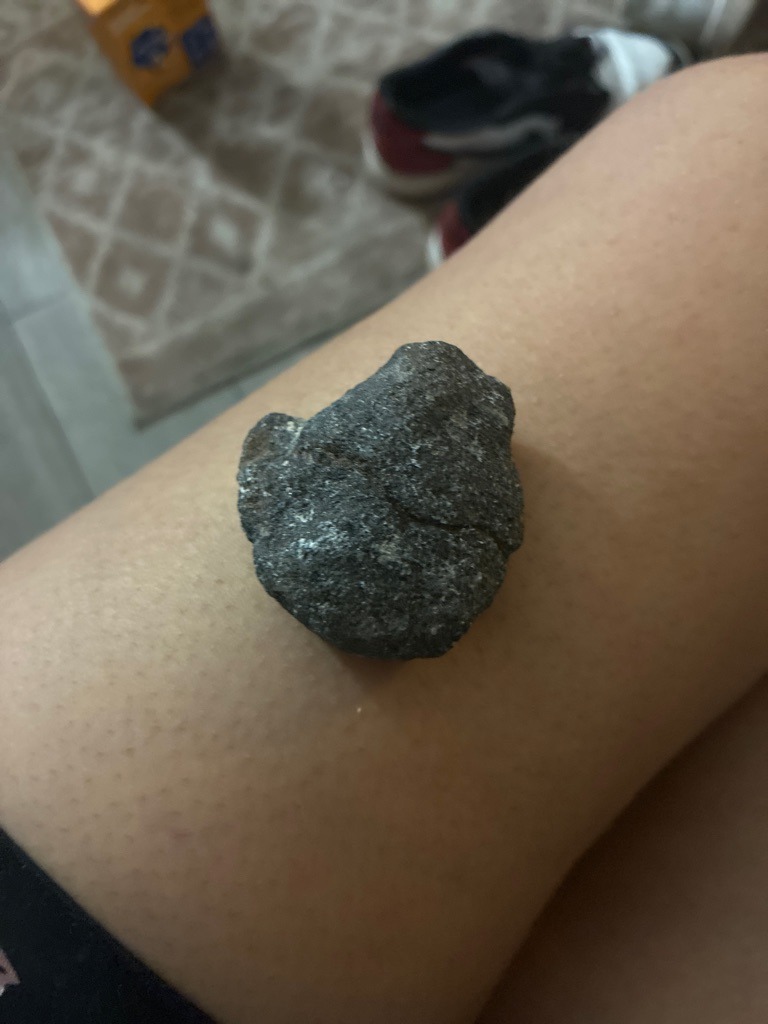
Estimated 15 to 25 carats based on size relative to human skin scale
Color
Dark grey to opaque black (Industrial grade / Bort)
Clarity
Included / Imperfect (Opaque with heavy internal fracturing and inclusions)
Shape
Rough, uncut, unpolished crystal aggregate / irregular nodule
Overall Assessment
The uploaded image appears to show a dark, rough, unpolished mineral specimen or industrial-grade rough diamond nodule resting on a leg. Because it lacks facets, transparency, and standard gemological proportions, traditional diamond grading metrics (cut, color, clarity on the D-Z/FL-I scales) do not apply. Professional physical and chemical testing (such as a thermal conductivity tester, specific gravity test, or Raman spectroscopy) is strongly recommended to confirm the exact mineral composition.
Cut Quality
Not Applicable (Uncut rough stone)
Brilliance
None (Opaque material does not permit internal light reflection)
Fire
None (No spectral dispersion due to opacity)
Scintillation
None
Proportions
Not Applicable (Uncut stone lacking standard facets, table, and depth percentages)
Symmetry
Asymmetrical natural crystal form
Polish
Unpolished, natural rough surface texture
Fluorescence
Cannot be determined without UV light testing (typically inert to faint in industrial dark stones)
Inclusions
Dense internal clouding, feathers, fractures, and foreign mineral impurities
Blemishes
Natural surface pitting, rough skin, growth lines, and abrasions
Origin
Natural alluvial or primary kimberlite pipe deposit origin
Treatment Detection
No obvious signs of artificial enhancement; appears completely untreated and in its natural raw state
Estimated Value
Nominal value (Industrial rough diamonds or carbonado-type specimens generally range from $10 to $50 per carat depending on industrial utility or mineral specimen collector value)
Certification Estimate
Major gemological labs (GIA, IGI) would typically issue a 'Gemological Identification Report' for rough stones rather than a standard cut diamond grading report, noting it as natural rough industrial diamond or mineral aggregate.
Investment Potential
Low investment potential; industrial and lower-grade rough stones do not appreciate significantly like investment-grade polished diamonds
Similar Diamonds
Industrial-grade boart, carbonado (black diamond) rough, or low-quality alluvial rough diamonds
Setting Suggestions
Best suited for wire-wrapping, organic raw stone jewelry designs, or as a raw mineral specimen in a collection
Care & Maintenance
Clean with mild soapy water and a soft brush; avoid harsh ultrasonic cleaners due to potential hidden internal fractures that could cause the rough stone to split
Interesting Facts
Rough diamonds straight from the earth often look deceptively like ordinary pebbles, masking their extreme hardness until tested.