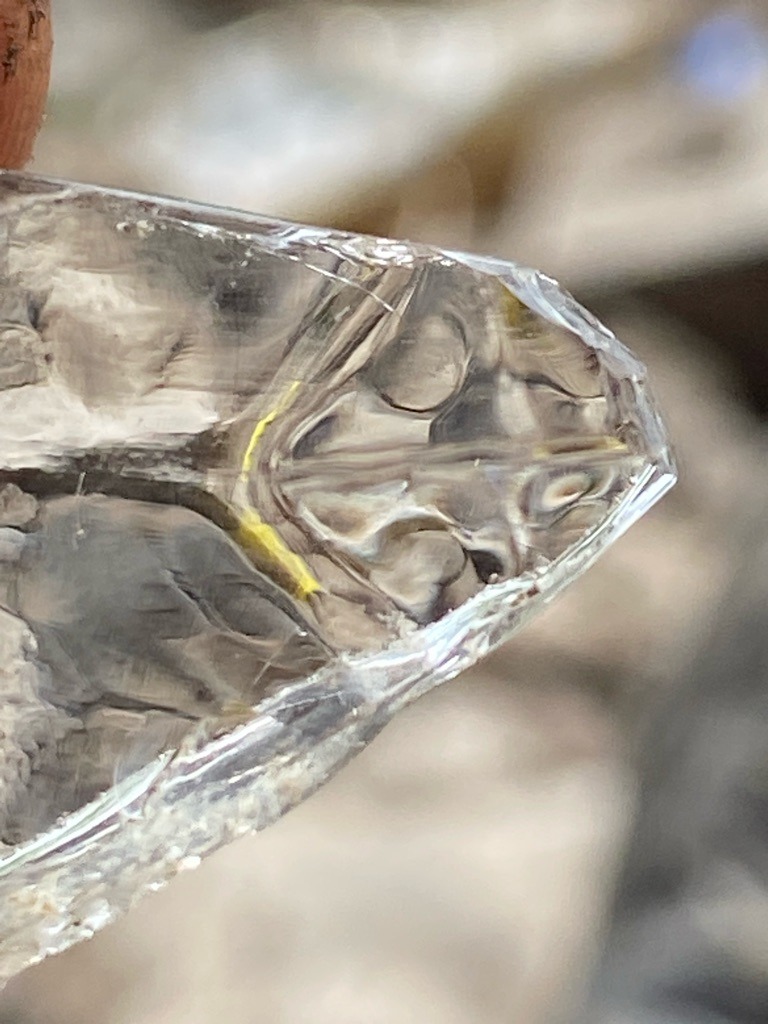
Quartz or Glass Imitation / Rough Crystal Fragment
Quartz or Glass Imitation / Rough Crystal Fragment · Irregular / Rough Fragment
Not Applicable (Rough, unpolished mineral fragment or molded glass) Cut
Carat
Cannot accurately determine from the portion shown, estimated > 5.0 carats based on visible scale
Color
Colorless / Transparent with inclusions
Clarity
I3 (Included with prominent internal fractures and bubbles/cavities visible)
Shape
Irregular / Rough Fragment
Overall Assessment
The specimen shown in the image lacks the characteristic crystal faces, adamantine luster, and optical properties of a diamond, appearing instead to be a raw mineral fragment or glass imitation.
Cut Quality
Not Applicable (Rough, unpolished mineral fragment or molded glass)
Brilliance
Low to Moderate due to poor optical clarity and heavy internal flaws
Fire
Very Low
Scintillation
Poor due to lack of standard facet alignment
Proportions
Not Applicable
Symmetry
Not Applicable
Polish
Raw / Unpolished fracture surfaces with mold-like features
Fluorescence
Unknown (Requires UV testing)
Inclusions
Heavy internal fracturing, concoidal fractures, and bubble-like cavities visible
Blemishes
Rough surface edges, chipping, and irregular surface texture
Origin
Natural quartz or synthetic glass imitation
Treatment Detection
Possible melted or molded glass indicators visible in cavity structures
Estimated Value
Minimal value as a mineral specimen or glass piece (under $10)
Certification Estimate
Not certifiable as a diamond by standard gemological laboratories (GIA, IGI, AGS)
Investment Potential
None
Similar Diamonds
None (this specimen does not share optical or physical properties with gem-grade diamonds)
Setting Suggestions
Not suitable for fine jewelry setting in its current state
Care & Maintenance
Standard gentle cleaning with warm soapy water if kept as a mineral specimen
Interesting Facts
The conchoidal fracture patterns and rounded internal cavities strongly suggest quartz, beryl, or even molded glass rather than crystalline diamond.