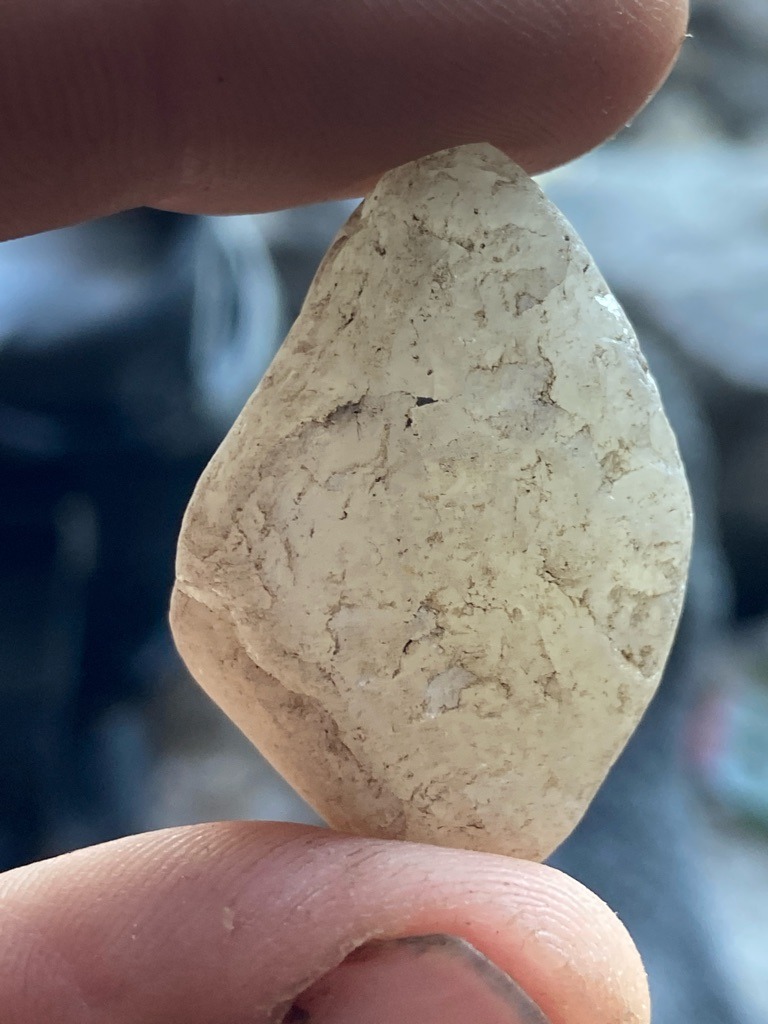
Natural rough stone (likely quartz, quartzite, or heavily included low-grade industrial diamond/bort, but visually consistent with alluvial quartz or silicate mineral given the heavy surface weathering and lack of crystal faces)
Natural rough stone (likely quartz, quartzite, or heavily included low-grade industrial diamond/bort, but visually consistent with alluvial quartz or silicate mineral given the heavy surface weathering and lack of crystal faces) · Irregular rough pebble / Rounded rough form
Not applicable (Rough, unpolished, water-worn pebble) Cut
Carat
Estimated 8.0 - 12.0 carats based on volume
Color
Off-white / Yellowish-brown heavily stained
Clarity
I3 / Heavily Included (opaque due to internal fractures and surface matrix)
Shape
Irregular rough pebble / Rounded rough form
Overall Assessment
Based on visual inspection, the specimen displayed is heavily weathered, opaque, and fractured. It lacks the optical properties, transparency, and crystalline structure typical of gem-grade diamonds, strongly suggesting it is either industrial-grade material or a non-diamond silicate mineral such as quartz.
Cut Quality
Not applicable (Rough, unpolished, water-worn pebble)
Brilliance
None (opaque and unpolished)
Fire
None
Scintillation
None
Proportions
Not applicable to rough stones
Symmetry
Poor / Irregular natural asymmetry
Polish
Unpolished natural rough surface with alluvial wear
Fluorescence
Cannot be determined without UV testing
Inclusions
Dense network of internal fractures, feathers, and mineral staining along fissure planes
Blemishes
Extensive surface pitting, abrasion, and natural weathering marks
Origin
Alluvial deposit (riverbed or secondary surface deposit)
Treatment Detection
No signs of artificial enhancement; surface features are entirely natural wear
Estimated Value
Minimal to negligible gem value (nominal value as a mineral specimen)
Certification Estimate
Major laboratories like GIA or IGI would typically decline grading unpolished industrial rough or non-gem mineral specimens without advanced spectroscopic testing confirming diamond species.
Investment Potential
None; lacks gem-quality characteristics and market liquidity
Similar Diamonds
Industrial grade diamond bort or heavy mineral quartz pebbles
Setting Suggestions
Not suitable for standard jewelry settings in its current rough, opaque state; requires professional lapidary work or wire-wrapping if displayed raw.
Care & Maintenance
Standard cleaning with mild soap and warm water; avoid harsh acids depending on true mineral composition
Interesting Facts
Stones found in riverbeds often exhibit a frosted, pitted skin known as frosting, caused by natural abrasion during transport.