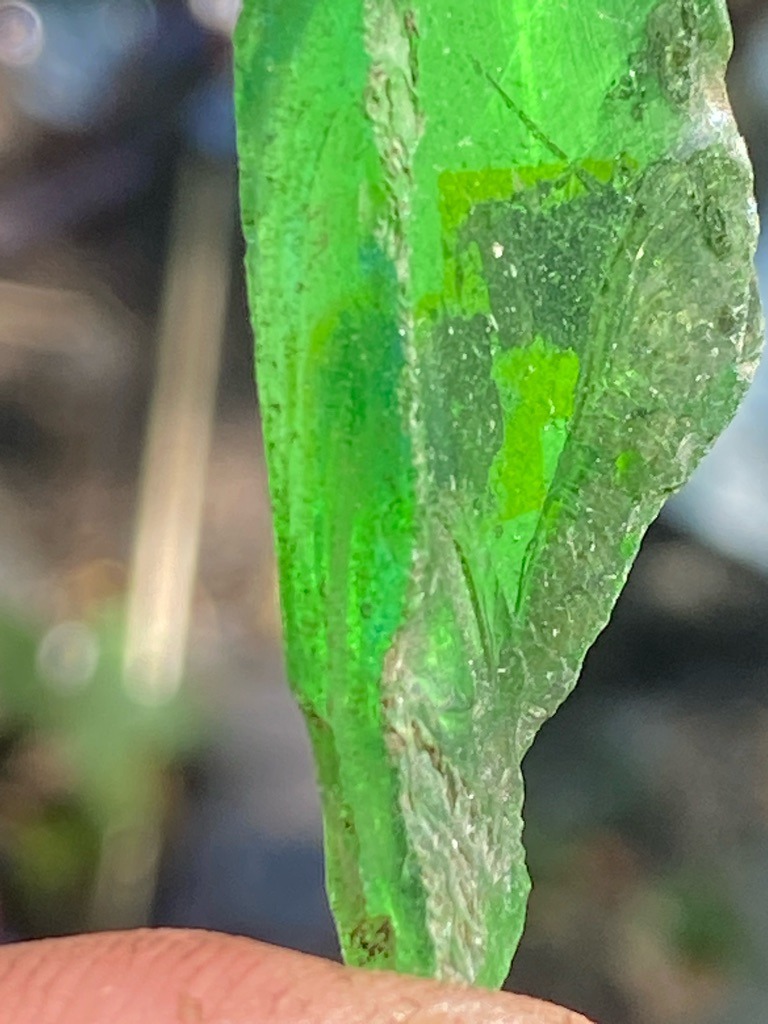
Not a diamond; this is a piece of green sea glass or weathered glass.
Not a diamond; this is a piece of green sea glass or weathered glass. · Irregular, raw, unstructured shard fragment.
Not applicable; naturally worn or broken shard. Cut
Carat
Not applicable (measured in grams for glass).
Color
Vivid green hue, typical of art glass or bottle glass.
Clarity
Transparent to translucent with internal flow lines and bubbles typical of glass.
Shape
Irregular, raw, unstructured shard fragment.
Overall Assessment
This item is an interesting fragment of green glass often collected as sea glass, with no gemological relation to a diamond.
Cut Quality
Not applicable; naturally worn or broken shard.
Brilliance
Low to moderate, glassy luster.
Fire
None, as glass lacks the high refractive index and dispersion of diamond.
Scintillation
Minimal, limited to surface reflections off the flat glassy planes.
Proportions
Irregular flat shard with variable thickness.
Symmetry
Asymmetrical due to random breakage.
Polish
Matte, frosted, and weathered by natural abrasion.
Fluorescence
Unknown without UV testing, though some green glasses fluoresce mildly.
Inclusions
Internal gas bubbles and flow lines characteristic of manufactured glass.
Blemishes
Surface scratches, pitting, and abrasion from environmental wear.
Origin
Man-made glass container or fragment found in nature.
Treatment Detection
None applicable as it is artificial glass.
Estimated Value
Nominal/decorative value (less than $1 as beach/sea glass).
Certification Estimate
None; gemological laboratories (GIA, IGI) do not grade glass.
Investment Potential
None as a gemstone or investment asset.
Similar Diamonds
None; visually and chemically distinct from all diamond types.
Setting Suggestions
Wire-wrapping or bezel settings if used for artisanal jewelry.
Care & Maintenance
Standard cleaning with mild soap and water; avoid harsh impacts to prevent chipping.
Interesting Facts
Green glass often derives its color from iron oxide or chromium traces introduced during manufacturing.