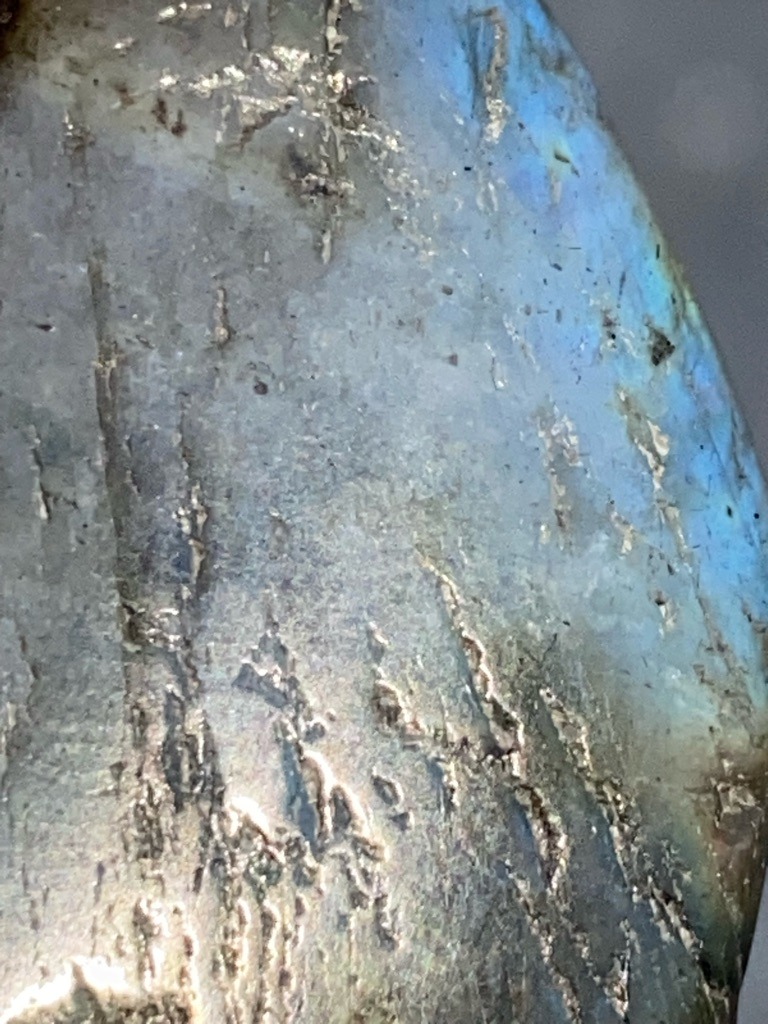
Not a diamond; this is a mineral, specifically Labradorite (feldspar) showing labradorescence.
Not a diamond; this is a mineral, specifically Labradorite (feldspar) showing labradorescence. · Irregular / Cabochon or rough slab structure, not faceted.
Not applicable; unpolished or minimally worked mineral specimen. Cut
Carat
Not applicable; typically measured in grams for minerals.
Color
Grayish-green body color with iridescent blue and gold schiller/flash.
Clarity
Not applicable; contains natural cleavage planes, inclusions, and fractures typical of feldspar.
Shape
Irregular / Cabochon or rough slab structure, not faceted.
Overall Assessment
This specimen is a classic example of labradorite feldspar displaying characteristic optical interference effects, entirely distinct from diamond.
Cut Quality
Not applicable; unpolished or minimally worked mineral specimen.
Brilliance
Low to moderate vitreous to pearly luster, superseded by optical labradorescence.
Fire
None; displays interference colors (labradorescence) rather than dispersion.
Scintillation
Flashes of blue and gold light shifting with the angle of observation.
Proportions
Not applicable for faceted gemstones.
Symmetry
Asymmetrical, natural mineral formation.
Polish
Matte to natural surface finish with visible striations and cleavage steps.
Fluorescence
Inert to faint, typical of feldspar group minerals.
Inclusions
Natural twin planes, internal fractures, and lamellar twinning.
Blemishes
Natural surface pitting, rough texture, and weathering.
Origin
Commonly sourced from Madagascar, Canada, Finland, or Russia.
Treatment Detection
No treatments detected; natural mineral state.
Estimated Value
Nominal decorative or specimen value, typically very low compared to precious gemstones.
Certification Estimate
Gemological identification report from GIA or equivalent confirming Labradorite.
Investment Potential
Low; collected for mineral specimen and ornamental value rather than investment.
Similar Diamonds
None, as this is a feldspar mineral and not a diamond.
Setting Suggestions
Wire-wrapped or bezel setting in sterling silver or copper for artisan jewelry.
Care & Maintenance
Avoid harsh chemicals, ultrasonic cleaners, and sudden temperature changes due to perfect cleavage.
Interesting Facts
Labradorite exhibits a phenomenon called labradorescence, caused by light diffraction in microscopic lamellae layers.