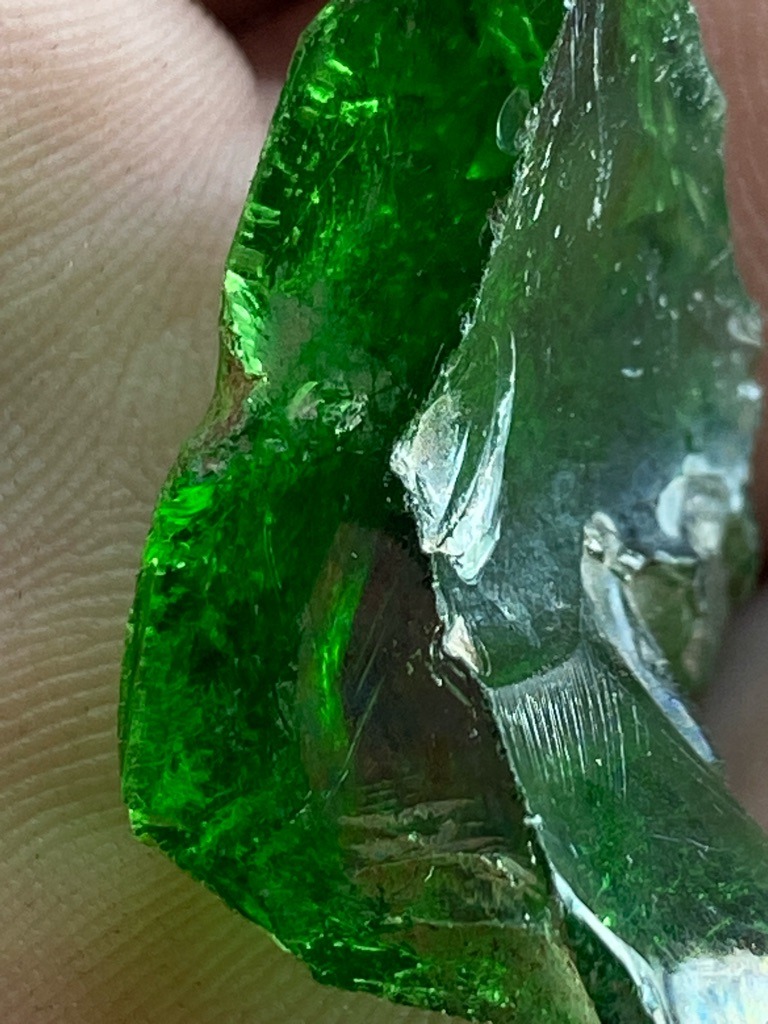
Not a diamond; this specimen appears to be green glass or a green mineral aggregate (such as green quartz, glass slag, or rough tsavorite garnet), lacking the characteristic cubic crystal habit, high refractive index, and adamantine luster of diamond.
Not a diamond; this specimen appears to be green glass or a green mineral aggregate (such as green quartz, glass slag, or rough tsavorite garnet), lacking the characteristic cubic crystal habit, high refractive index, and adamantine luster of diamond. · Raw, unpolished rough crystal fragment with conchoidal fracture typical of glass or quartz.
Not applicable (rough, uncut, unpolished material). Cut
Carat
Estimated around 3.5 to 5.0 carats equivalent weight based on visual proportions.
Color
Vivid intense green (Fancy Green equivalent if it were gemstone material).
Clarity
Included with internal fracture lines and bubbles/inclusions characteristic of glass.
Shape
Raw, unpolished rough crystal fragment with conchoidal fracture typical of glass or quartz.
Overall Assessment
The specimen shown is visually identified as green glass or a non-diamond mineral rather than a genuine diamond, exhibiting characteristic conchoidal fracture and surface wear inconsistent with diamond properties.
Cut Quality
Not applicable (rough, uncut, unpolished material).
Brilliance
Vitreous to dull luster, lacking diamond-like brilliance.
Fire
Minimal to none; lacks the high dispersion of diamond.
Scintillation
Poor due to lack of facet arrangement.
Proportions
Irregular raw crystal form; standard table and depth percentages do not apply.
Symmetry
Asymmetrical raw specimen.
Polish
Raw fractured surfaces, no optical polish.
Fluorescence
Indeterminate without UV testing, likely none to inert.
Inclusions
Conchoidal fracture lines, internal striations, and potential gas bubbles.
Blemishes
Surface scratches, chipped edges, and uneven raw texture.
Origin
Likely manufactured green glass slag or common green silicate mineral.
Treatment Detection
Appears to be man-made or untreated raw raw material, though colored glass is inherently synthetic.
Estimated Value
Nominal value as a decorative mineral specimen or collector glass piece ($5 to $20 USD).
Certification Estimate
Not eligible for diamond certification (GIA/AGS/IGI would reject as non-diamond).
Investment Potential
None; this specimen holds no financial investment value.
Similar Diamonds
None, as natural green diamonds of this saturation are extremely rare and valuable type Ia or Ib stones.
Setting Suggestions
Not recommended for fine jewelry due to softness and lack of durability compared to diamond.
Care & Maintenance
Avoid harsh chemicals, ultrasonic cleaners, and impact, as glass or soft minerals scratch easily.
Interesting Facts
Green-colored rough stones found outdoors are frequently industrial slag glass rather than precious gems.