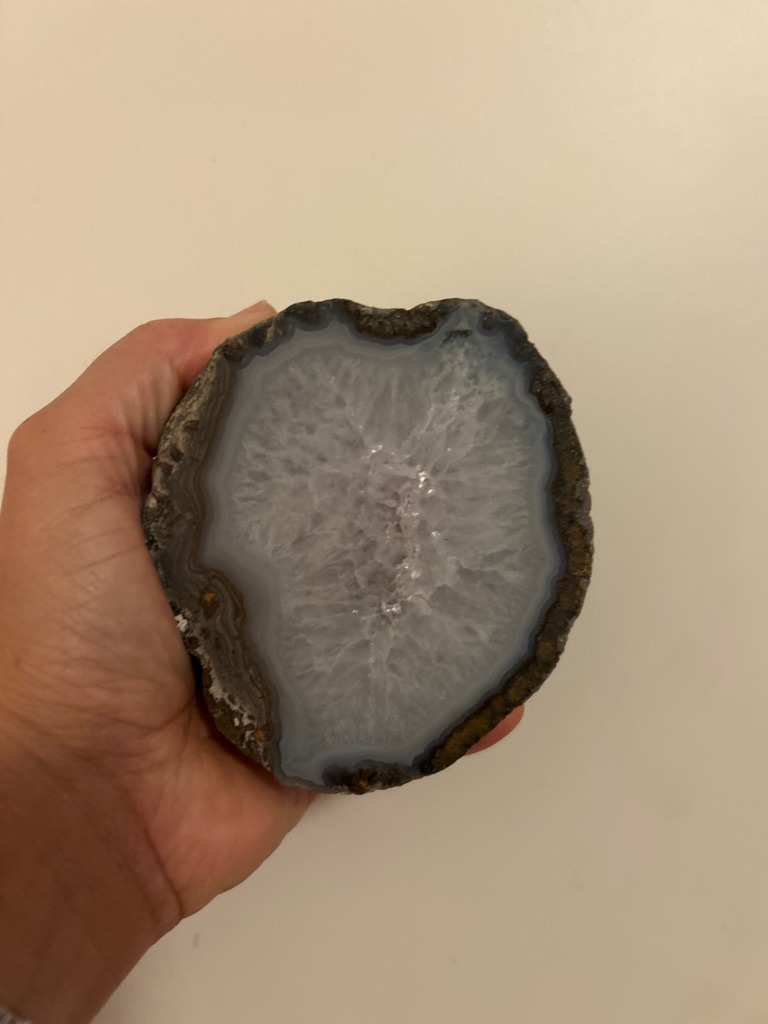
Not a diamond; this is a mineral specimen, specifically an agate or chalcedony nodule slice (quartz variety).
Not a diamond; this is a mineral specimen, specifically an agate or chalcedony nodule slice (quartz variety). · Freeform slice/nodule cross-section.
Not applicable; polished slab rather than a faceted gemstone cut. Cut
Carat
Not applicable; gemstone specimen typically measured in grams (estimated 150-250g).
Color
Grayish-white with translucent banding and potential druzy quartz center.
Clarity
Not applicable to chalcedony/agate; contains natural microcrystalline inclusions and banding.
Shape
Freeform slice/nodule cross-section.
Overall Assessment
This is a visually striking and aesthetically pleasing natural agate slice displaying characteristic concentric banding and a crystalline center, serving well as a decorative mineral specimen.
Cut Quality
Not applicable; polished slab rather than a faceted gemstone cut.
Brilliance
Vitreous to waxy luster typical of chalcedony, with occasional sparkle from central quartz crystals.
Fire
None; quartz and chalcedony do not exhibit significant dispersion (fire).
Scintillation
Limited to light reflection off the flat polished surface and any central druzy crystals.
Proportions
Not applicable; slab format.
Symmetry
Asymmetrical, natural organic formation.
Polish
Smoothly polished flat face with a rough, natural outer rind (cortex).
Fluorescence
Variable depending on mineral composition, often inert or weak greenish/blue under UV if organic inclusions are present.
Inclusions
Natural concentric banding, microcrystalline quartz structures, and potential crystalline druzy pockets in the center.
Blemishes
Natural surface pits, fractures, or matrix remnants along the outer rind.
Origin
Global distribution; common sources include Brazil, Uruguay, Madagascar, and the United States.
Treatment Detection
Commonly dyed to enhance color, though natural specimens also exist; inspection needed for dye concentration in micro-fractures.
Estimated Value
$20 - $60 USD depending on size, origin, and aesthetic appeal.
Certification Estimate
Gemological laboratories typically issue identification reports rather than grade certificates for agate specimens (e.g., GIA Identification Report).
Investment Potential
Low investment potential; largely valued as a decorative or collectible mineral specimen rather than an appreciating asset.
Similar Diamonds
None; completely different mineral family (silicon dioxide/quartz vs. pure carbon).
Setting Suggestions
Not suitable for jewelry mounting as a faceted gem; better utilized as a display specimen, bookend, or wire-wrapped decorative piece.
Care & Maintenance
Clean with warm soapy water and a soft cloth; avoid harsh chemicals, prolonged direct sunlight (which can fade dyes), and hard impacts.
Interesting Facts
Agates form in cavities of ancient volcanic rocks, where silica-rich groundwater deposits microscopic quartz crystals in regular layers over thousands of years.