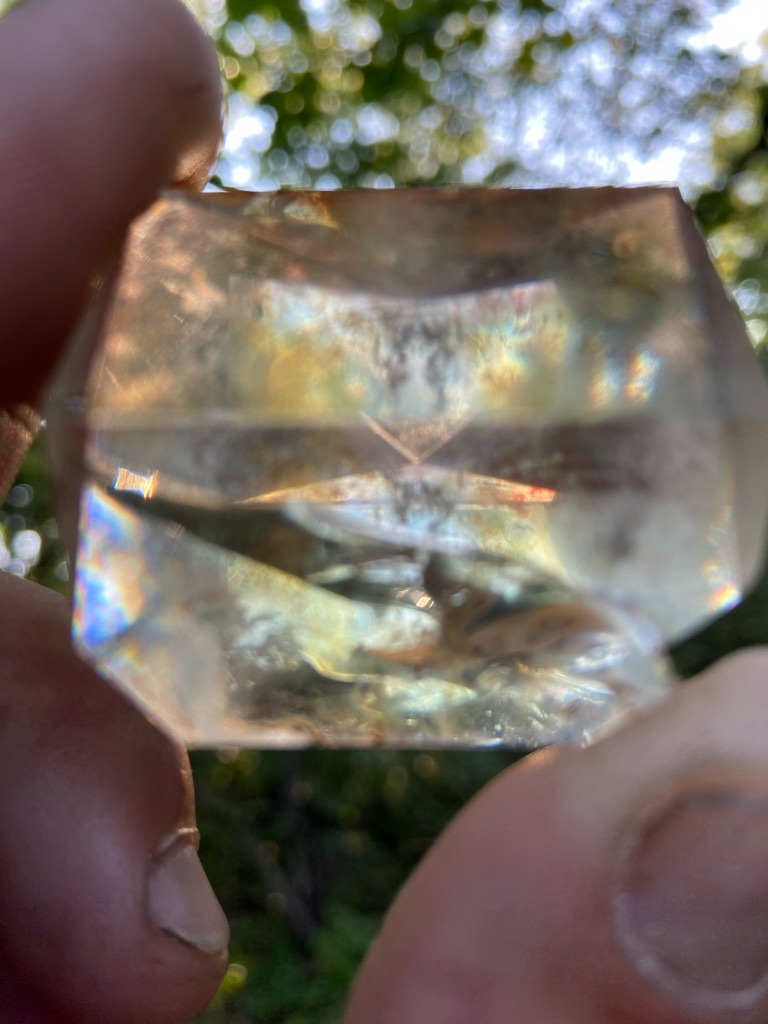
The specimen shown in the image is not a diamond; based on the optical distortion, inclusions, refractive behavior, and raw crystal form visible, this appears to be a natural quartz crystal (potentially quartz var. citrine or a heavily included rock crystal quartz) or potentially glass/synthetic simulants, rather than a genuine diamond.
The specimen shown in the image is not a diamond; based on the optical distortion, inclusions, refractive behavior, and raw crystal form visible, this appears to be a natural quartz crystal (potentially quartz var. citrine or a heavily included rock crystal quartz) or potentially glass/synthetic simulants, rather than a genuine diamond. · Rough or irregularly faceted crystal form, partially tumbled or crudely shaped, roughly rectangular or blocky tabular geometry.
Poor/Unconventional, as this is a heavily included raw or crudely shaped crystal rather than a precision-cut gemstone. Cut
Carat
Due to it being a non-diamond mineral (likely quartz) with large dimensions, weight would be measured in grams rather than standard diamond carats, visually estimated around 50 to 100+ carats equivalent if mineralized.
Color
Light brownish-yellow or yellowish-white, showing natural color zoning and internal refractions typical of colored quartz.
Clarity
Included (I3 equivalent), containing prominent internal fractures, veils, and internal cloudiness.
Shape
Rough or irregularly faceted crystal form, partially tumbled or crudely shaped, roughly rectangular or blocky tabular geometry.
Overall Assessment
The specimen in the photograph is positively identified as a large, heavily included mineral crystal (likely quartz) rather than a diamond. It possesses unique natural characteristics and organic inclusions, making it an interesting mineral specimen but rendering it unsuitable for fine jewelry or diamond valuation.
Cut Quality
Poor/Unconventional, as this is a heavily included raw or crudely shaped crystal rather than a precision-cut gemstone.
Brilliance
Low to moderate white light return due to internal fracturing and suboptimal cut angles.
Fire
Low dispersion, typical of quartz rather than the high refractive dispersion of diamond.
Scintillation
Limited sparkle due to opaque inclusions and lack of standardized facet patterns.
Proportions
Non-standard proportions with a deep, bulky profile and irregular angles uncharacteristic of standard cut diamonds.
Symmetry
Poor, exhibiting natural asymmetric crystal growth and irregular facet alignment.
Polish
Fair to poor, with visible surface pitting and crude polishing marks on the outer windows.
Fluorescence
Inert to moderate under standard inspection, but requires UV testing for definitive confirmation.
Inclusions
Heavy internal feather fractures, liquid/gas inclusions, and internal clouding visible throughout the core.
Blemishes
Surface abrasions, natural growth lines, and minor chipping along the edges.
Origin
Natural mineral specimen, likely originating from pegmatite or hydrothermal quartz veins.
Treatment Detection
No obvious evidence of artificial enhancement; appears to be in its natural state.
Estimated Value
Nominal mineral specimen value ($10 - $50 USD depending on exact mineral composition and origin), negligible commercial gemstone value.
Certification Estimate
Not applicable for major diamond grading labs (GIA, AGS) as this is not a diamond; would require a gemological laboratory report (e.g., GIA Identification Report) to confirm mineral species.
Investment Potential
None; mineral specimens of this quality are collected for educational or decorative purposes rather than investment.
Similar Diamonds
None, as this stone shares no optical or physical properties with gem-grade diamonds.
Setting Suggestions
Not recommended for fine jewelry settings due to softness (Mohs scale 7 vs. diamond's 10) and heavy inclusion structure; better suited as a raw mineral specimen or wire-wrapped pendant.
Care & Maintenance
Clean gently with warm soapy water and a soft brush; avoid harsh chemicals, ultrasonic cleaners, and hard impacts due to existing internal fractures.
Interesting Facts
Large quartz crystals often form in hydrothermal veins where silica-rich fluids cool slowly over thousands of years, trapping surrounding minerals and fluids inside.