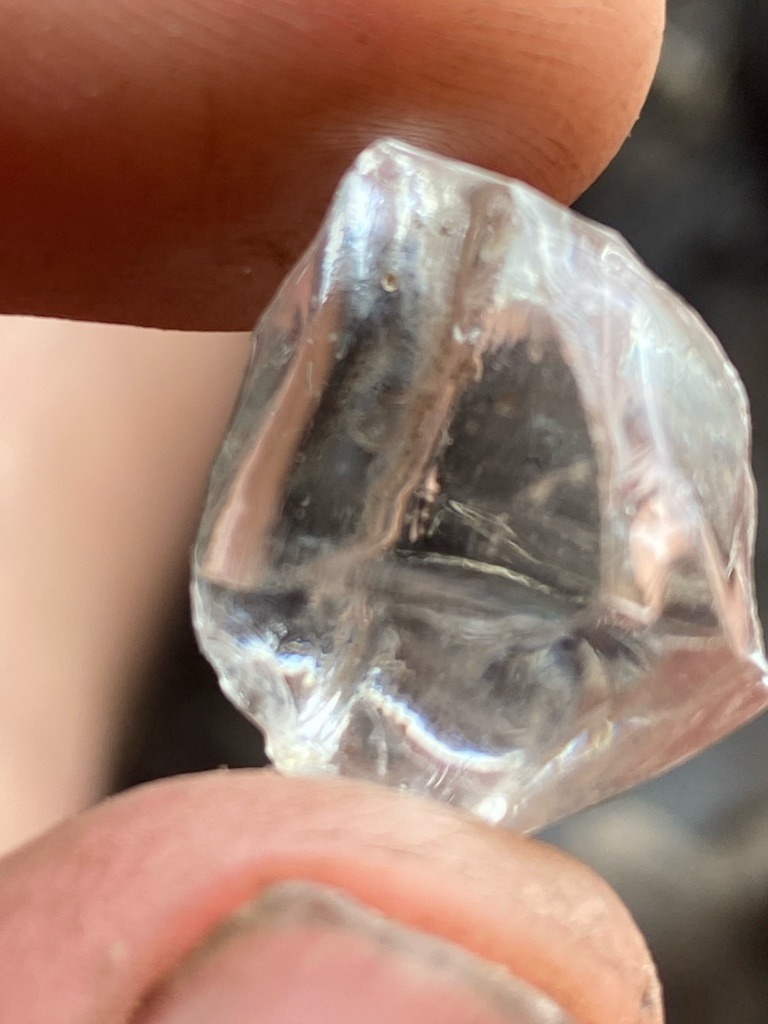
Natural rough diamond
Natural rough diamond · Uncut octahedral rough
Not applicable (rough, uncut crystal) Cut
Carat
Estimated 2.5 to 3.5 carats
Color
Estimated near-colorless (G-I range)
Clarity
Estimated SI1 to SI2 (moderate natural inclusions visible)
Shape
Uncut octahedral rough
Overall Assessment
A promising gem-quality natural rough diamond crystal with good transparency and potential for a fine finished faceted gemstone
Cut Quality
Not applicable (rough, uncut crystal)
Brilliance
Moderate to low due to unpolished and irregular surface
Fire
Limited dispersion due to rough state and surface texture
Scintillation
Minimal flash effect until cut and polished
Proportions
Natural crystal habit, untolled raw dimensions
Symmetry
Natural octahedral symmetry with slight distortion
Polish
Natural crystal face texture (trigons and striations visible)
Fluorescence
Indeterminate from visual assessment (typically tested under UV)
Inclusions
Internal feather fractures and mineral crystal inclusions
Blemishes
Natural surface pitting and growth lines
Origin
Alluvial or primary kimberlite pipe deposit origin
Treatment Detection
No signs of artificial treatment; completely natural crystal
Estimated Value
Depends heavily on final cut yield, roughly $1,500 - $3,000 USD in rough form
Certification Estimate
GIA or EGL rough diamond evaluation report
Investment Potential
Good potential if cut expertly to maximize finished weight and grade
Similar Diamonds
Typical run-of-mine gem-quality rough stones from African or Canadian deposits
Setting Suggestions
Can be set raw in a custom organic wire-wrap or bezel setting, or polished into a brilliant cut
Care & Maintenance
Store separately to avoid scratching other stones; clean with warm soapy water and soft brush
Interesting Facts
Rough diamonds retain their natural geological history, often showing curved growth steps and triangular etch marks called trigons