Not a diamond (Glass/Quartz fragment)
Not a diamond (Glass/Quartz fragment) · Irregular raw fragment
Not Applicable (uncut raw fragment / broken glass shard) Cut
Carat
Estimated equivalent weight approx. 2.0-3.0 ct based on physical size, but material is not diamond
Color
Colorless / Transparent
Clarity
Included / Poor (shows conchoidal fracture typical of glass)
Shape
Irregular raw fragment
Overall Assessment
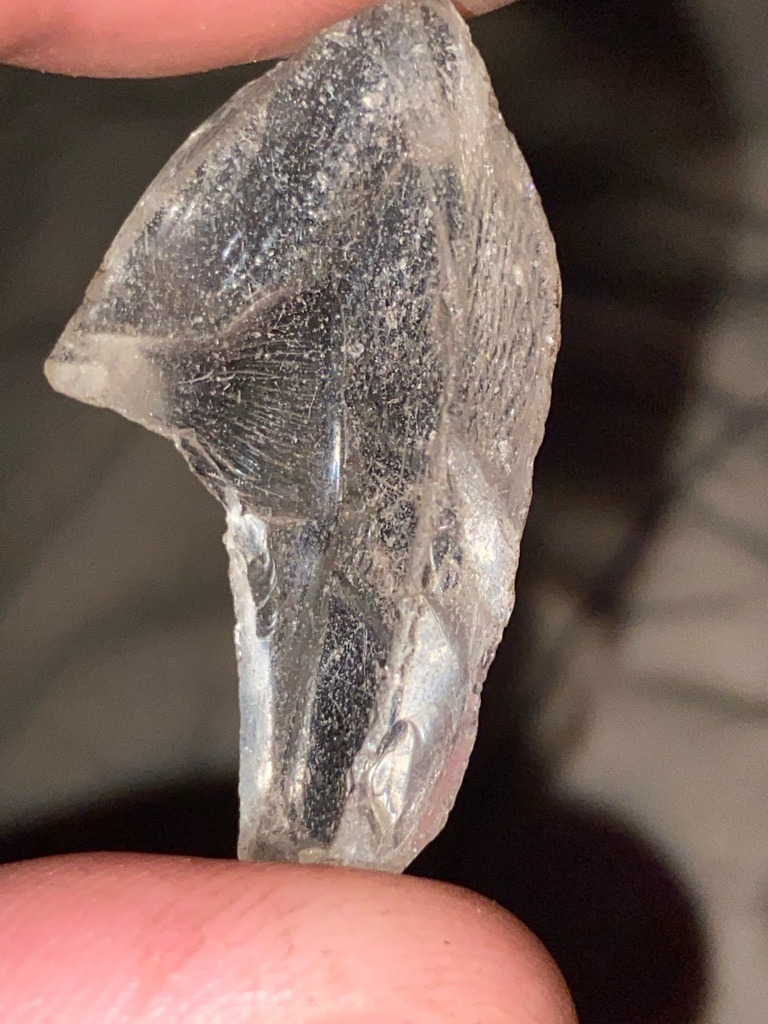
The specimen displayed in the image is an irregular fragment of glass or quartz showing distinct conchoidal fracture lines and surface textures. It lacks all optical, chemical, and physical properties of a diamond, such as the adamantine luster and high refractive index.
Cut Quality
Not Applicable (uncut raw fragment / broken glass shard)
Brilliance
Low to moderate vitreous luster, significantly lower than a diamond
Fire
Very low dispersion compared to diamond
Scintillation
Poor scintillation due to lack of standard facet arrangement
Proportions
Irregular proportions with no standard facets
Symmetry
Asymmetrical raw shard
Polish
Raw unpolished fracture surfaces
Fluorescence
None observed
Inclusions
Numerous bubbles and internal stress lines typical of manufactured glass
Blemishes
Surface scratches, chips, and conchoidal fracture ripples
Origin
Man-made glass or natural quartz shard
Treatment Detection
None (raw base material)
Estimated Value
Minimal to negligible (common glass or quartz fragment value)
Certification Estimate
Cannot be certified as a gemstone by standard labs (GIA/AGS/IGI)
Investment Potential
None
Similar Diamonds
None (no diamond characteristics present)
Setting Suggestions
Not suitable for jewelry setting due to low durability and non-gem status
Care & Maintenance
Handle with care to avoid cuts from sharp edges
Interesting Facts
The conchoidal fracture pattern clearly visible on the surface is a classic diagnostic feature of glass and cryptocrystalline quartz rather than diamond.