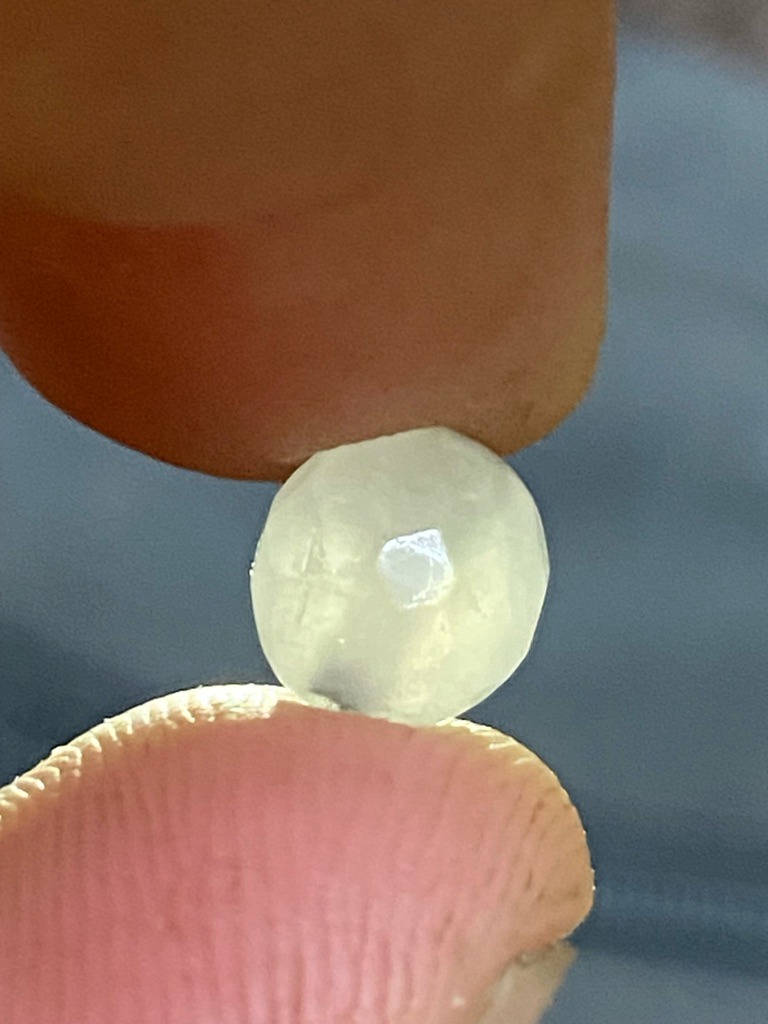
Natural rough diamond, likely industrial or near-gem quality
Natural rough diamond, likely industrial or near-gem quality · Rough crystal / Uncut rounded octahedral or macle form with primitive faceting/wear
Not applicable (Rough, unpolished natural state) Cut
Carat
Estimated 0.85 - 1.25 carats based on visual scale against fingers
Color
Light yellow-green to off-white (Cape series / tinted)
Clarity
Included (I1 - I3) with visible internal clouds and feather/fracture zones
Shape
Rough crystal / Uncut rounded octahedral or macle form with primitive faceting/wear
Overall Assessment
This is a fascinating specimen of an uncut natural diamond in its raw form. While it lacks the sparkle and clarity of a cut and polished gemstone, its raw geological charm makes it a wonderful piece for mineral collectors and educational displays.
Cut Quality
Not applicable (Rough, unpolished natural state)
Brilliance
Low due to lack of faceting and translucent-to-opaque nature
Fire
Minimal due to frosted exterior and high inclusion count
Scintillation
Negligible in current rough state
Proportions
Natural unmodified crystal habit with rounded edges
Symmetry
Natural asymmetrical crystal form
Polish
None (Natural rough crystal faces and frosted skin)
Fluorescence
Indeterminate visually, typically medium to strong blue in natural rough under UV
Inclusions
Abundant internal clouds, pinpoint inclusions, and potential feather fractures
Blemishes
Natural surface trigons, pitting, and rough skin characteristic of alluvial or primary deposits
Origin
Natural alluvial or kimberlite pipe deposit (African or South American origin likely)
Treatment Detection
No signs of enhancement; completely untreated natural rough
Estimated Value
$50 - $200 USD as a specimen or low-grade industrial/rough collector piece
Certification Estimate
GIA (Rough Diamond Evaluation) or Kimberley Process certificate for origin verification
Investment Potential
Low investment value; primarily valued as a geological specimen or educational tool
Similar Diamonds
Ugly duckling industrial rough, specimen-grade uncut diamonds, or low-grade translucent boart
Setting Suggestions
Wire-wrapped pendant or rustic organic bezel setting to preserve natural rough character
Care & Maintenance
Clean gently with warm soapy water and a soft brush; avoid harsh ultrasonic cleaners due to internal fractures
Interesting Facts
Rough diamonds can take over a billion years to form deep within the Earth's mantle before being brought to the surface by volcanic eruptions.