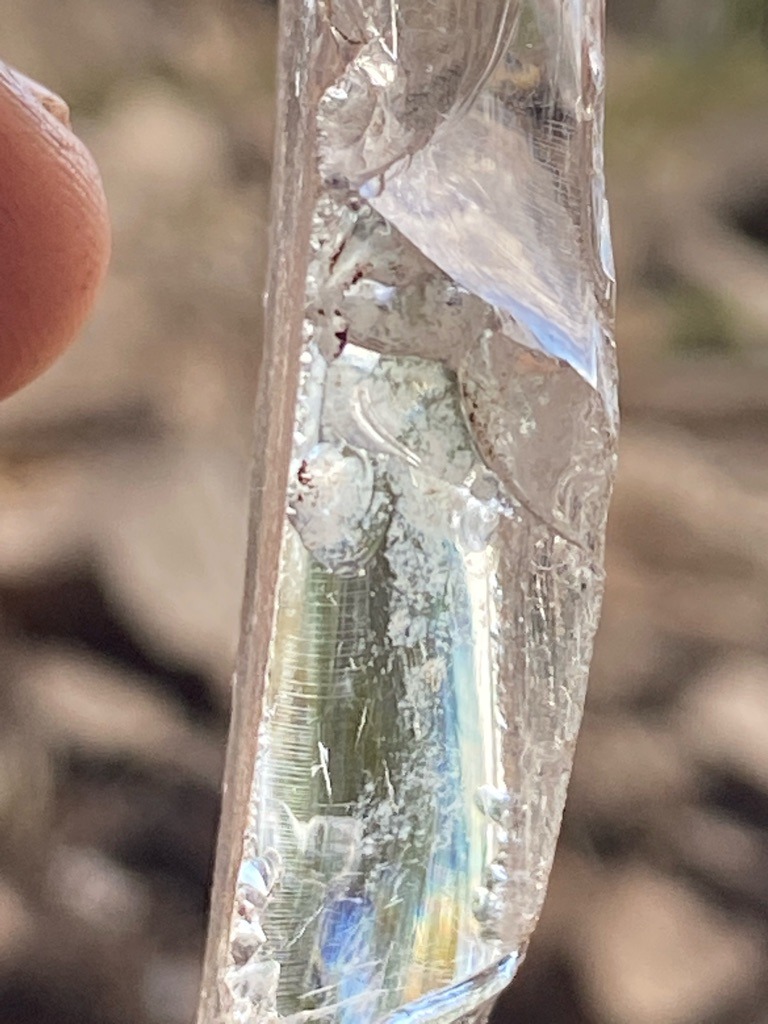
Not a diamond; this specimen appears to be a natural raw crystal, likely quartz or beryl, showing typical rough crystal striations and fracture patterns rather than crystalline carbon (diamond).
Not a diamond; this specimen appears to be a natural raw crystal, likely quartz or beryl, showing typical rough crystal striations and fracture patterns rather than crystalline carbon (diamond). · Raw, uncut, elongated crystal rough
Not Applicable (uncut rough mineral specimen) Cut
Carat
Cannot be precisely determined visually due to irregular rough shape, estimated roughly at 15-25 carats equivalent weight in mineral mass.
Color
Colorless / Clear with minor inclusions casting minor internal refractions
Clarity
I3 / Heavily Included (due to abundant visible internal fractures, striations, and inclusions)
Shape
Raw, uncut, elongated crystal rough
Overall Assessment
An interesting raw mineral crystal specimen showing classic natural growth features, but possessing no gemological relation to diamond.
Cut Quality
Not Applicable (uncut rough mineral specimen)
Brilliance
Low to moderate due to internal fracturing scattering light
Fire
Low dispersion, typical of quartz or similar silicates rather than diamond
Scintillation
Poor, restricted by rough, fractured internal structure
Proportions
Elongated tabular rough crystal formation
Symmetry
Natural asymmetric crystal growth
Polish
Unpolished natural crystal faces showing striations
Fluorescence
Not tested / Undetermined visually
Inclusions
Heavy internal fracturing, feather inclusions, and mineral inclusions visible throughout
Blemishes
Natural surface etching, rough growth lines, and surface fractures
Origin
Natural geological formation, likely from a pegmatite or hydrothermal vein system.
Treatment Detection
No signs of artificial treatments; appears entirely natural and untreated.
Estimated Value
Nominal mineral specimen value, typically ranging from $10 to $50 depending on exact mineral composition and locality.
Certification Estimate
Standard gemological laboratories (GIA, IGI) would classify this as a natural mineral specimen rather than a faceted gemstone.
Investment Potential
Low investment value as a gemstone, collectible mainly as a raw mineral specimen.
Similar Diamonds
None, as this is not a diamond. Comparable to raw quartz crystals or beryl rough.
Setting Suggestions
Wire-wrapped rough crystal pendant or organic custom prong setting in sterling silver or yellow gold.
Care & Maintenance
Handle with care due to internal fractures; avoid ultrasonic cleaners and harsh chemicals which could worsen fissures.
Interesting Facts
Raw crystals often preserve growth lines (striations) on their faces that reveal the history of their formation deep within the Earth's crust.