Cubic Zirconia / Glass Simulant
Cubic Zirconia / Glass Simulant · Round
Fair to Good (Machine cut, simplified facet structure) Cut
Carat
Approximately 0.25 ct equivalent
Color
Colorless (Simulated D-F)
Clarity
Eye-Clean (Simulated IF)
Shape
Round
Overall Assessment
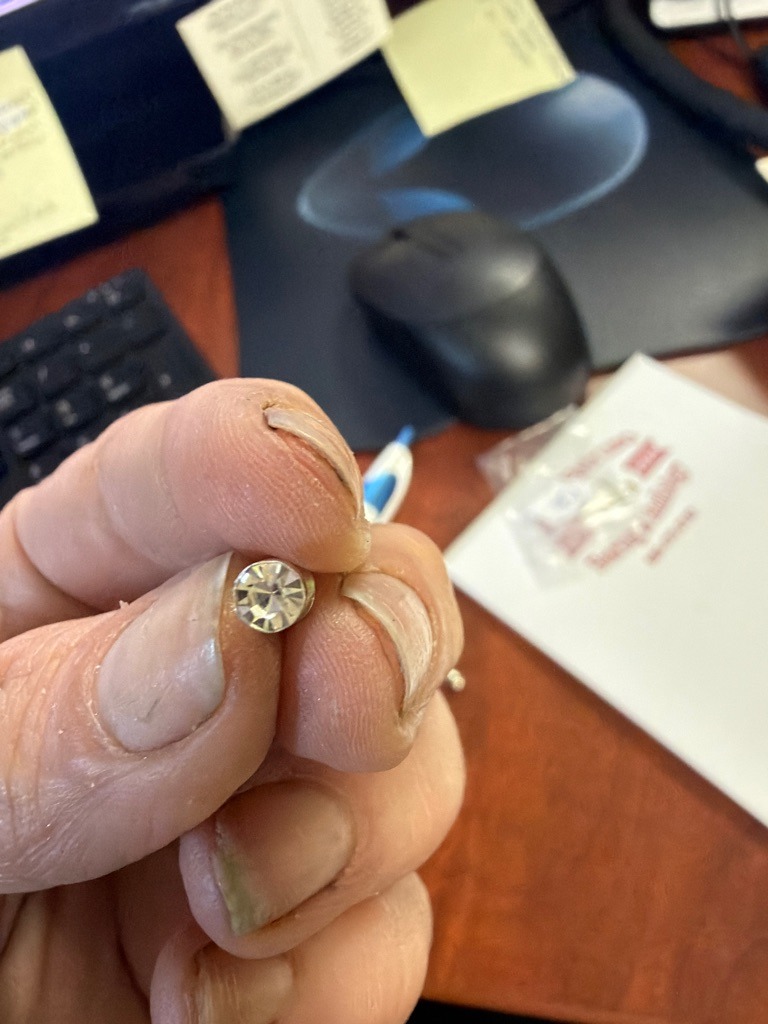
The item inspected is a small, inexpensive gemstone simulant—likely cubic zirconia or glass—set into a costume jewelry component rather than a genuine diamond.
Cut Quality
Fair to Good (Machine cut, simplified facet structure)
Brilliance
Low to moderate white light return compared to a genuine diamond
Fire
Exaggerated spectral dispersion typical of high-refractive-index simulants like cubic zirconia
Scintillation
Basic flash effect due to larger, simplified facet patterns
Proportions
Standard commercial proportions with a wide table facet
Symmetry
Moderate, typical of mass-produced costume jewelry stones
Polish
Average, showing machine polish lines under magnification
Fluorescence
None observed visually
Inclusions
None, consistent with a synthetic simulant
Blemishes
Minor surface wear and potential edge chipping visible under close inspection
Origin
Laboratory-created synthetic simulant
Treatment Detection
None applicable as it is not a natural diamond
Estimated Value
Nominal value (under $10 USD as part of costume jewelry)
Certification Estimate
Not eligible for certification by major gemological laboratories (GIA, AGS, IGI)
Investment Potential
None, holds no resale or investment value
Similar Diamonds
Comparable to standard commercial-grade cubic zirconia or crystal glass rhinestones
Setting Suggestions
Typically mounted in base metals like plated brass, stainless steel, or sterling silver
Care & Maintenance
Avoid harsh chemicals, ultrasonic cleaners, and prolonged exposure to water to protect the metal setting and prevent clouding
Interesting Facts
Stones of this type are frequently used in inexpensive fashion jewelry and novelty items rather than fine jewelry