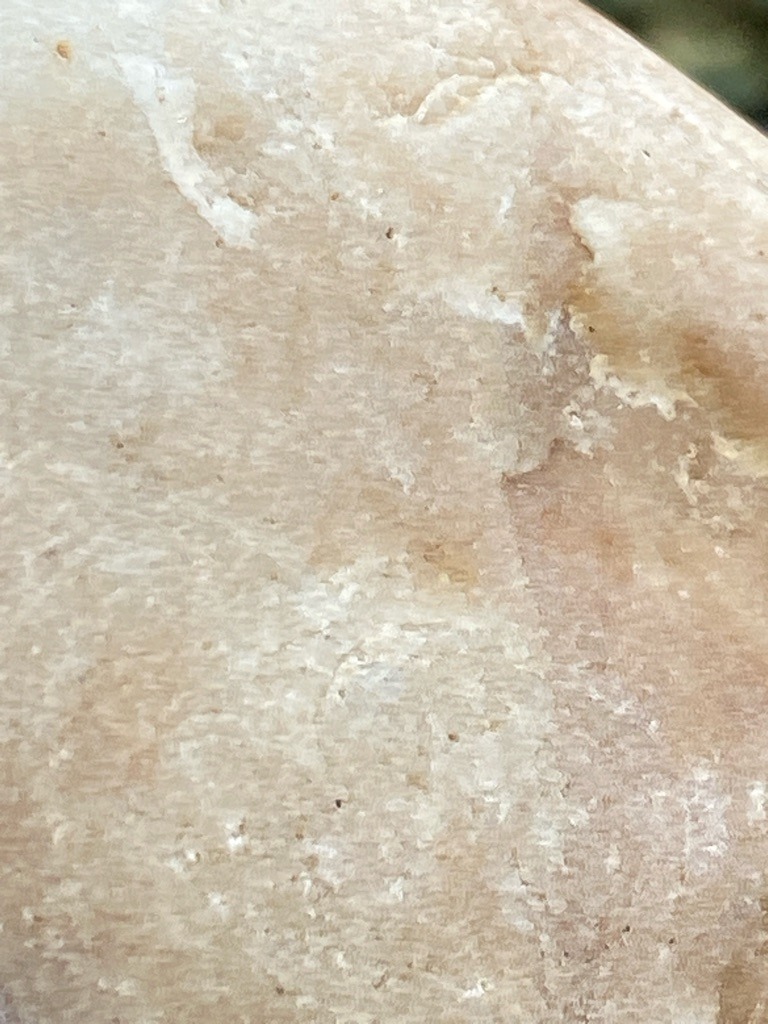
The image shows a raw mineral surface with a rough texture, brownish-white coloration, and uneven crystalline formations, lacking the distinct octahedral crystal habit, transparent gem-quality clarity, and adamantine luster characteristic of a diamond. This appears to be a geological rock matrix, possibly quartzite, marble, or altered feldspar, rather than a diamond.
The image shows a raw mineral surface with a rough texture, brownish-white coloration, and uneven crystalline formations, lacking the distinct octahedral crystal habit, transparent gem-quality clarity, and adamantine luster characteristic of a diamond. This appears to be a geological rock matrix, possibly quartzite, marble, or altered feldspar, rather than a diamond. · Not applicable as this is an unshaped, raw geological matrix rather than a faceted diamond.
Not applicable; uncut raw mineral surface. Cut
Carat
Not applicable as this is an unshaped rock formation, not a gemstone.
Color
Not applicable; the specimen exhibits earthy brown, beige, and off-white tones typical of non-gem mineral aggregates.
Clarity
Not applicable; heavily included and opaque throughout, lacking gem-grade clarity scales.
Shape
Not applicable as this is an unshaped, raw geological matrix rather than a faceted diamond.
Overall Assessment
The visual evidence confirms that the specimen in the image is a raw, unrefined geological rock sample rather than a diamond. Further testing such as hardness scratch tests or Raman spectroscopy would be required to determine the exact mineral species.
Cut Quality
Not applicable; uncut raw mineral surface.
Brilliance
Minimal to none; lacks the high refractive index and adamantine luster of diamond.
Fire
Absent; lacks the significant dispersion properties of diamond.
Scintillation
Absent; does not display the play of light and dark facets seen in cut gemstones.
Proportions
Not applicable as there are no standard faceted proportions (table, depth, crown, pavilion).
Symmetry
Not applicable to an irregular raw mineral surface.
Polish
Unpolished, rough natural texture.
Fluorescence
Cannot be determined without ultraviolet light testing.
Inclusions
The entire mass is composed of dense mineral aggregates, grain boundaries, and natural micro-fractures rather than specific internal diamond inclusions.
Blemishes
Surface pits, irregularities, and weathering typical of raw rock formations.
Origin
Terrestrial geological formation; specific locality cannot be determined from visual inspection alone.
Treatment Detection
No visible signs of artificial enhancement or treatment; appears completely natural.
Estimated Value
Nominal value as a common mineral sample or decorative rock specimen.
Certification Estimate
Not eligible for certification by major gemological laboratories like GIA, AGS, or IGI as a diamond.
Investment Potential
None as a gemstone or investment asset.
Similar Diamonds
None, as this specimen is not a diamond.
Setting Suggestions
Not suitable for jewelry settings in its current state.
Care & Maintenance
Standard handling for mineral specimens; avoid harsh acids depending on the exact mineral composition.
Interesting Facts
Raw mineral matrices often show fascinating natural weathering patterns that can be mistaken for other materials by untrained observers.