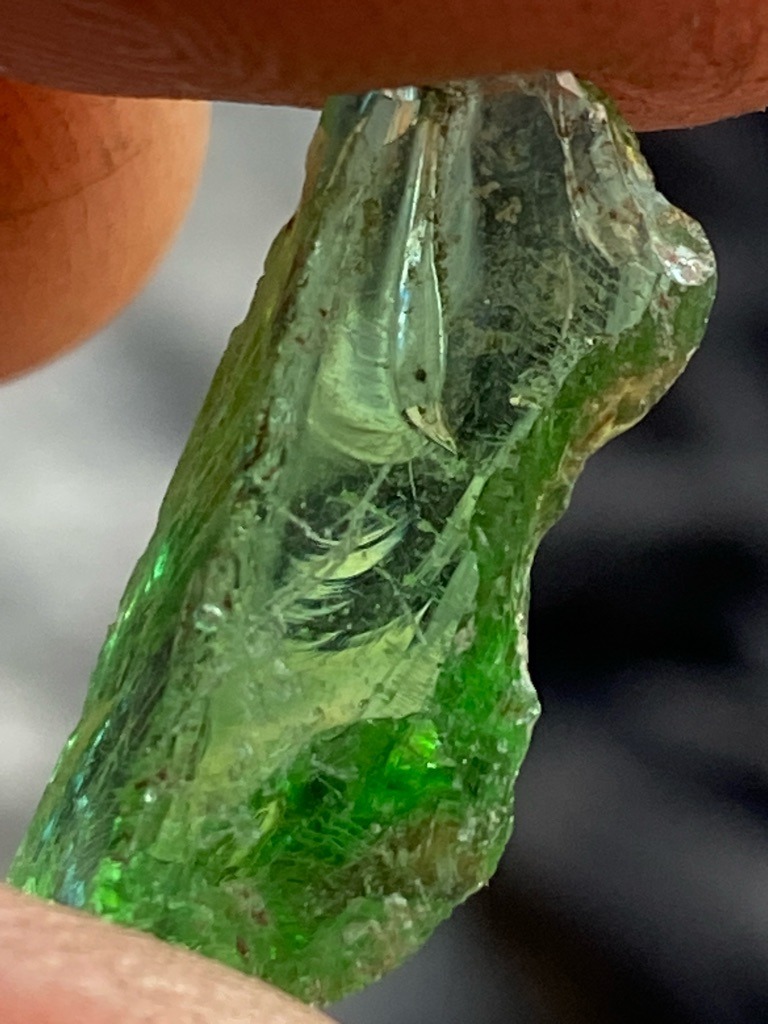
Not a diamond; this specimen exhibits conchoidal fracture patterns, vitreous luster, and high surface bubble inclusions typical of colored glass or slag, rather than crystalline diamond structure.
Not a diamond; this specimen exhibits conchoidal fracture patterns, vitreous luster, and high surface bubble inclusions typical of colored glass or slag, rather than crystalline diamond structure. · Rough, uncut, irregular fragment with conchoidal fracture surfaces.
Not applicable (uncut raw industrial or decorative glass fragment). Cut
Carat
Cannot be accurately assessed visually without specific gravity testing, but estimated at roughly 15-25 carats equivalent based on volume.
Color
Vivid green (Fancy Green equivalent if it were gemstone material).
Clarity
Included / heavily included (contains numerous internal bubbles and flow lines typical of manufactured glass).
Shape
Rough, uncut, irregular fragment with conchoidal fracture surfaces.
Overall Assessment
The specimen shown in the image is definitively identified as green glass, not a diamond or precious gemstone. It displays diagnostic features of glass including conchoidal fracture marks and internal gas bubbles.
Cut Quality
Not applicable (uncut raw industrial or decorative glass fragment).
Brilliance
Vitreous glass luster, reflecting white light adequately but lacking the high refractive index and dispersion of a true diamond.
Fire
Minimal dispersion; low fire compared to diamond or high-RI simulants.
Scintillation
Poor scintillation due to lack of faceted symmetry and presence of internal visual obstructions.
Proportions
Irregular raw fragment; table, depth, and angles do not apply.
Symmetry
Asymmetrical due to random fracture and breakage.
Polish
None; raw, unpolished fractured surfaces with glassy luster.
Fluorescence
Unknown without UV testing, though typical green glass may show weak inertness or green/yellow fluorescence.
Inclusions
Large spherical gas bubbles and internal flow lines visible, indicating artificial glass manufacture rather than natural crystal growth.
Blemishes
Surface chips, conchoidal rippling, and abrasion marks across the exterior.
Origin
Man-made / industrial origin (glass cullet or decorative glass fragment).
Treatment Detection
Material is fundamentally manufactured glass; no gemstone treatment applicable.
Estimated Value
Nominal decorative value (low commercial value as it is glass, not a genuine gemstone or diamond).
Certification Estimate
Standard gemological laboratories (GIA, AGS, IGI) would issue a report identifying this as synthetic glass rather than a diamond.
Investment Potential
None as an investment; possesses zero gemstone resale value.
Similar Diamonds
None; this specimen bears no similarity to natural or lab-grown diamonds.
Setting Suggestions
Not recommended for fine jewelry settings due to low hardness (Mohs ~5.5) and fragility.
Care & Maintenance
Store separately from harder gemstones to prevent scratching; clean with mild soapy water and a soft cloth.
Interesting Facts
Green glass fragments of this type are frequently mistaken by novices for rough emeralds, peridot, or green diamond crystals due to their striking color.